Shooting Film Again

Photography was not always a process of pixels, megabytes, SD cards and Photoshop. Once it was chemicals, paper, darkrooms and something called film. I learned to shoot in another age, when every shot counted, there were only 24 or 36 frames available. When it was a week or at least a few days before you knew if the shot worked.
Marble Grotto
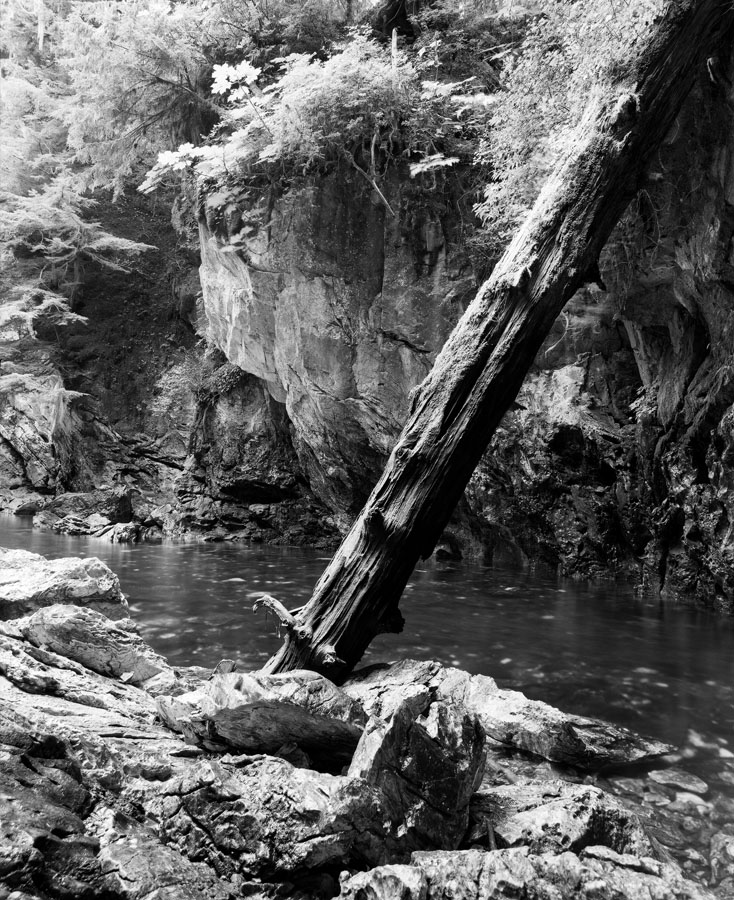
The stream flowing into marble Grotto makes a tempting target for a medium format film camera, photo by Randy Zelick
I still have a few relics of those days, cameras kept for the memories they carry. Traveling through Europe or the Desert Southwest, capturing images on celluloid and silver. Several experiences over the last couple months have served to remind me of those days… Walking into a camera store in Portland, a store that is as much a museum to the era of film, shelves filled with beautiful machines from the past. Watching Randy load roll film into a classic Pentax 6×7 on a glacier in Alaska, hearing the soft click of that mechanical masterpiece. Reading blog posts from a friend on Oahu about his adventures in film.

Continue reading “Shooting Film Again”

Snow on the Mountain

Winter might just be starting in Hawai’i. A fall storm dropped the season’s first snow on the summit of Mauna Kea this afternoon. Not much, just enough to turn the summit white. I had to scrape the frozen snow from the windshield to free the wipers before I could drive down.

We got 1.2″ of rain at the house, quite a bit when you consider we get 10″ a year in the shadow of the mountain. I am headed back to the summit tomorrow morning, wondering what we will find, this storm is just starting.

Snow on Mauna Kea
A light snowfall marks the start of winter on Mauna Kea.

Warped

Warping is not much fun. Warping is now on my list of responsibilities. At least I know I am accomplishing something critical to the operation of the telescope.

Segment
A Keck mirror segment after stripping and cleaning, ready to place in the chamber to receive a new reflective coating
Warping is a process of tuning the performance of a mirror segment after a segment exchange. A segmented mirror offers large advantages over a monolithic mirror, not least of which is the ability to swap a few segments out for re-coating and refurbishment without the weeks of downtime needed to re-coat a monolithic mirror. Throughout the summer Keck schedules a couple days of SegEx each month, so that at the end of the summer we have a completely clean and re-coated mirror.

Exchanging segments does require some interesting procedures to realign each new segment, each must be warped and the edge sensors tuned. The first few hours of the night after a SegEx is used to evaluate the performance of the newly replaced segments. Using a special alignment camera system the optical figure of each segment can be evaluated and a set of corrections generated to be applied the next day… Warping.

Keck Segment Types
A map of the segment types in the Keck primary mirror
There are six segment types that make up the primary mirror, each with the slightly different curve needed to make up the correct part of the hyperbolic curve. In theory the segments are interchangeable, any type four can be swapped with any other type four. This works… With a little help. It is necessary to adjust the figure of each segment, just slightly, to tune the figure of each segment for its place in the array.

To apply the correct pressure there are small knobs and screws at specific points in the whiffle tree. Each adjustment point also contains a strain gauge, allowing the applied pressure to be measured precisely. A computer and analog interface allows all of the points to be read out and checked against the calculated values.

Warping Computer
the warping computer set up in the subcell
There are thirty adjusters and strain gauges on the back of each mirror segment. The problem is that you can not simply adjust each one. Adjustment of one point affects all of the nearby points, particularly if the adjustment is large. Typically it is necessary to go around three times before the segment is properly warped. Thirty adjustments becomes ninety. Three segments in a day becomes 270 knobs to turn, 540 over two days, a lot of knobs.

After setup, it takes about an hour to do each segment, an hour of painstaking frustration. the mirror cell is just the right height, too high to sit down and reach the knobs, too low to stand up fully. Working in a jungle gym of frigid steel just makes it worse. A day in the mirror cell is a nice recipe for a tired and sore body.

How careful was I? Did I get all of the points set correctly? The computer is displaying all of the correct numbers. I will not know until the next day, when the night’s performance data is reduced, when we can see the figure of the primary mirror and check the errors.

My first warp is a success, most of the segments show less than 20nm rms error. Next SegEx there are only two segments being exchanged, but Sergey is threatening to have two others re-warped to address some lingering issues. Four? Better than six. Only 360 adjustments to make, more or less.

Mercury at Maximum Elongation

Today Mercury reaches maximum elongation, the furthest point it will reach from the Sun in our sky and the highest it will be above the sunset for this evening apparition. The planet is easily visible as a bright, starlike object about 25° above the setting Sun as twilight begins. Over the next couple weeks Mercury will slide back into the sunset, heading for inferior conjunction on November 1st.

Continue reading “Mercury at Maximum Elongation”

A Second Try for the EOS-M

My readers may remember that I purchased an EOS-M last fall. For a number of reasons I ended up returning the camera, a failed experiment.

Tenakee Docks at Night
Fishing boats under sodium lamps haunt the Tenakee docks
With the rumors of a new model or two on the horizon the prices on the original EOS-M dropped. Not just a little either, a camera that listed for over $800 was now available for $360 with the 18-55mm lens. Even less if you wanted the 22mm f/2 lens. For this price would I give the camera a second go?

In the interim a new revision of the camera firmware has addressed some of the major complaints about the camera, including the sluggish focusing. Low price, improved focusing, why not give it a try? I still like the idea of a camera with near DLSR capability, that is small enough to be carried at all times. Fine, I will order it again.

John Hopkins Glacier
John Hopkins Glacier in Glacier Bay National Park
With EOS-M in hand I went on two trips this summer, to Oregon Star Party and a ten day boat trip out from Juneau. On both trips I used the camera extensively, shooting under a huge range of conditions. This includes a fair amount of night shooting under the stars. I also set up the camera on the telescope again.

In Alaska I had four cameras with me… A Canon 60D, the EOS-M, a GoPro Hero 2 HD, and a Canon G12. It was the EOS-M that I used for all of the walkabout shooting on and off the boat.

The only real drawback to the EOS-M is speed, it simply does not shoot fast. As a result I kept the full DLSR ready with the long lens, the 70-200mm L series telephoto. When wildlife appeared I was ready to shoot fast. Whales bubble net feeding, a gizzly on shore, for these it was the Canon 60D I grabbed. For everything else it was the EOS-M in my hand.

Camping Under the Stars
A camper and telescope set up under a starry sky
One of the features I liked about the camera when first trying it was the touch screen. My first thoughts about this feature were not positive, I wondered just how useful it would be. I have come to really appreciate the touch screen and the ease with which some functions can be used. With my heavy use of an iPad and iPhone, the touch gestures are quite natural. There are drawbacks, inadvertent photos with the touch shutter are common. Plus, it is possible to switch a setting without knowing. Many operations such as selecting the focus point or reviewing exposures are much easier with the touch screen. More than once I have found myself brushing fingers on the LCD of my Canon 60D before remembering it is not a touch screen camera.

I have come to appreciate the EOS-M for the reason I originally wanted the camera. It is a great carry camera, small enough to keep with you at all times, ready to get the shot. It isn’t fast, but it does take beautiful photos, providing better quality than a compact and capable of shooting in a wider range of conditions.