
Postcard from Hawai’i – Orchids
When you want to see the stars, find someplace dark

A nice opinion piece by Chad Kalepa Baybayan in the local paper yesterday. He addresses the use of the summit of Mauna Kea for astronomy. There are some in the local community that object to the telescopes. While those very vocal opponents often grab the attention, they are by no means representative of the whole community. It is more complex than that, there are those in the Hawaiian community that support astronomy, and those opposed, and probably quite a few who are somewhere between those two positions.
Using the resources on Mauna Kea as a tool to serve and benefit the community through astronomy is consistent with the example of the adze quarry. To value astronomy and its work on Mauna Kea, you have to value the importance of “Ike,” knowledge, and its quest for a greater understanding of the universe we live in. – Chad Kalepa Baybayan, West Hawaii Today, April 19th, 2013
Give it a read!
Join us this Sunday for a live broadcast from Keck 2 remote observing! Here at Keck we will be participating in a campaign to observe Saturn’s auroras. Join JPL scientist Dr. Kevin Baines and Dr. Tom Stallard of the University of Leicester while they are engaged in using the telescope.

3am-5am Hawai’i Standard Time
6am-8am Pacific Daylight Time
9am-11am Eastern Daylight Time
1pm-3pm UT
You can join the webcast on UStream at the Live from Keck Observatory channel.
A number of telescopes are involved with these observations including NASA’s Hubble Space Telescope and the Cassini spacecraft in orbit around Saturn, the ESO Very Large Telescope (VLT) in Chile, and NASA’s IRTF telescope here on Mauna Kea.
At Keck the team of astronomers have five half night’s of observing on Keck 2 using the NIRSPEC spectrograph. They will be making infrared observations to understand more about the auroral features and the interaction of Saturn’s atmosphere with the planet’s magnetic fields.
Can a “mere” blogger have a positive effect on their community? Many figures in authority or traditional media often denigrate the effort of bloggers and the new media. To be certain, in the constant noise of network traffic there is a great deal of trash and misinformation. But quality still rises above the chaff, a good effort can have an effect.
My case in point is Kauai blogger Joan Conrow and her blog KauaiEclectic. I have had Eclectic on my personal reading list for years, her Musings article series are great commentary of life and current issues, both local and global. She tells of morning walks in the rain, swimming with sea turtles, GMO’s and pesticide use, dying bees, the abuses of immigrant labor, and killing endangered species.
Another exhibit built for public outreach functions. It was completed and used for the recent W. M. Keck Observatory open house. You will also be able to see it at the upcoming AstroDay fun in Hilo.
Ray-tracing is a standard way to analyze optical designs. The technique allows the optical designer to follow the path of each ray of light through a system of lenses and mirrors. While ray tracing used to be done with pencil and paper, it is now done on a computer screen. What I had never seen was this process done in the physical. But I can figure out how…
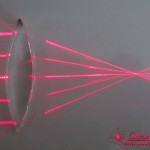
In the photo you can see the idea… Five red laser line modules are aligned across a table. Stick a lens section in the beams and you can observe refraction as it happens. Using a double convex lens, all of the beams converge to a focus. A clear demonstration of the basic principles of optics!
Today Mars will pass through superior conjunction, passing behind the Sun from our vantage point on Earth. During this time the red planet will be lost to view, vanishing from the evening sky, but reappearing in the morning sky during the last days of May.
While the Sun blocks our direct view of Mars the probes we currently have on and around Mars will suffer communications interference. For a few weeks mission planners at NASA place the various orbiters and rovers into a reduced communications routine. No commands will be sent to the spacecraft and only basic status updates sent back. This is nothing new, all Mars missions have had to deal with superior conjunction every two years. Once the red planet is clear of the Sun normal mission activities will resume.
By now you should have heard… The approval made national and international news. The Hawai’i state Board of Land and Natural Resources (BLNR) has granted final approval to the Conservation District Use Permit. This marks the end of the contested case hearing, essentially the final legal hurdle for construction of the Thirty Meter Telescope.

It is in reading the decision that you can learn much about the process. The news articles rarely cover anything beyond superficial details. The legal documents cover the arguments against building TMT atop Mauna Kea in great detail. The decision just published includes a legal response to all of the issues raised including references to each applicable statute and precedents.
Horned helmet snails feed on sea urchins. The snails are easy to spot once you know what to look for, a shape in the sand. The snail may appear like an abandoned shell on first examination, the top covered with algae. It is the size that is surprising, these snails are huge, the shell well over a foot long and almost as much in diameter.
If an urchin wanders by this snail comes to life, heaving itself out of the sand and moving towards its prey. The large foot appears, lifting the ponderous mass off the ground. A pair of tentacles with small black eyes on the sides appear, sweeping about to search for prey. Once the urchin is located the reaction is surprisingly swift, the snail heaves forward to engulf the hapless urchin.
