
Tonight a bright Jupiter, shining at -2.1 magnitude, will be just under 5° from a pretty crescent Moon. Look for a 20% illuminated Moon with Jupiter just above. The pair will be 50° above the western horizon at sunset.
Moon and Jupiter
Tonight the Moon and Jupiter will be close. Look for the pair about 40° above the western horizon at sunset. The Moon will be about 13% illuminated and about 7° below a bight Jupiter. Tomorrow the Moon will have moved to the other side of Jupiter but will be even closer, a little under 5° separation at sunset.
Adventures on eBay

There is some stuff that could have some value. Components and gear that could be sold, for that stuff there is eBay. I have eight listings active right now, and a few more I need to set up. Much of the stuff is electronic components, ICs and DC-DC converters. I am making some money from this stuff, not a lot, a few hundred dollars so far, perhaps enough to buy a few new toys.
A Trip Up The Coast
We limped back in on one engine.
An odd sound alerted Dennis to something amiss, a chuffing sound that the engine does not normally make. Opening the hatch showed more trouble, the engine had dumped all its oil into the bilge. It could be something bad, or something really bad, no way to find out without taking things apart, not something we were not prepared to do.

Conditions were decent, but not great, some surge was stirring up the water. Faint echoes of whale-song could still be heard, probably the last we will hear this season.
Just underneath the mooring at Pentagon is a wonderful complex of caves, this was where we spent much of the dive. This is a great dive site, a shallow coral plain pocked with numerous caves and small sandy areas. It is a good place to look for invertebrates, big and small. The caves shelter nudibranch and other small critters. The sand patches are home to one of the largest invertebrates found on Hawaiian reefs, the horned trumpet snail.
I located a species of nudibranch that was new to me, the snow-goddess nudibranch (Ardeadoris poliahu). A pretty animal about 4cm long among the algae covered rock in a cave. The nudi was nicely positioned on a boulder in a cave, no problem to photograph, except for the surge sweeping me back and forth. I also found a gold-lace nudibranch that was well positioned for photography. I got some good photos, so did Pete when I showed him where to find the critters.
We would head home on a single engine without making a second dive for the day. Never having done this we all wondered how fast we would go on a single engine and how long it would take to return to harbor. We were a long way north, over twenty miles up the coast from Honokohau, the absolute worst time for an engine to fail. Everyone good for docking at midnight? Would we all make it to work tomorrow morning? Our speculation was for naught, we could manage seven knots without straining the remaining engine, we could return to harbor in good time.
The trip back may have been a bit slower, but this was not a problem either. There were humpback whales along the coast. We had good views of several groups as we traveled, including a couple nice breaches right off the bow. Another group, a mother, calf and escort played about in very shallow water at Makalawena. It was just a nice day to be on the water, nobody was in a real hurry to get back to harbor.
The trouble with the engine has turned out to be fairly minor, the oil pressure switch failed, allowing the engine to pump itself empty of oil. A quick and inexpensive fix, but a real mess in the engine compartment.
Astronomers Using Keck Observatory Discover Rain Falling from Saturn’s rings
W. M. Keck Observatory press release…
NASA funded observations on the W. M. Keck Observatory with analysis led by the University of Leicester, England tracked the “rain” of charged water particles into the atmosphere of Saturn and found the extent of the ring-rain is far greater, and falls across larger areas of the planet, than previously thought. The work reveals the rain influences the composition and temperature structure of parts of Saturn’s upper atmosphere. The paper appears in this week’s issue of the journal Nature.
“Saturn is the first planet to show significant interaction between its atmosphere and ring system,” said James O’Donoghue, the paper’s lead author and a postgraduate researcher at Leicester. “The main effect of ring rain is that it acts to ‘quench’ the ionosphere of Saturn, severely reducing the electron densities in regions in which it falls.”
Continue reading “Astronomers Using Keck Observatory Discover Rain Falling from Saturn’s rings”
Gold Lace

Postcard from the Reef – A Trio of Raccoons

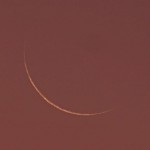
New Moon
Star Struck
For the W. M. Keck Observatory 20th anniversary I did a short video. The idea was to create a teaser that could be run at the start of many of the events.
It is surprising how much work can go into a 90 second video. With a very short time span to work with you have to pack a lot of visuals in quickly. The basic material was mostly historical images of the observatory construction, a few bits from local photographer Ethan Tweedie, recycle a couple bits from Keck in Motion add a few science images and pau!
Digging through the library archive with Peggi was a great look into Keck’s past. At one point we had dozens of photo albums scattered across the top of the cabinets and I notes that we were making a mess of her library. She replied in no uncertain terms… “This is great, this is what a librarian should be doing!”
If you have not already seen the vid enjoy!
Star Struck from Andrew Cooper on Vimeo.
The Moon and Mercury
Tomorrow morning, on April 8th, a thin crescent Moon will share the sky with Mercury. The pair will be separated by 8°41′ with the Moon further north. Both will be about rise within minutes of each other about 04:55HST and both will be about 16° above the horizon at sunrise. At magnitude 0.1 Mercury should be easy to spot, making a nice companion to a 3% illuminated Moon.