
NASA Tail
When you want to see the stars, find someplace dark


Note: This post has been revised based on current conditions and access. You can see the revised post here.
Getting close to flowing lava is a great experience, but one that is fraught with risks. Sometimes the lava is relatively easy to access, near a road or developed trail. Most of the time it takes a serious hike across the old flows to get near, an arduous trip with no trail or map to guide you.
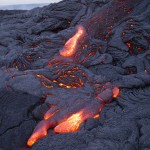
My most recent hike was my fifth trip out to the flowing lava, requiring my longest hike over the flows to date at just under three miles each way. OK, maybe I am not yet a veteran, but these trips have taught me a lesson or two. Going onto the lava is an inherently risky proposition and one must accept that risk. With a little knowledge and preparation the risks can be mitigated. Besides, the reward is spectacular!
You can take my word for it, or perhaps read the same information from someone who has been out far more than I. We will all tell much the same story.
So for the last few days things were a little rough on Darker View. Very slow load times, and for part of Sunday the site was not available at all. I do mean slow, well over a minute to get a 50k image file?
I have had a trouble ticket active with GoDaddy Support since Saturday, no proper response to the ticket yet, or at least no acknowledgement that they have fixed the issue. I have bounced a few answers back and forth. On the other hand everything seems to be running just fine as of Monday morning. Load times are snappy! Let us hope that is the end of it.
This is a recoding of a Keck Observatory Astronomy Talk given by Dr. Günter Hasinger, Astronomer and Director of the University of Hawaii Institute for Astronomy. His talk, ‘Black Holes ad the Fate of the Universe’, was given on November 20, 2012 at the Gates Performing Arts Center at Hawaii Preparatory Academy, part of the W. M. Keck Observatory public lecture series.
It’s a little bit of the story of the Universe from beginning to end,” said Dr. Hasinger. “What role do black holes have on the fate of the universe, what are they, and how we can understand them better?”
Günter Hasinger from Keck Observatory on Vimeo.
W. M. Keck Observatory press release…
A team of astronomers from the University of California, Berkeley and the University of Hawaii at Manoa has found that 17 percent of all sun-like stars have planets one to two times the diameter of Earth in close orbits. The finding, based on an analysis of the first three years of data from NASA’s Kepler mission and the W. W. Keck Observatory on the summit of Mauna Kea, Hawaii, was announced at the American Astronomical Society meeting in Long Beach, California this week.
While other studies had shown that planets around stars are common in our galaxy, until this study, it remained unclear if this is true for Earth-size planets.

To find planets, the Kepler space telescope repeatedly images 150,000 stars in a small region of the sky. It looks for a tiny dip in each star’s brightness that indicates a planet is passing in front of it, much like Venus passed between Earth and the sun last summer.
We took a census of the planets detected by the Kepler Space Telescope,” said Howard. “Erik Petigura wrote a new pipeline to detect the shallow dimmings of Earth-size planets in Kepler photometry. With his efficient and well-calibrated pipeline we could confidently report the size distribution of close-in planets down to Earth-size. The result is that Earth-size planets are just a common as planets twice Earth size. Remarkable.”

The aircraft is rather unremarkable, a standard small jet sitting among many similar aircraft at the Kona airport. It is the NASA colors and the odd pod hanging underneath that belies that this jet is somewhat unusual. This aircraft does not shuttle passengers across the country, it is home to a unique instrument called UAVSAR.

During this deployment the aircraft has quartered the Big Island, mapping any changes in the landscape on this volcanically active land. The acronym UAVSAR stands for Uninhabited Aerial Vehicle Synthetic Aperture Radar. As the name implies the system is designed to operate from a UAV, but it is currently installed in a crewed Gulfstream III aircraft.
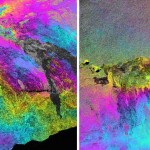
For this mission it is this volcanic island that is the target. As any islander knows we live on a rock that moves. The island settles into the sea, slides into the ocean, and swells where magma pushes its way into the volcano. Each year they return to Hawai’i to re-map the island, this is the fourth year they have returned to check the changes wrought by the volcanoes.
The JPL/NASA folks have completed their mission to the island for the year. Our tour was the morning they were due to depart, flying back to the Dryden Flight Research Center in California.
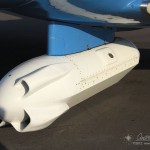
Hanging underneath the aircraft is the pod containing the radar itself. Bright white, the pod sports a flat antenna down the port side for the sideways looking beam. A trio of scoops on the front ram air through the pod to keep the electronics cool.
We chatted with the flight crew and the radar team learning about the instrument and aircraft. They travel all over the US and sometimes around the globe. They have mapped volcanoes in Alaska and Japan, glaciers in Iceland, measured oil spills, and scanned regions effected by major earthquakes. We noted that they had a fascinating job, while they said the same right back at us.
After the tour our hosts kicked us off the plane and began start-up for their hop back to the mainland. We got the data disks with the GPS data we needed for our tests and traded business cards and contact info. I will have to keep my eye out for the results of this year’s Big Island deployment.
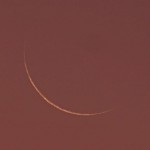
Tomorrow morning will find a razor thin crescent Moon about 5° from a brilliant Venus just above the rising Sun. The Moon will rise about 05:50HST, with Venus already in the sky. With sunrise at 06:59HST the pair should rise about 13° above the sunrise. This is enough to allow the the Moon, only 1.9% illuminated to be spotted fairly easily given a clear eastern horizon.