
Control
When you want to see the stars, find someplace dark

The W. M. Keck Observatory operates the world’s two largest optical/infrared telescopes located on the summit of Mauna Kea on the Big Island of Hawaii. Both telescopes are equipped with AO systems which are routinely used in both Natural and Laser Guide Star (LGS) AO modes. These systems have been extremely productive scientifically. New, more capable, systems are currently in design and development including the implementation of a new laser, new laser launch telescope, near-infrared tip-tilt sensor and a facility to provide simultaneous AO-corrected point spread function estimates to support science data reduction.

The AO Scientist will also participate in improvements to the existing AO facilities including performance optimization and characterization.
Minimum requirements for this position include: Ph.D. level degree in adaptive optics or high angular resolution astronomy or equivalent experience; three years of relevant experience in the development and/or use of AO for astronomical research; two years of work experience in instrumentation development or operations; a broad understanding of the multiple engineering disciplines needed to develop AO systems; and experience in data visualization and analysis. Desirable qualifications include: a proven track record in the development or optimization of AO systems for astronomy; demonstrated leadership skills; optical, mechanical and controls design and engineering expertise; expertise in the development of the high level software needed to operate and optimize AO systems; and previous Observatory experience.
The following skills are required: Excellent written and oral English communication skills, ability to work independently and as part of a team, strong project and time management skills; ability to set priorities and meet deadlines with flexibility.
This position requires you to submit your resume on-line at: http://keckobservatory.iapplicants.com/ViewJob-324991.html with your cover letter that states why you are uniquely qualified for the position.
Additional information about WMKO and this position may be found on our web site at www.keckobservatory.org

Kepler’s follow-up observers confirm new discoveries
More than 2,300 exoplanet candidate discoveries have made it the most prolific planet hunter in history. But even NASA’s Kepler mission needs a little help from its friends.
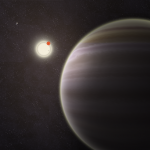
A single Kepler observation alone is often not enough to prove that the telescope has found an exoplanet, said Nick Gautier, the mission’s deputy project scientist at NASA’s Jet Propulsion Laboratory, Pasadena, Calif., who coordinated and continues to help run Kepler’s robust follow-up program.
Kepler finds exoplanets by watching for worlds that move directly between the telescope and their host stars. As they do this, they block a tiny fraction of the star’s light, an event astronomers call a “transit.”
Continue reading “Kepler Gets a Little Help From Its Friends”
W. M. Keck Observatory press release…
This Spring, the W. M. Keck Observatory is throwing a weeklong party called Keck Week 2013, to celebrate the observatory’s first twenty years of high-impact, game-changing astronomical discoveries from the venerable twin-domes on the summit of Mauna Kea, Hawaii. The festivities will take place in several Kohala Coast resort venues as well as in the town of Kamuela and will mark a distinctive confluence of the brightest minds in astronomy alongside our country’s most significant scientific philanthropists. Early registration lasts until December 20th, offering a 30 percent discount off all events.

Keck Week 2013 will open March 14th at The Fairmont Orchid, with the Keck Observatory 20th Anniversary Science Meeting – a rare, two-day binge of astronomy discourse and finely honed presentations describing Keck’s legacy discoveries. On March 16th, Keck Week will peak with a Star Struck Fundraising Gala, a grand evening at the Four Seasons Resort Hualalai and feature a live auction of spectacular items, a gourmet dinner, live music and dancing, and remarks by special guests. Other events planned for Keck Week 2013 include:

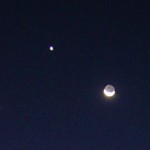
Tomorrow morning will find a nice crescent Moon near Saturn. The Moon will be 33% illuminated and about 5° away from the ringed planet shining at 0.6 magnitude. The pair will rise about 1:40HST and be high in the sky by dawn.
I am a bit behind in entry of all the significant astronomical events for 2013. Never fear! Everything important has been entered for January, so I am still ahead of the posting schedule! A few more evenings of blogging and I will have the whole year done.
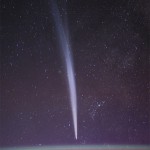
While C/2011 L4 PanSTARRS is a good comet, comet C/2012 S1 ISON is likely to be a great comet. This comet will pass incredibly close to the Sun and reasonably close to the Earth. If we get lucky, and luck is a significant factor with comets, this could be the comet of a lifetime. Predictions for this comet indicate a possible magnitude well into the negative numbers during November and December. These sort of numbers indicate the comet may be visible in the daytime, and spectacular after sunset. Unlike comet C2006 P1 McNaught in early 2007, this comet will favor viewers in the northern hemisphere!
No great eclipses this year. There are no total lunar eclipses to be seen anywhere, just a partial and two minor penumbrals. An annular solar eclipse visible in the South Pacific that will be visible as a modest partial solar eclipse here in Hawai’i. A hybrid solar eclipse will be visible across the Atlantic and central Africa.
Meteor showers are a mixed situation for the year, some good news, some bad. We will be able to observe the Persieds in a dark sky after the setting of a waxing crescent Moon. The Leonids will occur during full Moon, but are not predicted to be great this year. The Geminids also occur during a full Moon, damping this reliable shower.
2013 will be a great year for watching the sky. Stay tuned to Darker View for alerts on any significant event occurring overhead.
W. M. Keck Observatory press release…
Astronomers using the Canada-France-Hawaii and W. M. Keck Observatory telescopes on the summit of Mauna Kea, Hawaii have been amazed to find a group of dwarf galaxies moving in unison in the vicinity of the Andromeda Galaxy. The structure of these small galaxies lies in a plane, analogous to the planets of the Solar System. Unexpectedly, they orbit the much larger Andromeda galaxy en masse, presenting a serious challenge to our ideas for the formation and evolution of all galaxies.
The findings are being reported on the cover the upcoming issue of the journal, Nature.
While Persian astronomers were the first to catalogue the Andromeda galaxy, only in the last five years that we have studied in exquisite detail the most distant suburbs of the Andromeda galaxy via the Pan-Andromeda Archaeological Survey (PAndAS), undertaken with the Canada-France-Hawaii Telescope and measured with the Keck Observatory, providing our first panoramic view of our closest large companion in the cosmos.
The study culminates many years of effort by an international team of scientists who have discovered a large number of the satellite galaxies, developed new techniques to measure their distances, and have used the Keck Observatory with colleagues to measure their radial velocities, or Doppler shifts (the speed of the galaxy relative to the Sun). While earlier work had hinted at the existence of this structure, the new study has demonstrated its existence to a high level of statistical confidence (99.998%).
Continue reading “A Vast Rotating Disk of Dwarf Galaxies Surrounding the Andromeda Galaxy”
We are attempting to deal with our banana surplus issue.
A bunch of bananas is too much fruit for us to use in the few days before they spoil. A single bunch can yield 50 to 60 bananas. We snack on bananas, we make smoothies, we slice bananas onto our morning cereal, it is still too many bananas. Our standard answer to avoid waste is to give away much of the fruit. Apple bananas are quite popular and quickly accepted when given away to neighbors an co-workers.

This time we are trying dried bananas using a recently purchased food dehydrator. A bit of an experiment, I have never done this before. I dimly remember my mother drying bananas when I was a kid, I do remember the results being pretty good.