
Off to See the Lava… Again
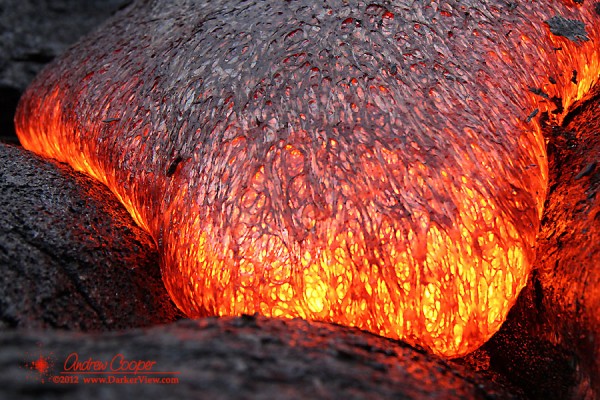
Hiked out to the lava again today. My friend Olivier will be leaving the island soon and wanted to cross one more item off his bucket list. Another 2am dash across island… Worth it! Another 12Gb of photos and video!
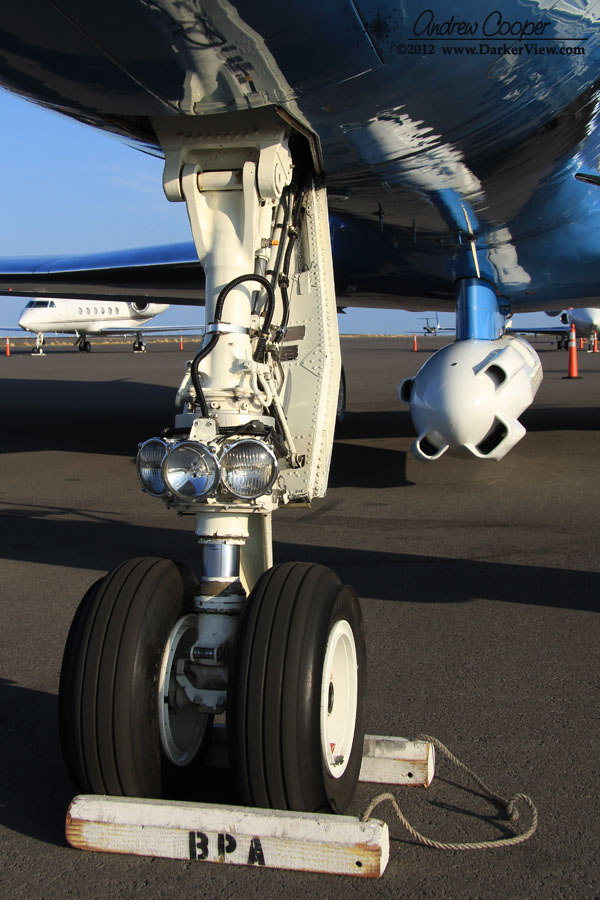
Testing TBAD with UAVSAR
So we have a system that will detect aircraft and shutter the laser.
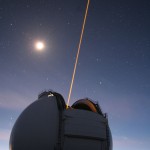
In theory TBAD will detect the TCAS transponder on an aircraft, turning off our AO Laser to avoid illuminating the aircraft. This work via means of a directional antenna mounted to the front of the telescope that is able to detect the 1090MHz TCAS transmissions from the aircraft. The system has been operational for the better part of a year, mounted to the Keck 2 telescope. It operates all the time, whether or not we are using the laser.
The problem is that there is very little air traffic over the summit, it is even more rare that a plane goes directly in front of the telescope while we are observing. It is these test cases we need to prove the system, an aircraft passing through where the laser would be. Though the first year of running the system we logged a total of one detection that would have resulted in a laser shutter event. We need more test cases if we are to prove to the FAA that the system works as designed.
UAVSAR
Postcard from the Reef – Zoanthid Colony

The Moon and Jupiter
This evening sky-watchers will note Jupiter directly beside a bright Moon. The pair will be very close separated by only 1°09′ as of sunset here in Hawai’i. Accounting for the radius of the Moon this will mean that the planet will be only 55′ off the limb of the Moon.
Observers further east and south will be able to see an occultation, with the Moon passing in front of Jupiter. Here in Hawai’i the occultation will be over before sunset. It is no use observing during the daytime either, as the planet will pass north of the Moon for our latitude.
The proximity of the two does provide a nice opportunity to see Jupiter in the daytime, as the Moon will provide a signpost to the location of the planet. The pair will rise about 14:00HST and be well up before sunset. Look just to the north of the Moon (left as they rise) for a pinpoint of light. At -2.6 magnitude the planet should be easy to spot as long as the sky is clear and not hazy.
Shift a Little Weight
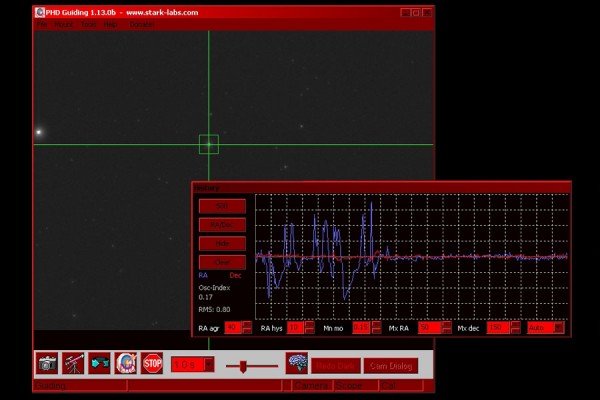
The trade-winds have returned for the evening. And while they are welcome for the comfortable temperatures they bring, the winds are unwelcome for the problems they create at the telescope. I am trying to get in one last exposure sequence for the evening, but the guider graph shows trouble. There are constant errors, not small errors either. The Right Ascension axis seems to be the issue, with errors of +/-3 pixels on the guider. This is just not going to work.
I watch the graph for a while, trying to figure out what I can do. I have had an issue where the guide star was the source of the problem, two stars to close together, a double star I did not notice when selecting my guide star. I stop the guider and select another star… The problem continues.
As I feared, my problem is most likely the wind this evening, a continual issue on this rock I live on. A speck in the middle of a very large ocean, the winds are a fact of life here. I only shoot with small telescopes, less sail area to catch the wind with a short tube. A TeleVue 76mm, an AT6RC, or simply a wide angle camera lens. The smaller scopes provide less loading for the old Losmandy G11 I mount them on.
I decide to try something else, shifting the balance to load the RA gear down. I gently slide the counterweight down the shaft about an inch. There is barely a blip on the guider as I make the adjustment. Better yet the guide error graph settles down! Looks like I will be able to get in a few more exposures before putting the ‘scope away.
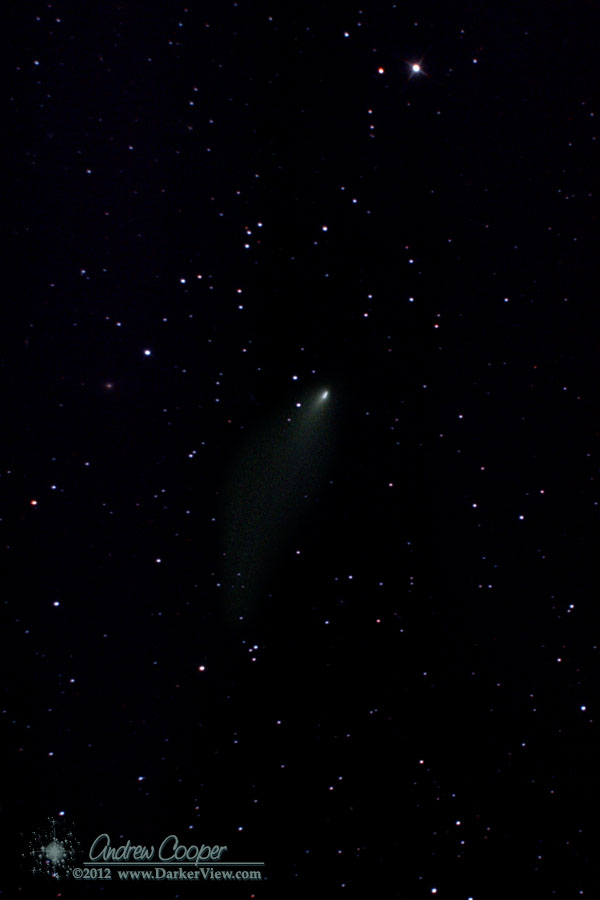
Postcard from the Universe – Comet C/2012 K5 (LINEAR)
Another product of imaging earlier this week. Comet C/2012 K5 (LINEAR) is fading, but still bright enough to image. Right beside Orion it was well placed to target from my driveway. Just refreshing my comet hunting skills, getting ready for the show over the next few months as C/2011 L4 (PanSTARRS) comes into view.
Postcard from the Universe – NGC1365 and Supernova 2012fr
A photo taken from my driveway of NGC1365 and supernova 2012fr. It is a bright supernova in a classic barred spiral galaxy. I had observed NGC1365 in mid-October with the 18″, noting the beautiful spiral structure. The supernova appeared about two weeks later. I have since observed it in a couple telescopes, including Cliff’s 24″.
The nova seems to be fading now, it peaked around 12th magnitude in November. Currently about 14.5 magnitude, but still easy with the AT6RC and Canon 20Da camera.

Mercury at Superior Conjunction
Today Mercury passes through superior conjunction, passing behind the Sun as seen from the Earth. The planet will appear in the sunset early next month, reaching maximum elongation on February 16th.