He’e
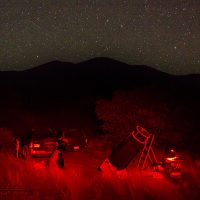
When you want to see the stars, find someplace dark

Today the Earth is closest to the Sun, a point called perihelion. We will be about 147,099,000km (91,403,000miles) from the Sun. Compare this to the 152,096,000km (94,508,000miles) we will be at aphelion on July 4th, a difference of about 4,996,000km (3,104,000miles) occurs throughout one orbit.
It may seem odd that we are actually at the closest for the middle of northern winter, you just have to remember that proximity to the Sun is not the cause of the seasons. The seasons are caused by the axial tilt of the Earth, creating short and long days throughout the year, with a resulting change in the angle and intensity of the sunlight.
| 2013 Solstices and Equinoxes | ||||
|---|---|---|---|---|
| UT | HST | |||
| Perihelion | Jan 2 | 00:59UT | Jan 1 | 14:59HST |
| Spring Equinox | Mar 20 | 11:02UT | Mar 20 | 01:02HST |
| Summer Solstice | Jun 21 | 05:04UT | Jun 20 | 19:04HST |
| Apehelion | Jul 5 | 18:59UT | Jul 5 | 08:59HST |
| Fall Equinox | Sep 22 | 20:44UT | Sep 22 | 10:44HST |
| Winter Solstice | Dec 21 | 17:11UT | Dec 21 | 07:11HST |
| Source: NASA Sky Calendar | ||||
Looking through the site statistics is an interesting exercise. I get a chance to see what people are reading. The vast majority of readers do not write comments, the stats are the best tool for feedback I have. Perusing the stats is also an realization of one’s own vanity, a necessary motivation for all writers, not just bloggers.
Site traffic has taken a large hit with the transfer to the WordPress platform. I expected this, there would inevitably be loss of links and search engine traffic with the changeover. This has begun to recover, but very slowly. There have been 55 thousand views of the Darker View blog in 2012. Overall there were 66 thousand views of the entire site for the year, not just the WordPress material. This compares to 91 thousand visitors in 2011, about two-thirds of pre-changeover traffic. Total traffic to Darker View since inception in 2007 is now over 288 thousand visitors.
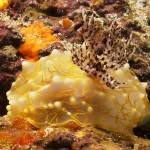
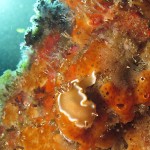
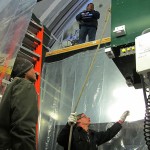
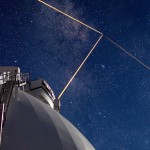
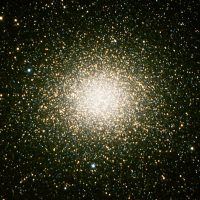
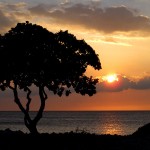
For your viewing pleasure, here are some of the best photos from Darker View assembled into a gallery. New Year is a time for reviewing the year past. I have enjoyed the last year, with the photos to prove it. I hope that 2013 brings you the chance to collect your own gallery of photos and memories.








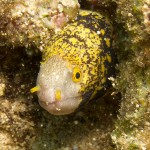
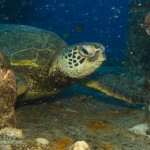
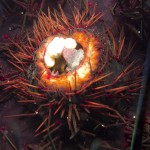
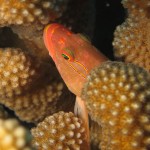
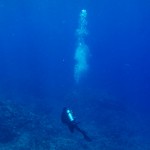
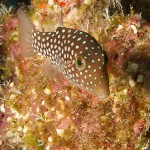
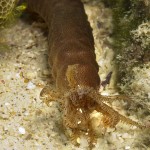
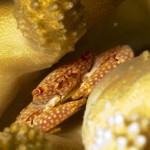
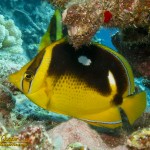
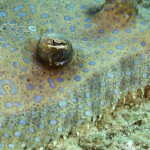
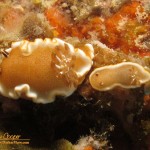
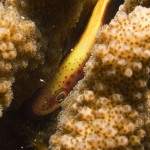



What else would I do on a Christmas Eve? Go shopping? Not really my ideal plan for the day. What about going diving? Not a bad idea at all…
Pete and I had already planned to go diving, but the plan had been to go shore diving somewhere. Then Dennis extended an invitation to join him on the boat, a gracious invitation we quickly accepted. As a result, the morning of the 24th saw us leaving Honokohau Harbor looking for a dive site to try.
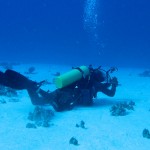
We did not go far from the harbor. First choice was a dive site called Sharkfin Rock just off Old Airport Park about two miles south of Honokohau. It is always a good sign when you can see the bottom 60 feet below through the blue water. Just inshore from the mooring a few surfers enjoyed the breaks along the park. Except for the one bodyboarder who was yelling at us to stop blocking his waves, as if a mere boat can have any significant effect on waves of any real size!


We found nothing truly unusual.. There were a number of nice encounters with reef regulars, some uncommon species of butterflyfish, a large day octopus, a young whitemouth moray. The second site at Eel cove was definitely one of the fishiest sites I have seen in quite a while. A lot of young fish to be seen. I expect the the more exposed site offers good feeding opportunities and less abuse from the aquarium collectors. I got a few good photos, particularly of the octopus. I have not seen what results Pete got from his efforts.
The day was simply a nice day to be out on the water, with good dive conditions that provided two nice dives. In the end I did do a little shopping. A stop at Costco was convenient as it is right above the harbor. There I grabbed a quick lunch and a couple things to keep our refrigerator stocked over the holiday.
The first meteor shower of 2013 is the annual Quadrantid meteor shower. The Quadrantids are a reliable shower, producing 60-120 ZHR, one to two meteors per minute. The Quadrantids are named for the obsolete constellation Quadrans Muralis, now part of the constellation Boötes.
Unlike other showers where activity can occur for days or even weeks, the Quadrantids have a sharp peak, activity falls off rapidly on the preceding and following nights, or even a few hours away from the peak. Thus it is important to observe the Quadrantids quite near the peak prediction. For 2013 the peak is predicted for January 3rd around 13:33UT, or 03:33HST on this side of the globe, excellent timing. This is the good news for observers here in Hawai’i. The bad news is that the peak will be sullied by the light of a bright last quarter Moon.
Watching meteors requires no more equipment than your eyes and a dark sky, and can be enjoyable for just about anyone. While the viewing conditions for this year’s Quadrantids are possibly spoiled by moonlight, it may still be worth a peek. Set the alarm early?