
Tonight will find the Moon about 7° away from Jupiter. Tomorrow the pair will be even closer, a separation of only 4.5°. The pair will be well up at sunset, to dominate the sky for much of the night.
Mercury Exits the Dawn
This week Mercury will be exiting the dawn sky, sliding closer to the Sun in our sky each day. It will pass through superior conjunction on January 17th, heading for an evening apparition beginning in the final days of January.
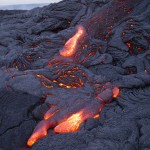
Trek to the Lava
The lava has been entering the sea for over a month now. I have wanted to hike out, but life and other commitments have consistently intervened. With off-island guests, I made the offer to lead a hike out to the flowing lava. My sister-in-law Darcy was the only one that took me up on the offer, the prospect of a 2am wake-up and a two hour trek across rough ground too much for some. We left the others in bed.
Postcard from the Summit – Hard Headed

Winter Solstice
Winter solstice occurs today at 01:12HST. Today the Sun will occupy the most southerly position in the sky of the year. The term solstice comes from the latin terms Sol (the Sun) and sistere (to stand still). On this day the Sun seems to stand still as it stops moving southwards each day and begins move to the north. This is the first day of winter as marked by many cultures in the northern hemisphere.
| 2012 Solstices and Equinoxes | ||||
|---|---|---|---|---|
| UT | HST | |||
| Perihelion | Jan 5 | 03:59UT | Jan 4 | 17:59HST |
| Spring Equinox | Mar 20 | 05:14UT | Mar 19 | 19:14HST |
| Summer Solstice | Jun 20 | 23:09UT | Jun 20 | 13:09HST |
| Apehelion | Jul 4 | 23:59UT | Jul 4 | 13:59HST |
| Fall Equinox | Sep 22 | 14:49UT | Sep 22 | 04:49HST |
| Winter Solstice | Dec 21 | 11:12UT | Dec 21 | 01:12HST |
| Source: USNO Data Services Website and the NASA Sky Calendar | ||||
Working the Weather
One of the little side jobs I have gotten assigned at Keck is updating the weather station. This involves replacing all of the weather monitoring equipment that allows the operators to keep an eye on conditions around the telescopes. This gear is absolutely critical, giving the operators the data they need to protect our equipment, including the irreplaceable mirrors.
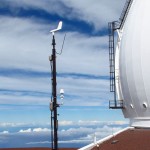
It has been fun to learn about measuring temperature, humidity, dew point and more. It seems so simple at first, but the complications of getting a good reading are subtle. Passive instrument shelters, active ventilation, instrument positioning, calibration and more. Issues that can make a good instrument give bad data.
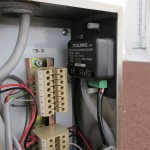
Last week I installed a new barometric sensor. This was the last part of the existing weather instrument suite that needed to be replaced. I got lucky, it was a great day on the summit, sunny with just a modest breeze. Just the day to spend a couple hours hanging off the weather mast in a climbing harness rewiring a junction box for the new cables. A few holes to drill, a few bolts, a couple cables… done!
My next item is to install an anemometer. We have not had an operational anemometer in many years and our observing staff has made it abundantly clear that they want an anemometer. Not that this one will be easy, it is a bit of a challenge to get a decent wind reading anywhere near a 100ft diameter dome. This challenge will be a bit more involved, and involve some good engineering fun. Time to learn about measuring wind-speed and how to do it right. Looking forward to the next part of the plan!
Resting

Found: One Planet Orbiting Sun-like Star. Only Twelve Light Years Away
W. M. Keck Observatory press release…
An international team of astronomers using the W. M. Keck Observatory and other telescopes, has discovered that Tau Ceti, one of the closest and most Sun-like stars, may host five planets – with one in the elusive ‘Goldilocks Zone’.

The international team of astronomers, from the UK, Chile, the USA, and Australia, combined more than 6,000 observations from three different instruments, including HIRES on the Keck I telescope. Using new techniques, the team has found a method to detect signals half the size previously thought possible. This greatly improves the sensitivity of searches for small planets and suggests that Tau Ceti is not a lone star but has a planetary system.
Continue reading “Found: One Planet Orbiting Sun-like Star. Only Twelve Light Years Away”
Postcard from the Summit – Sunset Crowd

Riding Waipio
Off island guests, always the best excuse to get out and explore the Big Island. this time it is my sister in-law Darcy and her friend Karen. With three horse addicted women, add my wife to that list, it is inevitable that at least one excursion would involve a ride.

Na’alapa Stables offers a two and a half hour morning or afternoon ride. We chose a morning ride to avoid the usual afternoon clouds common on the Hamakua Coast. The ride is just under $90 per person, and they do offer a kama’aina discount.