Science Fair Season

School science fair season is here! As an engineer, it is wonderful to see school kids doing science and engineering tasks. I enjoy going to see what the students have come up with and giving a little of my time to support science and engineering education.

Science Fair
Students from Parker School participate in science fair
In the past two weeks I have served as a judge for two science fairs, Parker School and Kanu o ka ‘Āina. Parker is a private school in Waimea with a well deserved reputation for excellence. Kanu is a charter school with a heavy emphasis on Hawaiian culture. Both schools make a special effort with science fairs, expecting their students to participate and go on to the county and state wide competitions.

As usual, the projects are quite the mix. Some projects are simply the usual stuff, variations on the standard projects one can find posted to the internet, standard fodder for science fairs nationwide. Not that I totally disapprove of these common projects, students can gain valuable experience when performing any good experiment, even one done many times before. It is all in the execution.

One difference you really find here in Hawai’i, is a heavy emphasis on Hawaiian culture and special problems unique to the islands. This leads to unique experiments that address local issues. Propagation of native plants, alternative energy, permaculture, issues that have a direct connection with island life. Some student explore aspects of native Hawaiian technology. I was particularly impressed by experiments in traditional dye mordants examining the effectiveness and permanency of various mordants with tumeric dye and cotton cloth.

The results are likewise quite the mixture. Experiments that result in good success, to others that do not fair so well. Looking at a growth chart with all zeros in the data table I was forced to ask… “did the plants just not grow?” …”They all died.” Still, failures can be just as good learning experiences as success, sometimes better. I am always impressed by a student who admits failure and can explain what went wrong.

Some of the students I graded will go on to the regional competitions, I expect some will do quite well. Good luck!

Visiting the Summit of Mauna Kea

Visiting the summit of Mauna Kea is high on many visitor’s to-do list when coming to the island. The summit region is spectacularly beautiful, even after six years of visiting several times a week I still find it so. My habit is to drive, or to ride shotgun in order to enjoy the view. I keep a camera at hand, ready for the inevitable situations where beautiful is transformed to spectacular with a well placed cloud or shaft of sunlight.

Summit Visitors await Sunset
The usual crowd of summit visitors await sunset along the ridge between the Gemini and CFHT telescopes
Any visit to the summit starts by stopping in at the Mauna Kea Visitor Information Center. Located at 9,200ft the center is found at the end of the paved road. The folks here are responsible for providing visitor information and helping you out if you get into trouble, a service provided by the observatories through Mauna Kea Support Services. This includes the Mauna Kea Rangers who patrol the mountain, providing information, advice and assistance to visitors. Also found at “The VIS” are bathrooms, a gift shop, and the evening star gazing program.
Continue reading “Visiting the Summit of Mauna Kea”

The Moon, Mercury and Venus

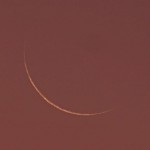
Tomorrow morning, December 11th, a nice trio will see three bright objects create a close 6° triangle. Lowest of the three will be Mercury, shining brightly at -0.6 magnitude, at about 18° elevation at sunrise. About 4° above Mercury will be a nice 4% illuminated crescent Moon. Above the Moon will be Venus, shining at -3.9 magnitude it will be very hard to miss. About 16° above the trio you can find Saturn, making three bright planets in the dawn. This conjunction should be worth setting the alarm clock early for.

A Line of Planets in the Dawn

Tomorrow morning, December 10th, you will find a nice lineup of planets in the dawn sky. Mercury, Venus and Saturn will be in a line about 20° long. Adding to the lineup will be a nice crescent Moon, a bit over 10° higher in the sky than Saturn.

The view at 06:00HST will find a 19% illuminated Moon at 38° elevation. Working down the line you will see Saturn at 29° elevation, Venus at 15° elevation and Mercury at 9° elevation. With sunrise not until 06:46HST this will give plenty of time to view, and perhaps photograph, a line of planets in the dawn.

Over the next few days the view will be much the same, with the Moon lower each morning. On December 11th the Moon will sit between Venus and Mercury creating a nice trio.

Rewiring a Celestron NexStar Telescope

The original NexStar telescopes are great instruments. Ours has seen many uses, from dark skies to not so dark skies as it has been set up in the Arizona Desert, the summit of Mauna Kea, or various school yards and resorts for public viewing. It has been used as a visual instrument, a photographic ‘scope, even done a little real work.

For the most part the scope has worked well, and has been well maintained, even updated with the latest hand pad controller. But on occasion there is a problem… connection issues would crop up. The dreaded “No Response 16” or “No Response 17” errors would appear, indicating that the motor control board is not talking. This would result in having to power cycle and realign the telescope.

Lately the errors have become more problematic. The last straw was a public event I recently used the telescope for, setting up the telescope for Halloween. Continual errors plagued the evening, a constant struggle. While the scope usually tracked, I could not use GOTO as each alignment was quickly off by just enough to be useless.

Under the Hood
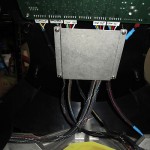
Under the hood of the NexStar showing the new cables

I have had the telescope apart too often in attempts to fix this, inspecting and re-seating the cables. This usually works, the problem will go away, for a while.

In general I like what I see inside the telescope. A well designed piece of kit with good components. Decades of taking gear apart have provided me so many examples of poor or good design. Inside the NexStar I just like what I see. The telescope is easy to get apart, just a few screws to remove each cover, exposing everything you might need to work on. The designers of this telescope obviously took pride in their work, it shows.

The exception to this is the wiring. There are a number of issues that can create trouble. Or rather there were a few issues, I just took care of that…

Continue reading “Rewiring a Celestron NexStar Telescope”