I have been looking for a frogfish for years. Even so far as to comb a coral pinnacle where one had been seen the previous day with a group of other divers. So far I have had no success. These fish possess remarkable camouflage, I have probably swum right over more than one. But given how thoroughly I can comb a section of reef it is surprising that I never found one.
My friend Pete however…
A commerson’s frogfish (Antennarius commerson), photo by Pete Tucker, used with permission
The annual Geminid meteor shower has become one of the most reliable annual meteor showers. Known for bright and slow moving fireballs the Geminids can provide a good reason to spend a few hours outside on a December night. This shower has routinely provided rates above 100 meteors per hours in past years, this year should be no exception.
A pair of Leonid meteors streak through Orion, combination of 10 x 15s framesFirst observed over 150 years ago this is a interesting meteor shower. The parent body for the Geminids is not a comet as with most showers, but rather the asteroid 3200 Phaethon. It is somewhat of a mystery how this mostly rocky body gives rise to the debris stream needed to generate a meteor shower. The asteroid does orbit well inside the orbit of Mercury every four years, where intense solar heating may heat trapped ice and liberate loose material from the surface.
Stargazing on Hawai’i
Here on the Big Island the single best place to stargaze is the Mauna Kea VIS. The dark skies are usually free of clouds and are well away from the lights of Hilo and Kona. After dark use for stargazing is not only permitted, but encouraged. It can be cold at 9,200ft, bring warm clothes and blankets
The peak is expected to occur around December 13, 07h to December 14, 04h UT. For viewers here in Hawai’i this occurs on the night of December 12th. The Geminids feature a broad peak, with high rates for nearly 24 hours, thus allowing the all time zones a decent chance to enjoy the show.
There should be no substantial moonlight to drown out this years showing, dark skies to allow even the faintest meteors to be seen. The Moon is a thin waxing crescent, 1% illuminated on the morning of the 13th, essentially new.
The Geminid radiant rises round 8pm, thus meteors should be visible all night long. You can stay up late or set the alarm early, your preference. Southern viewers will have to wait until around midnight for the constellation Gemini to rise, making this a morning shower.
A group of astronomers from the University of Hawaii at Manoa, the U.S. Mainland, Canada, and Europe recently used the twin telescopes of the W. M. Keck Observatory on Mauna Kea, Hawaii, to conduct a census of the brightest, but until now unseen, galaxies in the distant Universe, bringing astronomers one step closer to understanding how galaxies form and evolve.
A 3D projection of almost 300 galaxies in the census in the same part of the sky.These galaxies glow so brightly at infrared wavelengths that they would outshine our own Milky Way by hundreds, maybe thousands, of times. They are forming stars so quickly that between 100 and 500 new stars are born in each galaxy every year, and have been coined “starbursts” by astronomers.
While it’s not clear what gives these galaxies their intense luminosity, it could be the result of a collision between two spiral-type galaxies, similar to the Milky Way and Andromeda Galaxies. Or they could be in a particularly gas-rich region of space, where galaxies form stars quickly due to constant bombardment from gas and dust.
Today Mercury reaches maximum elongation, the furthest point it will reach from the Sun in the sky and the highest it will be above the sunrise for this morning apparition. The planet is easily visible as a bright, starlike object about 15° above the rising Sun as the twilight begins. Over the next couple weeks Mercury will slide back into the sunrise, heading for superior conjunction on February 16th.
The West Hawai’i Astronomy Club will hold its December Meeting as usual on the second Tuesday of the month, December 11th at 7pm. We will be unable to have the meeting at CFHT due to conflict with another event, thus we will be meeting at Keck Observatory HQ in Waimea.
As many of our members traveled to observe the recent total solar eclipse in Australia we expect to be treated to photos and travelogues of their expedition. Join us for eclipse photos and more.
Jupiter will pass through opposition at 14:43 today. The planet will rise at sunset and transit at midnight, available for observation for the entire night. For the remainder of the year and much of the spring, the planet will shine brightly in the evening sky.
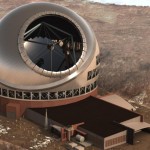
An overhead view of the proposed Thirty Meter Telescope, credit TMT Observatory CorporationThe takeaway is that the petitioners in the contested case failed to prove their claims. Indeed, much of the report is quite critical to a number of claims made by the petitioners.
There are numerous claims that seem quite odd to anyone familiar with the summit, claims that were easily disproved during the investigative process. An “extensive fencing network”? What fences? Anyone who has visited the summit knows that there are no fences around the observatories at the summit. There are some small enclosures necessary to keep people safe around storage tanks and such. Well below the summit the VLBA antenna is enclosed for safety reasons, as is an electrical substation at Hale Pohaku.
49. Petitioners contend that a purported “subdivision” of land among the various existing observatories is evidenced by an “extensive fencing network.” Exhibit A-202 at 22. As was plain during the site visit, there is no “fencing network,” much less an “extensive” one, in the summit region of Mauna Kea.
Claims that the TMT would negatively impact the waters of Lake Waiau? The TMT is not located anywhere near the lake’s watershed. The petitioners engaged in legal mudslinging, throwing as many claims as possible at the case to see what would stick, a legal tactic I dislike immensely. Making such unfounded claims merely serves to discredit the petitioners, distracting the conversation away from the real issues involved in sharing the summit region.
466. Considering all of the evidence, including but not limited to the testimonies of Drs. Liu and Kauanui, and giving such evidence due weight, Petitioners have not offered reliable, probative, substantial, or credible evidence, scientific or otherwise, to suggest that the Project will be harmful to the health, safety, and welfare of native Hawaiians or anyone else.
There are reasonable cultural objections to the use of the mountain for astronomy. These are what must be addressed in this process. Can use of the summit be shared among the various parties? The report clearly comes to the conclusion that we can share the summit and that the presence of the new telescope can be minimized through proper measures.
101. Petitioners did not offer reliable, probative, substantial, and credible evidence, whether from expert or lay witnesses, that would support the conclusion that the TMT Project would cause substantial adverse impact to plants, aquatic life and wildlife, cultural, historic, and archaeological sites, minerals, recreational sites, geologic sites, scenic areas, ecologically significant areas, or watersheds.
There is a list of conditions, which seem quite reasonable… The staff must receive cultural and environmental education on the special nature of the summit of Mauna Kea. We do this at Keck, something I usually find quite interesting. They must use a completely enclosed waste water system. There must be an invasive species plan. Conditions around the construction site must be monitored, including arthropod populations, during construction and for two years afterwards. There is an extensive list that goes on from here…
e. The proposed land use, including buildings, structures, and
facilities, will be compatible with the locality and surrounding areas, appropriate
to the physical conditions and capabilities of the specific parcel or parcels
Will this be the end of the legal process? No. There is an additional hearing for the petitioners to take place before the Hearings Officer so that both sides may review the findings. It is also likely that at least one lawsuit will be filed in reaction to issuance of the CDUP. Unless there is some new legal issue these are unlikely to progress very far. The process so far has been quite exhaustive, any further legal action would simply be a rehashing of what we have already heard.
The first astrophoto taken with the EOS-M. Considering the trouble it is to manually trigger the exposures without proper camera control, I am surprised I stuck it out to take 40+ subs. Since 30 seconds was the longest I could program the camera for I simply maxed out the ISO and took a lot of subs plus a dozen darks. There is still way too much noise in the resulting frame. Still, the ISO 12,800 frames are not all that bad, better than I expected. If this camera had remote control it would be a decent little astro camera. Longer subs and a lower ISO would deliver decent results.
The Orion Nebula with and EOS-M, 40x30s exposures @ ISO12,800, AT6RC and 0.8x focal reducer, a set of 12x4s exposures used to reveal detail in the core.