I have known about these guys for a while, even looked a few times. It is daunting when you know exactly where to look, but that place is heavily defended and tough to approach. Obtaining a photo of something that is nestled amongst six inch spines? Challenging…
A female sea urchin crab (Echinoecus pentagonus) in the anal cavity of a large banded urchin (Echinothrix calamaris)
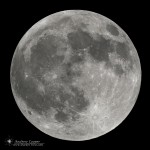
Full Moon taken 27Aug2007, 90mm f/12 APO and Canon 20DaFull Moon will occur today at 04:46HST.
A penumbral lunar eclipse will be visible from western North America, across the Pacific to much of Asia. This is a fairly minor eclipse, with the Moon passing through the outer penumbral shadow of the Earth. A careful observer will note the light of the full Moon dimmed. As the Moon will not enter the darker umbral shadow the effects of this eclipse will not be obvious.
Tonight the Moon will be about 7° away from Jupiter, a bright pair rising together in the eastern sky after sunset. Tomorrow, November 28th, will see the Moon east of Jupiter, but even closer, just under 5° away.
In the few days I had the camera I was determined to acquire some astrophotography test shots with the EOS-M camera. Even if it meant getting up at 3am to have some dark sky after moonset. It would have been easier a few days before, but a Pacific storm system had provided several days of overcast with occasional rain. This particular morning was just about perfect, clear skies, decent seeing and no wind to bounce the telescope around.
Astrophoto setup with AT6RC, SBIG STi autoguider and the EOS-M cameraFor testing I used the same setup I often use with my Canon 20Da or 60D. An Astro-Tech 6″ (150mm) Ritchey–Chrétien telescope riding atop a Losmandy G11 mount. A 0.8x focal reducer has T-thread at the rear allowing a Canon EOS lens adapter. To attach the EOS-M I used the Canon M Mount to EOS Mount adapter. An SBIG STi autoguider completes the setup.
The result is an f/7 optical system with 1080mm focal length. This gives a field of view of about 72×48 arc-minutes (1.2 x 0.8 degrees) on the sky when using a camera with an APS-C sensor.
Tomorrow morning, November 26th, will see a very close rendezvous of Venus and Saturn in the dawn. The two will be less than a degree apart, with a separation of only 40 arc-minutes. This will put both planets in the same low power telescopic view. The pair will rise about 04:30HST and be well up, nearly 30° above the horizon, at sunrise.
This is a mismatched pair, with Venus dominating the view at a brilliant -4.0 magnitude. Saturn will be far dimmer at 0.6 magnitude.
DSLR cameras have been the design of choice for professional and serious amateur photographers for over a decade, ever since the era of digital photography began. Big lenses and big sensors made the most of what light was available offering the best possible photographic performance. This performance is a huge jump over what the smaller lenses and sensors of compact cameras offer. A performance gain that makes carrying such a large camera worthwhile.
A DSLR is big because of the demands of the available technology. The swinging mirror directs light into optical viewfinders and phase detection focus sensors. Over the last couple years a new type of camera has appeared, taking advantage of advances in technology to dispense with the bulky swinging mirror design. Fast, high resolution electronic viewfinders and better focus technology allow this transformation. Engineers can create a camera far smaller while keeping the large sensor and interchangeable lens. Better yet, getting the lens closer to the image sensor allows a smaller, lighter, less expensive lens without sacrificing performance. Enter a new paradigm of camera that offers much of the performance of a DSLR in a compact design.
The Canon EOS-M with the 22mm f/2 kit lensAll of the major players have now released their own spin on the mirror-less design. Panasonic and Olympus jointly released compatible designs under the Micro Four-Thirds standard. Sony has released their NEX system and Nikon the Nikon 1 system. A number of lens makers, Zeiss, Tamron, and Sigma now make lenses for these cameras. Canon was the last to release an entry into this new market segment.
Over the coming days, Venus and Saturn will rendezvous in the dawn. Already drawing close, the pair is separated by less than 4° this morning. Close approach will be on the morning of the 26th when the separation will be only 40 arc-minutes. The two will remain close for about a week, the separation having grown to over 4° on the morning of the 30th.
This is a mismatched pair, with Venus dominating the view at a brilliant -4.0 magnitude. Saturn will be far dimmer at 0.6 magnitude.
Mercury is beginning its third and final dawn apparition of the year. Today the planet will be over 10° from the Sun, rising a little further each day until maximum elongation on December 4th. There will be a nice trio with the Moon and Venus around December 11th.