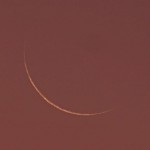
A thin crescent Moon will be about 5.5° from Mars tonight. The Moon will be a thin crescent, only 8% illuminated. The pair will be about the same elevation, 25° above the horizon at sunset.
Streaming
New Moon

During this new moon a total solar eclipse will sweep across Northern Australia and the South Pacific, ending before reaching the west coast of South America. None of this eclipse will be visible from Hawai’i.
Postcard from the Summit – TRICK
Saturn and the Moon
Tomorrow morning, November 12th, Saturn will join a very thin Moon in the dawn. The pair will be at about the same elevation, 15° above the horizon at sunrise and about 4.5° apart. The Moon will be very thin, only 2.3% illuminated. Above the pair a brilliant Venus will shine at about 30° elevation at sunrise.
The Moon and Venus
A thin crescent Moon will rise in accompaniment with Venus tomorrow morning. A brilliant Venus, shining at -4.0 magnitude, will rise about 5.5° from a 7% illuminated Moon. The pair will rise about 04:10HST and be about 30° above the horizon at sunrise.
Mercury Exits the Evening Sky
Mercury is ending it’s last evening apparition of 2012. Over the next few days the planet will slide into the sunset heading for inferior conjunction on November 17th and begin a morning apparition beginning in waning days of November.
A Cometary Breakup
While Comet 168P Hergenrother may be a bit of a mouthful, it is the proper designation for an interesting comet. Discovered in 1998, the comet is one of dozens that orbit in the inner solar system. Normally inconspicuous objects, these comets orbit quietly, objects that only astronomers love, or even know about. You would normally have needed a substantial telescope to see 168P, shining very dimly at magnitude 15.5 at it’s brightest. A community of amateur astronomers keeps tabs on these comets, occasionally photographing them, updating the orbits.
As the comet approached perihelion during the beginning of October, it became apparent that something had happened. Several observers were reporting that the comet had brightened. Suddenly the comet was far brighter, eventually reaching near 8th magnitude, over 500 times brighter than expected. We have seen this sort of thing before, a cometary breakup. Observations from several large telescopes, including Gemini North here on Mauna Kea, showed that the comet has split into at least four pieces.
When a breakup occurs it exposes a great deal of fresh material and debris, dramatically adding to the supply of dust and gas in the coma and creating a far brighter object. It is not the comet itself we see, that is fairly small. It is the coma and tail, the cloud of dust and gas that reflects the sunlight and gives a comet the synonymous appearance.
Comet 168P Hergenrother currently sports a small fan shaped tail, easily visible in the telescope. We enjoyed this classic comet shape in the telescopes last new moon at the Mauna Kea VIS. Setting up a telescope and CCD camera last night allowed me to photograph the comet, appearing much the same as it did a few weeks ago.

White-sided Dolphin
Postcard from the Summit – Walking to the True Summit
It has been many years since I last stood atop the summit of Mauna Kea, the true summit that is. A couple decades ago, while on vacation I walked to the summit as a tourist. All these years of driving past on the way to work, I have not stopped and taken the short walk to the summit of Mauna Kea from the road, until now.
Broken gear on a weekend, driving up the mountain by myself. Once the gear was fixed I was free to head back down. Without a vehicle full of guys just wanting to go home after a full day at work, I was free to stop and take a walk with the camera…