Aiming a telescope at the Sun is deceptively difficult. You can not use a optical finder for risk of eye damage. Unit power finders, like a Telrad, are of little use as you can not see the projected image. Telrads can also be damaged by sunlight. In a pinch you can simply use the shadow of the telescope, positioning for a minimum shadow. This at least gets you close.
A Sun Finder mounted to a TeleVue 76mm 'scopeThe best solution is to build a finder designed just for the Sun… A Sun Finder.
There are many plans for Sun Finders posted to the web. Most use a shadow or projected point of light. The version I built is no exception, using a pinhole to project a point of light on a translucent screen. The trick is to make such a device simple and accurate.
With simple metal working capability a Sun Finder like this one can be made from sheet metal, or machined from solid aluminum. I chose the latter as I had the capability. This design uses a pinhole that projects a similarly sized dot of light at the rear of the finder. The front face or the finder, through which the pinhole is drilled, creates a shadowed area for in which the projected dot can be seen.
A Sun Finder in use with the projected dot visibleA longer distance from the pinhole to the screen will increase the sensitivity in aiming. In practice I have found that at least three inches is sufficient for most telescopes while keeping the device compact. Experimentation with the design can be entertaining and educational. No need to stick strictly with this design, just borrow the basic ideas, a lot of variations will work.
This design is based on an aluminum extrusion, a 3″ x 1.5″ channel. This save a good deal of machine work in creating the finder. As much of the machining is done along the length, a number of finders can be made at the same time. I made six finders from a seven inch scrap of extrusion out of the shop scrap pile.
Plans for the Sun FinderThe screen is made from a small piece of 1/8″ thick acrylic. Common 0.1″ thick material will work as well. One side is frosted with sandpaper to create a translucent screen. Use of a clear screen allows the solar dot to be seen from front or behind while aiming the telescope. The screen is simply secured with a glue, preferably RTV. The frosted side should be mounted towards the pinhole.
To keep the device simple there is no adjustment in aiming. If the finder is mounted reasonably well, the dot of light will be on the screen. The first time out it is necessary to first get the Sun in the field of view. You can then mark the position of the projected dot with a permanent pen (Sharpie or similar). After that aiming is simply a matter of positioning the dot on the mark. If the mark is made on the smooth side of the acrylic screen it can be easily erased and re-marked if necessary.
Done, a simple and reliable Sun Finder to work with just about any small telescope.
It was a full dress rehearsal. Both telescopes, two cameras, the entire streaming rig set up on the lanai. No less than three computers with cables all over the driveway! Surprisingly enough, everything went pretty well!
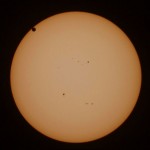
The Sun on June 2, 2012If you had been watching the Keck Transit of Venus stream, you would have been looking at a live image of the Sun for several hours. The seeing from my driveway was pretty poor, but there is a nice collection of smaller sunspots across the disk.
Everyone wandering by the house noted the telescopes. I gave peeks to our mail-lady and a couple young women who stopped by, intending to read me a bible verse or two (that was fun;)
Two technical issues were key today… Using thirty feet of active USB extension cables to run the streaming camera remotely, no problem. Co-aligning the two telescopes to aim at the same point, no action needed, aligned from the start. I had thought I might need to shim the mount for the piggyback ‘scope. I was also able to play with the streaming camera further. The Baader film filter gives a blue-white image. Adjustment of the camera white balance will restore a little yellow cast. I do not have much problem with the white, but a hint of yellow will allow people to instantly realize they are seeing the Sun. The same reason I adjust my processed photos for a golden orange hue.
We are all swapping gear around to get the set-up ready. Chris was nice enough to loan me a Canon T-ring and some Baader film. I built a battery pack and some sun-finders for several telescopes. Last night I picked up a whole solar rig from Cliff for delivery to Olivier. Olivier lent a 40mm eyepiece to Keck for the public telescope that will be setup at HQ. The list goes on…
I was not the only one doing a dress rehearsal. So far today I have been on the phone to other folks setting up and using a sunny Saturday to check gear. Some of the guys over on Maui even posted a video of their test run. I should have thought to do the same thing! Will have to time lapse the summit setup.
This is your last chance this lifetime to witness a Venus transit! On June 5th the Earth, Venus and the Sun will line up correctly so that earthbound observers will see Venus cross the disk of the Sun.
Mercury transiting the face of the Sun, 6 Nov 2006Venus transits are relatively rare events, that occur in pairs1, with the paired events separated by eight years. Each pair is separated from the next pair in a predictable pattern, alternating 105.5 or 120.5 year gaps. The first transit of the current pair was in June 2004, with the 2012 event completing the pair. The next pair of events will begin in December 2117. Given the century long separation between events Venus transits have only occurred seven times since the invention of the telescope (1631, 1639, 1761, 1769, 1874, 1882 and 2004)2.
For Hawai’i the event will begin at about 12:10pm with the Sun high in the sky, mid-point will be about 3:26pm and will end about 6:44pm, just before sunset. These times are only approximate, exact times will depend on the observer’s location and can vary by several minutes across the islands.
Keck Observatory will be making an extra effort for this transit as Mauna Kea is perfectly positioned to observe the event. We will be webcasting the transit from a small telescope located at the summit. The webcast can be seen on your computer, or come over to our headquaters in Waimea to see the webcast and a live view in a solar telescope if the weather cooperates. there will be extra staff on hand to answer your questions.
Stay tuned to DarkerView for further details as the transit draws near.
The rearrangement of my astrophoto setup proceeds. If somewhat frantically in the face of the upcoming Transit of Venus. Another device has joined the toolkit, a bit of hand-wired electronica that gets the job done.
A copy of Gene Nolan's USB to ST-4 guiding adapterThis particular device will allow remotely guiding of the telescope during the seven hour long event. The computer sitting beside the telescope will be controlling both a camera and the mount. Also set up on the computer is a VNC server, so I can remotely view the screen from inside. With this arrangement I can keep an eye on the whole setup, including nudging the telescope as needed to keep the Sun centered in the image. Since the mount will only be roughly polar aligned, set up during the day, I expect to get a fair amount of drift during the event.
I did not design the device this time. This would have been completely within my capability, but why do so when someone else has already done the job? This is typical within the astronomy hobby, where many designs are shared for the benefit of everyone. In this case it is the USB to ST4 adapter designed by Gene Nolan.
All I had to do was follow the schematic and download the code into the microcontroller, the device worked first time. Gene does sell kits, but I wanted to do this quickly and had everything I needed on hand except the microcontroller and opto-isolators.
The only real problem that cropped up during construction was the wrong part received for the opto-isolators. The DigiKey description read DIP-8, so I ordered it, expecting to get something that fit into the DIP socket I had already wired onto the board. When the parts arrived I found that they were indeed DIP… lead-formed DIP packages meant to be surface mounted, with chopped off leads. I ended up soldering the devices to another DIP socket, using it as a header, which then plugged into the socket on the board. It looks funny, but it works.
It did take a couple hours of downloading and installing the drivers and other useful software packages to get everything working. This includes the very useful ASCOM driver framework, and PHD Guide. Both of which I plan to use beyond the upcoming Transit of Venus to do more astrophotography.
My wife may have been a little perturbed by the testing setup strung across the kitchen table, a laptop and the heavy Losmandy head, a Canon 60D camera, all connected by a snake pit of cables. But it worked, first time, that is always nice.
Saturn, the Moon and Spica form a trio high in the eastern sky at sunset tonight. The three will be within 7° of each other. The Moon will be just short of full, over 85% illuminated. Saturn will be shining at 0.4 magnitude while Spica is very close to 1.0 magnitude. Look for the planet Mars 38° west of Saturn and a bit brighter.
As we approach the Transit of Venus I decided to attempt to photograph Venus as a very thin crescent. I do not normally pay much attention to the planet, it is pretty when seen in the sunset. But when you turn a telescope to Venus it is quite boring, a white ball with no detail to be seen. I find I have been paying a bit more attention with the transit looming close on the calendar.
I could photograph the planet after sunset, but as Venus is quite near the Sun it would be very low in the sky and I would be shooting through a lot of air to get the imagery. Atmospheric distortion would be a major problem. The other method is to try something I had not done before, photograph the planet in the daytime, high in the sky and quite near the Sun.
Imaging Venus in the daytime a mere 12°44' from the Sun.Don’t try this at home?
Yeah, This will be a tricky operation. Venus will be only 12°44′ from the Sun, meaning I will have to be quite careful to avoid roasting my equipment, or my eyes.
I chose to use the 90mm APO refractor. With the optics at the front there will be some sunlight splashed down the interior of the tube. It should not be a focused image as it will hit the tube not even halfway down. There the heavy aluminum tube walls should dissipate the heat efficiently. The fully baffled tube should also stop much of this light before it reaches the camera. I may not have designed and built the optical tube with this sort of abuse in mind, but I did build it heavy, it will take it.
Venus on 28May2012, about 12°44' from the SunI located Venus by centering the Sun with the solar filter on the ‘scope. I then adjusted the setting circles and offset to the correct coordinates for Venus. After a visual safety check I removed the solar filter for a look. And there it was, a graceful and very thin crescent shining brightly against the blue sky. Replacing the eyepiece with a camera I focused and shot several video sequences.
The results? The final image can bee seen to the left. Not horrible, but it could have been better. The seeing at 11am was already starting to degrade, I am always amazed at how well the software can extract a half decent image from such distorted original material. The magic of sorting through and averaging a thousand frames. I wonder what I could do with better seeing.
Another try? Probably not, Venus is quickly getting closer to the Sun as we approach transit in nine days. The next time I photograph Venus it will most likely be silhouetted against the solar disk. Maybe an attempt after transit? I could shoot earlier in the morning with possibly better seeing.