
Heron
When you want to see the stars, find someplace dark

This evening will see the Moon pass by Mars. The two will be about 12° apart tonight and about the same tomorrow night. As the red planet passed through opposition on the 3rd it is still quite bright at -1.2 magnitude, a nice match for a nearly full Moon.
The two brightest planets in the sky will join up for a dance spanning several days starting this evening. Looking up tonight you will see the pair about 5° apart, with the dimmer Jupiter above Venus. Over the next few days they will slide closer, arriving at their closest approach on March 13th, with about 3° separation. The pair will remain close for several evenings, on the 14th the distance will have widened to just over 3° and on the 15th the separation will be 3.5°. This is the last dance of the February-March planetary alignment, after this the dancers will go their separate ways.
This week will find Neptune emerging from the Sun’s glare to reappear in the dawn. The planet will arrive at opposition on August 24th.
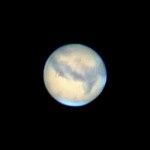
Mars was at opposition two days ago, but not at its closest. Close approach of the two planets is not necessarily on the same day as opposition, but can vary up to two weeks. This year sees the two planets approaching to 99,331,411 km (61,721,554 miles) at 07:01HST. At this distance the red planet will show a disk 13.89″ arc-seconds across in the eyepiece.
All month Mars will be visible throughout the night, high in the sky at midnight. This is the time to enjoy observing our closest neighboring planet while it is nearby and high in the night sky.
Today Mercury reaches maximum elongation, the furthest point it will reach from the Sun in the sky and the highest it will be above the sunset this apparition. The planet is easily visible as a bright, starlike object about 15° above the setting Sun as the sky grows dark. Over the next couple weeks Mercury will slide back into the sunset, heading for inferior conjunction on Mar 21.
Jack Thompson’s house has become something of an island legend. When the rest of the development burned beneath the lava his house was spared. For three decades the lava has repeatedly run past the house. East and west there was nothing but lava fields, around the house lush Puna jungle created an island amongst the devastation.
Jack’s luck has finally run out, madame Pele claiming the last house in the Royal Gardens subdivision.
You can get the whole story, along with a set of photos at Leigh’s Hawai’i Lava Daily blog. Leigh was there for the last hours, photographing the lava, and helping Jack remove a few last belongings when the time came to take the last helicopter out.

W. M. Keck Observatory Position Announcement…
Human Resources Generalist
Under the general supervision of the Human Resources & Administration Manager, the Human Resources Generalist (HRG) provides a wide variety of both complex and routine administrative services. The HRG position is dedicated to providing assistance to departments and employees in the review and processing of transactions related to recruitment, benefits, compensation, absences and resignations. Also assists with various aspects of the HRIS integration and maintenance project as well as other HR related projects.
The observatory operates two of the largest and most scientifically productive optical/infrared telescopes in the world. The twin 10-meter telescopes are located amidst several other world class observatories on the summit of Mauna Kea, at 13,796 feet above sea level on the Big Island of Hawaii, one of the premier sites for astronomy. Our headquarters is located in Waimea, at 2,500 feet above sea level.
Required: Bachelor’s degree and five years of hands-on HR experience in personnel related processes in functional areas including; benefits, classification/compensation, employment and personnel records management. Must possess strong communication skills. Preferred degree in Human Resources Management, Business Administration or Industrial Relations.
This position requires you to submit your resume on-line at: http://keckobservatory.iapplicants.com/ViewJob-279721.html with your cover letter that states why you are uniquely qualified for the position.
Additional information about WMKO and this position may be found on our website at www.keckobservatory.org EEO Employer
Last week I shot a little video of Mars and Saturn in an attempt to get some nice imagery of these planets. Mars is approaching opposition and Saturn is well placed in the sky for observation. It appeared at first as if the seeing was pretty good, but reviewing the video shows that there were issues.
The results? No so good actually. The Mars shot shows no detail beyond the polar cap, the Saturn shot is marginally better, but still nothing I am happy with. The imagery was taken with the Canon 60D in crop movie mode, and the C11 telescope operating at f/10. I spent some time tweaking the collimation, that looked looked fairly good. The video? The resulting material is not so good, I suspect the main cause of the poor results was seeing, some variant of high frequency distortion blurring the fine details.
There may also be some issues with the new version of Registax. Version 6 has some major differences in how it operates, not sure if I am doing everything right. The program may have some bugs as well, I crashed it several times while attempting to process the imagery.

Closest approach of the two planets is not necessarily on the same day as opposition, but can vary up to two weeks. This year closest approach will occur March 5th with the two planets approaching to 99,331,411 km (61,721,554 miles) at 07:01HST. At this distance the red planet will show a disk 13.89″ arc-seconds across in the eyepiece.
All month Mars will be visible throughout the night, high in the sky at midnight. This is the time to enjoy observing our closest neighboring planet while it is nearby and high in the night sky.