The storms seem to have passed, the swell subsided, time for another dive.
While the invitation was extended to all of our usual crew, Pete was the only one to accompany us for the day. A small dive party this time, no problem, the arrangements were a little last minute. Some swell was forecast so we headed to a sheltered spot, End-of-Road, Puako.
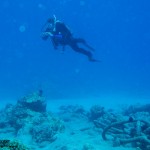
Pete enjoying a dive at End-of-Road, PuakoWith our tanks in for hydrostatic testing it was necessary to rent a pair for the day. No problem, just rent a couple tanks at Kohala Divers for the day. They always have tanks available for walk-in business. Worse yet, we have to return them, and they are just downstairs from Kohala Burger and Taco for an after dive lunch. Inconvenience all the way around.
Conditions at End of Road were fairly good, a bit choppy perhaps, but no current in the cove. Visibility was OK, but not great, a little bit of murk floating in the water from the swell. Having not used the End of Road site lately, we followed the usual plan, cut north out of the cove to drop into the first couple canyons. The goal was a long, relaxed, shallow dive to explore the caves and canyon walls.
I came across nothing new or spectacular on this dive. There were sleeping turtles everywhere in the caves, we found at least a half a dozen. A big moray met me face to face in one crevice. A nice weekend dive, another 80 minutes spent underwater.
The battery compartment on my strobe flooded. When I realized this I quickly surfaced and removed the batteries. At least the compartment is sealed from the remainder of the unit, thus there was little harm. The rechargeable AA NiMH batteries themselves are likely toast, with electrochemically corroded contacts.
Without the strobe I did use a small LED flashlight to illuminate some targets for photography. But the beam was much too narrow and concentrated. Perhaps a small modeling light is in order, something with a bright, but broad beam that can illuminate a target one or two feet in front of the camera. This would be great for cave and night diving, also providing a backup.
Deb and I are off for the week. I had to use up some vacation time, Deb is on spring break from the school. Our tanks have passed hydro and are ready to pick up. I expect another dive in our near future.
Possibly one of the best dive sites in the islands and certainly a favorite with local divers. The reputation stems from two factors, great diving in interesting terrain and easy shore access. The diving here can range from acceptable to spectacular with stunning water clarity and spectacular views of the coral.
View Larger MapGoogle map of the Puakō End-of-Road dive site, click on the markers and the course line for specific information.
Just north of the cove where you will enter, there is a series of deep canyons into the coral. These start near the surface in 6-10ft of water and descend to 25-30 ft. The result of the canyons are a range of vertical coral walls that reach from near the surface to depths of 20-40ft. At the head of several of the canyons are a series of arch caves and skylights to explore. You can just make out this cave on the Google map at right, just into the reef from the marker.
A canyon wall at Puakō End-of-Road dive site with Yellow Tangs (Zebrasoma flavescens) and Raccoon Butterfly Fish (Chaetodon lunula)
In our favorite cave a large arch leads into a wide cavern with a skylight. A second arch leads to a smaller cavern, and so forth until they are too small to enter. Look into the side ledges and caves for squirrelfish and sleeping turtles. Much of the interesting diving is shallow allowing for long dives. If you want to go deeper just swim out further from shore as the reef continues to descend.
Reach this site by driving north from Kona on the Queen Ka’ahumanu Hwy to the Puakō turn off. Drive down the main road through town, mostly just homes along the beach, for about three miles to reach the end of the road. The beach access is on the right about 100yds before the road ends in a locked gate to a private estate. The parking area is easy to spot as it will be busy with other divers and locals enjoying the beach. There is a fair amount of space but this place can get busy later in the day, particularly on a weekend. Park under the trees just a few feet from the water, you should not have to carry your gear very far. The map at the right should give you the right idea.
The entry at End-of-Road, Puakō
Most divers enter from the rocks or use the slot into the rock at the north end of the cove. From here you need to swim to the center of the cove over shallow rock and coral (4-8ft) to go around a shallow bar that juts out from the north shore. Once over the bar bear to the north to find the canyons across coral at 10-15ft. A little swim, but very scenic snorkeling along the way.
Avoid use of the site if there is substantial surf across the bars at the north and south side of the cove. These create a stiff outwards current at the center of the cove that can be difficult to negotiate getting back to shore. Just look for the surfers! If they are happy and surfing nice waves, a diver will not be happy.
End-of-Road is a good dive site to consider if the more exposed sites further north or south are problematic with a large swell. The region from Waikoloa to Kawaihae is some of the most sheltered coastline on the island. We often head here during the winter for shore diving, leaving sites like O’oma or Mahukona for the calmer days.
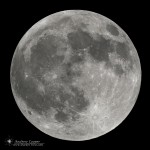
There will be a bright triangle in the sky tonight made up of the Moon, Saturn and Spica. All three will be within 10° of each other. The Moon will dominate the trio at over 87% illumination as it waxes towards full. Saturn will be shining at 0.4 magnitude while Spica is very close to 1.0 magnitude.
A desolate rocky plain, red, cold, dry, a scene from an alien world. In the distance there is movement, a swirling dust devil slowly works its way across the plain.
To truly appreciate such an image takes you to another world, so similar, yet so different from our own. The world is Mars, the scene is real, captured by the HiRISE camera orbiting aboard the Mars Reconnaissance Orbiter. I never get tired of these sort of pictures…
A dust devil crossing the rocky Amazonis Planitia of Mars, image credit NASA/JPL/University of Arizona
This temporary position provides electronics and electrical engineering support to develop new observatory capabilities and for upgrades to our existing observatory infrastructure. This is a challenging fast-paced technical environment where teamwork and good interpersonal communication skills are essential.
Utilizing the Keck 1 Laser Guide Star during the nightThe observatory operates two of the largest and most scientifically productive optical/infrared telescopes in the world. The twin 10-meter telescopes are located amidst several other world class observatories on the summit of Mauna Kea, at 13,796 feet above sea level on the Big Island of Hawaii, one of the premier sites for astronomy. The successful candidate will have the opportunity to join a skilled and deeply committed team of technical professionals who enable exciting and important astronomical discoveries.
Desired competencies include, but are not limited to: understanding of analog and digital electronics, data communications and computer interface electronics, industrial control systems experience including specific PLC competencies. The ideal candidate should be a motivated self-starter who can manage multiple projects and priorities within a fast paced environment.
Qualifications for this position include a Bachelor of Science in Electrical Engineering or equivalent; two years of work experience performing design and documentation, analysis, fabrication, test, and troubleshooting of electronics and electromechanical systems; engineering process and configuration management experience.
Heading north from Kawaihae there is some of the best diving in the islands. Most of the sites along this rugged coast northern are best dived from a boat. You can reach many from shore, but access can be tricky and a matter of knowing which 4WD road will get you to a usable put in point. There are a couple exceptions where access is easy, the best is Mahukona.
What you find here is a small port from the days when sugarcane and cattle were transported on small steamships that plied the waters up and down the Hawaiian Islands. A substantial pier and other facilities were built in a small cove to serve the north end of the island. A railway terminated here, allowing products to be brought in from much of North Kohala. Most of that is gone now, replaced by good roads, semi trucks and the large port at Kawaihae. What is left is a sleepy little cove with perfect water and great diving.
Deborah exploring wreckage from the SS Kauai at MahukonaThe area is a county park used by locals and the few tourists that venture this far north. Camping is allowed by permit and there are some facilities, but maintenance is a little scarce. The large concrete wharf is in decent shape and allows parking right at the water. Do be aware of boat traffic, this is still a harbor. Power boats are unusual here, it is a long way to any boat launch, but we have seen one come into the harbor… once. The usual traffic here are the many kayaks and rowing canoes that use Mahukona as a put-in or pull-out point.
A steel ladder at the top of the wharf provides access right into the water. The access is simply the easiest I have ever used on a shore dive. No sand, no slippery rock, simply a parking lot at the waters edge!
View Larger MapGoogle map of the Mahukona dive site, click on the markers and the course line for specific information.
Once you leave the pier head for the center of the harbor. You will quickly find several heavy mooring chains. Large and obvious these chains are heavily encrusted with coral, simply follow them out to the wreck of the Steamship Kauai. The wreck lies in 12-24 feet of water at the center of the harbor.
The engine and propeller are the largest parts to be found and are a little to the north of the large sandy area at the center of the cove. The propeller is in only about 12-15ft of water, accessible to snorkelers as well as divers. Connected to the propeller by the shaft is the large steam engine. This is less obvious when you first see it, but hard to miss once you know what it is. Closer inspection will show numerous pipes, control linkages and the large flywheel at the rear of the engine. Looking into the engine you can see the crankshaft and the numerous fish that find the engine a perfect hangout. Spend some time here, we have found a dwarf moray, blue dragon nudibranch and great fish at the engine.
Scattered out from the engine is a great deal of other evidence of the wreck. The steamship had a cargo of agricultural products and railroad parts when it sank. You will find quite a few wheel sets for narrow gauge rail car use, one is under the engine, others in the middle of the sandy area just seawards of the engine. Cables, piping and ballast bricks are everywhere. A boiler can be found on the north edge of the sandy area, about 4ft in diameter and 12ft long. Check inside to see who is home.
We found three different species of moray eels here, good fish and healthy coral. Not many large fish, fishing and spear hunting is allowed in the area. The small fish area very numerous with large numbers of fry int the shallows and around the wharf.
Mahukona is just about the perfect shore dive site. Park on the pier, and just drop your gear in the water. Shallow diving unless you head out of the cove, but a lot to see in the harbor, you may never make it any further. This site makes for a long shallow dive exploring a little local history.
The CME from yesterday’s solar flare struck at about 01:00HST, not as strongly as predicted. Right now there is a geomagnetic storm going on, but only at a moderate intensity, Kp=5. It takes something with a Kp>10 before aurora become a likelihood at low latitudes. Expect some nice photos from the folks up north as they get to enjoy the show.
The sunspot responsible for the flare, AR1429, is still there, pointed directly at our Earth. It harbors the energy for more X class flares, stay tuned!
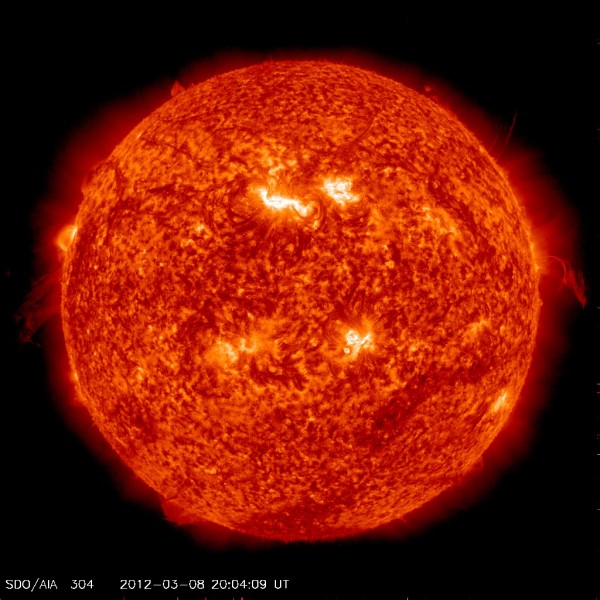
The Sun at 30.4nm (extreme ultraviolet) on 8Mar2012 showing the large sunspot group AR1429 (upper center), image credit NASA/SDO
The planet Uranus as it appears in a mid-sized telescopeThis week we will see Uranus slide into the sunset, lost to the Sun’s glare. The planet will pass through superior conjunction on March 24th, to reappear in the dawn during mid-April.
At 00:28UT March 7th (14:28HST March 6th) our Sun let loose with a X5-class solar flare. This is the largest event in many years, and the impact will be felt here on Earth later today. We can expect a major geomagnetic storm when the mass of charged particles strikes the Earth’s magnetic field sometime around 0625UT (±7hr) on March 8th (2025HST March 7th).
Skywatchers at all latitudes have a chance of seeing aurora.
Yes, this means a chance of seeing aurora here in Hawai’i. I have seen aurora in southerly locations, including Tucson at 32° latitude. It is possible given a strong enough event. Fortunately the tropical storm we have experienced for the last few days appears to be clearing out. I will have to check the northern skies this evening.
The culprit is sunspot group AR1429, an enormous magnetic disturbance on the face of the Sun. An enormous amount of energy stored in the twisted magnetic fields of AR1429 was released when the fields ruptured. The result was a powerful solar flare. This event was recorded by severalspacecraft at a number of wavelengths. The resulting imagery and movies are worth checking out.