One of my favorite moons in the solar system has to be Hyperion. This small icy body is one of those truly weird places.
An oblong shape roughly 360 x 200km (220 x 120miles) the moon is composed of primarily water ice with a small amount of rock in the mix. The moon is thought to be highly porous, a loosely held together rubble pile perhaps. This is indicated by the odd appearance of the many impact craters, looking as if the impacting body is absorbed as much as vaporized. The material of the crater walls then slumping back into the void.
My apologies if you have already seen this video, it is making the rounds. On the other hand it is so totally spectacular I just had to post it.
A series of time lapse sequences taken from the International Space Station. There are cities, seas, lightning storms and aurorae, star and skyglow and more. Hit the Vimeo icon for a better description than I can write. Turn off the room lights, expand to full screen and enjoy…
Winter has arrived on Mauna Kea. the last few weeks have brought regular snow, ice and fog to the summit. Quite a few nights have been completely or partially lost to weather. We always wonder what winter will bring. In the last few years I have seen winters with hardly a lost night, and no substantial snowfall. Other winters I have helped dig our way into the building. What the winter of 2011-2012 will bring? We will just deal with what Poli’ahu delivers.
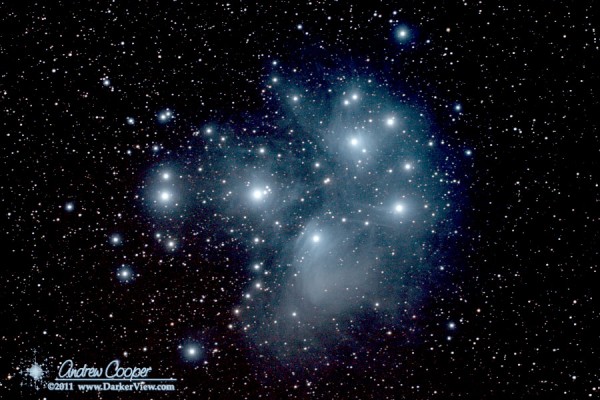
Yes, I have shot the Pleiades many times before. Still, a nice test of the new camera. I was limited to short exposures, 2 minutes in this case, as I was not setup for guiding. I took more frames instead, over thirty exposures of two minutes each for an hour total. After throwing a few out I still had enough to beat down the noise. I expect that with guiding and longer exposures the result would be better, but this wasn’t too bad…
The Pleiades, M45, sum of 27x120s exposures, TV-76mm and Canon 60D
It is interesting to write a piece for a more traditional format. With the added advantage of having a professional do the editing, with feedback. The result is much like the articles I have written for Darker View. Some rehashing of material I have used here, but re-written to provide a more complete story. The photo below is the one chosen by the editor to illustrate the article.
For meteor watchers there is probably no more anticipated show that the annual Leonid Meteor Shower. The Leonids are renowned for reliable showings featuring bright fireballs.
The reputation is not without reason, Leonid events over the last decades have produced spectacular showers. The 2001 Leonids have become legendary, for a few brief hours on the morning of November 17th the shower became a true meteor storm, with rates of more than one thousand meteors an hour visible across the western United States and the Pacific. The sky was constantly peppered with streaks, many dim, but some very bright, every few minutes a fireball would be brilliant enough to light up the landscape. Other observers will mention that the 1998 Leonids produced a impressive number of bright fireballs, making that year particularly memorable.
1833 Leonids, the engraving is by Adolf Vollmy based upon an original painting by the Swiss artist Karl Jauslin, that is in turn based on a first-person account of the 1833 storm by a minister, Joseph Harvey Waggoner on his way from Florida to New Orleans.Nor is the 2001 event unprecedented. This has happened in the past, with Leonid meteor storms occurring several times in the last couple centuries. In 1833 a massive shower woke residents across the eastern United States with a fury that had many thinking that Judgment Day was upon them.
The Leonid meteor storms incited terror and religious revelation, but also stimulated the study of meteor science. It is from studies of these storms that astronomers began to realize that meteor showers were natural, and predicatable phenomena. This led to the realization that the annual meteor showers were associated with comets with orbits that cross the orbit of the Earth.
Just how impressive a show depends on a set of complex factors, meteor prediction is not an exact science, but astronomers are getting steadily better at these predictions. The meteoroids are found in clouds of debris left behind by a comet. In the case of the Leonids this is comet Temple-Tuttle, which has an orbital period of 33 years. All along the orbit of the comet there is a cloud of debris, small bits of dust and sand sized grains of rock-like material. Prediction is a matter of figuring out how this material will move about under the influences of gravity from the various planets and other factors like the pressure of the solar wind and even sunlight.
Unfortunately for meteor watchers, the 2011 Leonid shower is expected to be fairly weak, with ZHR rates around 20. There are some predicted peaks, due to specific regions of debris left behind by the comet several centuries ago, but the average meteor size is predicted to be quite small, leading to to faint meteors. This is further complicated by a bright waning gibbous Moon present during the shower peak. This is probably not a good year for Leonid observing.
A snippet of overheard conversation. I was in Keck 2 control talking with the operator when a few words drifted over the video conference link from Keck 1. Some sort of trouble. I headed for the other end of the building.
Sniffen, our night attendant was looking for the cause of a drive fault. For some reason the computer refused to move the telescope, displaying a drive fault error. It would not move manually either, drive power would not come on. As he explained this to me I was a bit worried. This could be really simple, or really bad. Possibly something that would cost us the night.
The Keck 1 Telescope awaiting lights out and release for the nightOpening the doors to the drive electronics cabinet I began decoding the cryptic status and error LED’s on the interlock control boards. Dozens of unlabeled indicators with a chart pasted to the door, a bit of 1980’s tech we still have to deal with, upgrade scheduled for the year after next. It takes a few moments… Right Final Limit error?
Sniffen and I looked at each other… How had the computer driven into a limit? This was not supposed to be possible. While we occasionally put the scope in a limit during maintenance, I had never heard of this occurring during the night. Was it really in the limit? The computer was indicating we were well clear of the limit. Something was lying to us.
Walking out into the dome and looking up confirmed we actually were on the limit switch. The telescope had driven as far around in azimuth as it could go, stopping just before the hard stop, a massive steel assembly that will definitely stop the telescope.
Oh !#%$! We have to push.
Yes, it is possible to push 300 tons of steel when it is floating on a film of oil. I have never had a chance to do it myself, but years ago someone had shown me how to do it. With Sniffen pressing a pair of pencils into the electrical contactors to release the brakes, I shoved the telescope out of the limit.
It moves surprisingly easy. I had braced my back against the laser enclosure and put my feet against the steel rails used to move the instruments. One good shove and it was moving. I really did not need to brace so well, just a good hard lean against the railings would have done it.
Once you get 300 tons of steel moving, it keeps moving. After I stopped pushing it continued to glide for another few degrees. Low friction creating a clear example of Newton’s first law of motion.
A surreal experience… 2am, in a darkened dome with stars overhead, pushing one of the world’s largest telescopes by hand. Life is interesting sometimes! Twenty six minutes of precious dark lost, but with a quick reinitialization of the telescope we were back on-sky.
We are going to get buzzed Tuesday. A reasonably large asteroid will pass quite close to the Earth, well inside lunar orbit. Asteroid 2005 YU55 will pass 325,000 km (202,000 mi) from the Earth. This is a good sized object, about 400m (1300ft) in diameter, large enough to create significant damage if it were to collide. We do know that the object will safely miss, this time. It is an object to track carefully. Data from this encounter and a future encounter with Venus in 2029 will set YU55 up for another encounter with Earth in 2041. Again we believe it will miss, but it will be close.
Keck 2 will be observing YU55 using adaptive optics and NIRC2 in an attempt to get high resolution imagery of the asteroid. It is quite convenient that this interesting asteroid is passing close to Earth, it will be in easy reach of our best astronomical instrumentation. I suspect I will be spending a little time in Keck 2 remote operations Tuesday night to get a look for myself.
Blog posts just read better when a photo is included. While a psychologist might argue, my guess is that the effect of a photo is due to our visually oriented minds. We simply like photos, the images give an immediate context for the article that is processed before we even complete reading the first sentence.
A 53% illuminated waxing Moon, afocal w/Canon G11, TV-102 & 32mm PlösslThe photo can be anywhere in the posting, to either side, across the bottom, as long as it is visible with the top of the article. It helps if the blog layout is clean, without too much visual clutter from other images or advertisements. Even worse is a background image that distracts from the primary article and images.
The extreme example are blogs that include a photo no matter the subject. One of my favorites is Photo Attorney by lawyer Carolyn Wright. This is a great blog covering the legal aspects of copyright law and the business of photography. Carolyn often includes a photo with every post. And while the post covers some legal aspect of photography the image is usually a dramatic wildlife photo taken by Carolyn. The juxtaposition is sometimes interesting, hawks or lions while talking about courts and plantiffs. There is no denying the effect of the photo, you just want to read the posting.
I make it a practice to include a photo in most postings. Even if it means reusing a photo that has been published before. After a while any blog begins to accumulate quite a collection of photographs. This provides a ready set of “stock” photos which can be used to illustrate any posting.
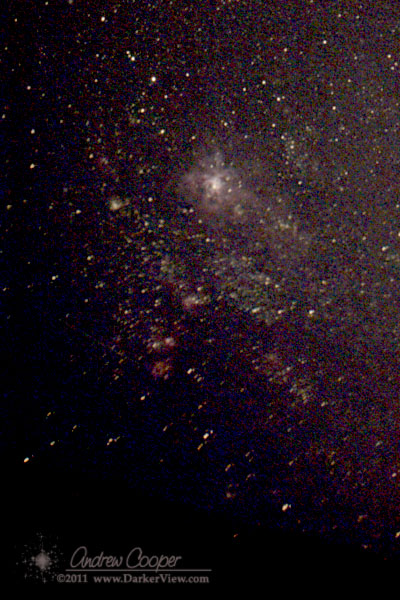
But it does prove one thing, you can see the Large Magellanic Cloud from Mauna Kea… Barely.
The photo was taken from the Mauna Kea VIS parking lot as the LMC rose above the slopes of Mauna Loa. As the object skirted the distant ridge line I shot a dozen frames with the 60D and the TV-76mm scope. The resulting photo is nothing to be proud of, I expected it to be pretty bad when I shot it. It was taken simply to prove the point.