Enjoying the Moonlight
Deb and I did a volunteer evening at the VIS last night. A great night with a great crowd, the sort of evening that defines the reason we continue to volunteer at the Mauna Kea VIS. Lots of great questions, great conversations and a little learning about the sky and Mauna Kea. As the southern cross hung above the slopes of Mauna Loa my green laser was busy pointing out constellations and bright stars.
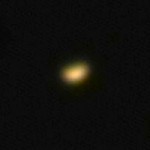
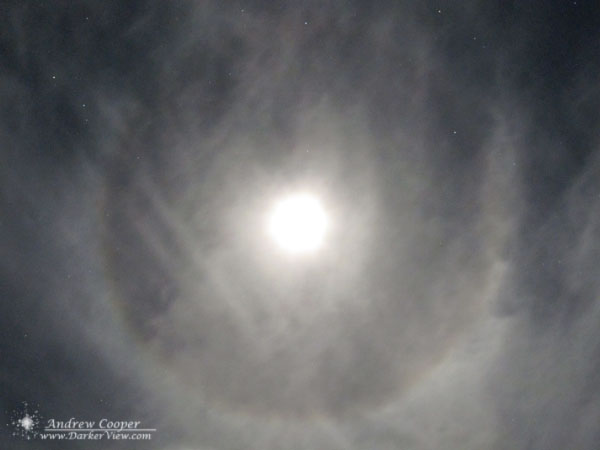
The only real problem with the evening was the nearly full Moon hanging in the sky. The bright moonlight drowning out many of the deep sky objects we would normally view. Even bright objects like M13 were merely dim smudged in the eyepiece in place of the beautiful sights they offer under darker skies. With these conditions much of the telescope viewing was concentrated on the Moon and a beautiful planet Saturn.
One activity that is always a hit with a bright Moon partly makes up for the loss of dark sky viewing. I hold and quick course in introductory lunar photography using the afocal method. Show a few people how to take lunar photos and there is soon a line of people waiting at the refractor for their turn to try a few frames. A few hints and people are quickly taking great lunar shots, a photo and a memory to take home from the mountain.
The evening sped by quickly, spent in conversation with guests from the islands and from across the US. People ask about the sky as seen from different latitudes and locations. A few visitors from other countries add their perspective. It is often interesting to hear about other names for constellations or to learn bits of folklore from many other cultures.
So often the crowd disappears an hour after dark, driven off by the cold and wind. This night many didn’t go until it was time to shut down the telescopes. I guess they were not ready to end an enjoyable evening under moonlight.

Summit Chaos
Tuesday, April 27th was an exercise in chaos.

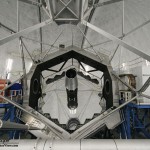
At Hale Pohaku we were met by a film crew. Documentary film crews are an occupational hazard at Keck. I have appeared in more than one show. Not usually a problem, this day the crew would be yet one more complication.
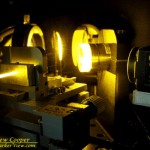
For myself, things started to go bad with an email message, trouble with a key piece of equipment in AO. At the heart of the adaptive optics system is a thin flexible mirror that can change shape to correct the light, the DM or deformable mirror. In order to monitor this mirror a WYKO interferometer is used to image its surface. This device shines laser light at the mirror, the return light is interfered with itself, allowing the surface shape to be analyzed with incredible accuracy. This is used to calibrate the AO system at the beginning of each night. Gone was my plan of a simple day doing some documentation checks to prepare for some upcoming modifications to the system.
Saddle Road Progress
Phase 5 in the rebuilding of Saddle Road is progressing rapidly, this is the totally new section from Mauna Kea State Park to MP42. As we came through the area Thursday morning a constant chain of trucks hauling asphalt was crossing the road. There was a great deal of other activity in evidence but we could not see the paving operation itself, it was somewhere out of sight behind the military barracks.
It appears that the entire segment now has at least some asphalt on it. This was most apparent at the east end. Monday afternoon this was still bare gravel, as of Wednesday the new roadbed was covered with a base layer of asphalt. The wide expanse of smooth pavement quite a contrast to what we had to turn down to continue our journey home.
As we come through the guys all take a moment to see where progress has been made. We all look forward to another seven miles of smooth and safe road.


Rained Out
Well, the Waikoloa Elementary School star party wasn’t much for stars. We did see one star briefly through the clouds. There were four telescopes setup in the schoolyard waiting in hopes that the clouds would clear, but it was not to be. We stood around talking story and examining Cliff’s 24″ telescope. A truss tube dob is a great scope to show how a telescope works, all the inner parts exposed.
We waited an hour, but around 8pm the first hints of rain began. As the drops thickened we scurried to get the telescopes put away.
My thanks to the WHAC members who came out in support of this event! We will be attempting to reschedule the event, possibly for May 22nd.
Minature Garden
Good Old Girl
A very nice musical compilation based on imagery of and from the Mars Rovers, Spirit and Opportunity. The set is put to some very appropriate music by Marian Call. Give it a listen while you consider the wear and tear of five years on Mars…
Hat tip to Phil at Bad Astronomy
Primary Gecko
In the tropical climate of Hawaiʻi small creatures are commonly found among one’s belongings. Spiders, centipedes, scorpions and more are a fact of life and can be found in anything that has not been carefully stored. Telescopes are often housed in the garage, particularly the large dobsonians that are too large to easily be carried into the house.

One can only imagine the poor creature’s predicament. A seemingly nice quiet, warm and dark place now subject to a great deal of motion and upheaval. Then the cover is removed to allow admission of cold mountain air. Hardly the safe refuge expected when the animal crawled into the box.

It was notable that everyone’s reaction was the same. Not the revulsion that finding a cockroach or centipede would have caused in the same situation. A gecko is almost universally liked, the results were laughter and amusement.
Instead of being hunted down and squished, this gecko was carefully caught to be given a ride back down the mountain to the warm tropical climate of Waikoloa. The next day he was released into the new rock wall I am building in the back yard for a vegetable bed. With the voids among the rock, this wall is a perfect gecko habitat.
He’e Mauli
Keck and Kepler Team Up to Find Other Earths
W. M. Keck Observatory press release…
For nearly a decade, Cal-Berkeley astronomer Geoff Marcy and his colleagues have been using the W. M. Keck telescopes to discover giant planets orbiting distant stars. Now, with the successful launch of NASA’s Kepler mission, they will be using Keck I’s ten-meter astronomical eye to discover distant Earths. Kepler will pick out Earth-like candidates. Keck will then zero in on them and determine, with certainty, if they are at all similar to our home planet.
“Keck and NASA have a long-standing partnership to push astronomy research to its fullest potential. This Keck-Kepler collaboration gives that partnership a compelling new scientific focus,” said Taft Armandroff, the Director of Keck Observatory headquartered in Kamuela, HI.

“Kepler does not tell astronomers with certainty if the object taking a bite out of the starlight is a planet or another star. That is where Keck plays a crucial role to the Kepler mission,” said Marcy, a frequent Keck user and Kepler mission co-investigator. He, along with a large international planet-hunting team, has discovered nearly half of the 300-plus known planets outside the Solar System.
Continue reading “Keck and Kepler Team Up to Find Other Earths”