After five years of living on the Big Island we finally took a few days to hop to another island and do some exploring. The selected target was Oahu, a place we have never properly visited before, changing planes at the airport does not count.
First impressions… Oahu can be a nice place to visit, but the traffic is beyond terrible! The roads packed with cars playing by aggressive city rules. Even the North Shore and Windward were bad, not just Honolulu. After years of driving on the Big Island, where there are no interstate freeways and the driving is quite relaxed, it was an unpleasant experience. I managed, and we got around with little real trouble, re-learning the old skills of dealing with heavy city traffic. I am so glad to be back to Hawai’i and out of that traffic.
The Fourth of July is a pretty good day to visit patriotic monuments like the battleship Missouri and the Pacific Aviation Museum. This was the plan and it executed well.
The 16″ guns of the Battleship Missouri in Pearl HarborI had wanted to visit the Missouri for some time, I love museum ships, such tangible remnants of the past. This battleship is simply big, everything about her was big, from the enormous guns to the massive anchors. The exception was the average crewman’s bunks, which were stacked in ranks throughout much of the first deck. There was a tangible sense of history here, the silent guns spoke of the fierce battles of WWII. A simple plaque in the deck marked where that terrible war finally ended.
For the Fourth all of the ships in the harbor were decked out in flags, including the Missouri, the many US Navy and foreign ships gathered for the upcoming RIMPAC exercises. Another treat was the Mississippi Lions All State Band performing pier-side the battleship.
This is not a case of “I wish you were here”, but rather another lesson in the many hazards of diving.
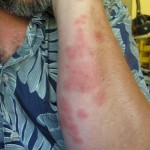
The welts left behind by hydroid stings across a forearm one day after the injury
I know when I got hit, a series of pricks down my left forearm. I didn’t even react, I was concentrating on the photo. I continued to brace myself against the surge by using the rocks of the cave floor. Those rocks were home to some little critters that had an issue with the disturbance I was creating… Hydroids.
Through the rest of the dive my arm continued to sting, discomfort that persisted but was not really all that bad. I took no action other than noting that I had gotten hit. It wasn’t until the next day that I realized that the stings were not going to go away quickly. I had a series of red welts across my forearm, and they itched. Time to break out the hydrocortisone cream. A week later the welts have faded and shrunk to pinpoints, no longer itch, but are still there.
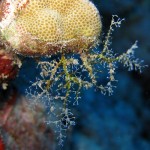
An unidentified hydroid hanging off a lobe coral (Porites lobata) Kohala Coast at about 70ftThe angry red welts did attract comment all week, they were rather noticable. I have had to explain what hydroids are a number of times. These small relatives of jellyfish posses the same defensive armament, stinging cells called nematocysts. As soon as you mention jelly stings the stories come out, most everyone on this tropical island has gotten stung at some point.
Friday evening we stopped into the shop of Kohala Divers for a bit. There were a few folks we know in the shop as they were having an open house. As I chatted with Lina Preskitt, a local marine biologist, I mentioned the stings, showing her my forearm. She raised her forearm to display a very similar set of red welts on her left arm! We laughed as we looked at a mirror of almost identical stings.
This is the second time I have been seriously stung by hydroids. Will it stop me from diving? Not at all. Perhaps be a bit more careful when mucking about on a cave floor.
I have not done much diving south of Kona, usually diving the shores close to home, the reefs of North and South Kohala. I have done a couple dives at Two Step, at Hōnaunau. The terrain is different further south, there are different species to see. Last weekend I got a chance to do some more diving down south.
This was made possible through a friend and fellow Keck engineer. Dennis owns a boat. Not just any boat… The Aqua Safari… A big boat, a fast boat, a dive boat, equipped for scuba, actually a pretty nice boat. I was invited to join the guys for a dive outing. I didn’t even ask where we were going, it really didn’t matter, I just wanted to dive.
Mark Devenot exploring the reef drop-off at TanksWe headed south of Kona to a dive site I had never explored before, a place called Amphitheater. Just around the corner from the famous Kealakekua Bay, the site features some large sea caves carved into the cliffs by the winter waves. An excellent site, featuring good fish, numerous lava tubes, and good coral cover. Visibility was great, allowing good photographic conditions.
A find of the dive was a Bearded Cusk Eel hiding in a crevice at the base of a rock wall. I managed one half-decent photograph before it disappeared further into the crevice, out of sight. I guess it did not like the strobe, cusk eels are notoriously shy.
Mark, Patti and I shared the meal preparations. They had brought sandwich makings, I brought tuna mac, drinks and chips. Deb even sent a long a batch of home-made chocolate chip cookies. We ate well indeed.
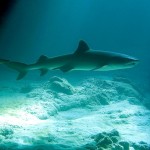
The second dive site was Tanks, a site just north of the old Kona Airport and south of Honokohau. A fair amount of surge made mooring quite a challenge, we actually gave up on one mooring buoy, too close to the rocks where we were getting bounced around. There was quite a bit of surge underneath as well, and visibility was poor. At least poor by Kona standards, fairly good for most anywhere else. The surge and vis did not preclude a decent dive, we descended to the edge of the dropoff, where the slope plunges into the deep blue abyss. A few good photos, including a Undulated Moray. We spent the last part of the dive exploring a number of small caves just under the shoreline, where we found several white tip reef sharks, including one of the largest I had ever seen. This shark was a bit more than six feet, and quite rotund. He lived up to the scientific name for the species Triaenodon obesus.
A great day and a couple good dives. That was the goal, and that was what we achieved. Thanks Dennis!
At the base of a large antler coral, a pair of butterflyfish that really didn’t want to leave, even when a large and noisy diver is sitting just a few feet away. I love these opportunities, any chance to get a closer shot of a fish that usually swims quickly away when approached.
Fourspot Butterflyfish (Chaetodon quadrimaculatus) under a coral head at O'oma
Just another whitemouth moray. But then, I hadn’t seen anything interesting to photograph for a few minutes as I wandered along the reef face. May as well shoot a few frames. Wait? There is a second eel in the cavity! A dwarf moray?
A Dwarf Moray (Gymnothorax Melatremus) and Whitemouth Moray (Gymnothorax meleagris) sharing a cavity in the reef
I didn’t spot it this time either. It was Mark who was pointing at the coral. I looked, looked again… Oh! There is something there. The camouflage these fish utilize is impressive, even from quite close they blend amazingly well with the coral and algae. I wonder how many times I have drifted past one of these fish without seeing it.
As Olivier and I got closer to take a few photos, the fish began to walk away. Yes, I said walk. The fish would walk several feet on its pectoral fins then try to sit still and hide again. A truly weird thing, watching a fish walk across the reef.
Devil Scorpionfish (Scorpaenopsis diabolus) on the reef at O'oma
At the very north end of the Mauna Lani resort complex, just beyond the gates into The Fairmont Orchid is a very nice public access to the coastline. With well maintained facilities, this park attracts local and tourists alike to the water. There are full bathrooms, a fresh water shower, picnic tables and barbecue grills to use amongst a rich lawn and pleasant shade trees. The coast here is a picturesque combination of blue water and black volcanic rock jutting into the sea. The parking is limited to a couple dozen spots just behind the park. The site can be used equally well by divers or experienced snorkelers with a rich coral reef just offshore the beach here.
The entry here is rough cobble and rock, care must be taken to scout a course through the many offshore rocks that complicate swimming to and from the beach. When the seas are calm, there should be little if any trouble getting to and from shore, do not attempt this area if there is any substantial surf to deal with.
View Larger MapGoogle map of Holoholokai Beach park, click on the markers and the course line for specific information.
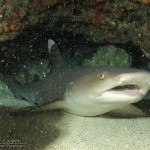
Whitetip Reef Shark (Triaenodon obesus) in a cave at Holoholokai, photo by Deborah Cooper
Reaching the site is fairly easy, following signs to the beach and to the petroglyphs through the Mauna Lani resort. Turn into the Mauna Lani resort from the Queen Ka’ahumanu highway at the obvious grove of tall palms surrounding the entrance. A little over a mile across the lava flows will bring you to a large roundabout (traffic circle in American). Turn on the first exit from the circle, heading north through the condominiums and town homes. A couple miles more will bring you to the entrance to the Fairmont Orchid. Just before the entrance a right turn leads down a paved road to the park.
A Whitetip Reef Shark (Triaenodon obesus) under a ledge at Holoholokai
Once into deep water the snorkeling or diving is as good as anywhere along the Kohala Coast, the same reef divers can enjoy at the Puako sites just north. The depth remains quite shallow until about 50 yards offshore where a series of steps can be found, the first dropping to 15-25ft and another just past this dropping yet further. The vertical walls of these steps are rich in coral and life. The shallow step provides the best place for snorkeling, while divers will quickly head for deeper water. Eels, octopus and other rich marine life are all to be seen here.
There are several very nice caves for divers here. Trending south from the entry area, one will encounter a surge channel in the coral. Two nice caves are found along this small canyon. The better of the two is on the north side where a low entrance at the base of the wall leads to a 40 foot diameter chamber with a large skylight. Sleeping white tip sharks are common in the caves and overhangs here, particularly first thing in the morning.
The parking lot also serves as a trail head for a three-quarter mile walk to the Puako Petroglyphs, a large collection of ancient Hawaiian rock art that is found in photos and guidebooks all across the islands.
Holoholokai makes for a nice beach experience with a pleasant park and good access to the water. Worth considering if looking for a place to get to the water amongst the resorts of the Kohala Coast.