
Mauna Kea Morning Air
When you want to see the stars, find someplace dark


We got lucky. When it happened we were well positioned to view, and photograph the show.

Even better, that night we were moored to a state float rather than simply sitting at anchor, or even worse, docked in a town or city. In Helm Bay, 22 miles north of Ketchikan, we had a beautiful dark sky and a perfect setting to watch the show.
With a float I had a stable platform from which to shoot time lapse video, no rocking or swinging at anchor. I could set up the camera and tripod and let the intervalometer click away for over an hour.
The video is made from 360 separate exposures compiled into a video about 30 seconds long. Each frame was 10 seconds at ISO6400 using a Canon 6D camera and a Rokinon 14mm f/2.8 lens set to f/3.2. The frames are projected at 12 frames per second in the version below.
The ten second frames are still too long, the glowing bands of light move quite quickly, at times rippling across the sky. The result is that the patterns and motion in the aurora is blurred.
The aurora was quite bright, my usual 15 second night sky shots actually overexposing. I dialed back the exposure a bit, and should probably have dialed it back a bit more.
Country and city have always been different world, as long as cities have existed. The language each uses to describe the other captures this… Hillbilly, city-slicker, redneck, yuppie, hick, the tradition of mutual derision is as old as history.

With a bed full of oleander branches piled higher than the cab and the tarp flapping I was off, with some very country, country music playing. There would be a few loads this Saturday before the county closed the scales at four.
One thing about country music, it is very reliable. Heavy on the guitar, simple melodic lines perfect for driving. The themes are often heavily based on nostalgia and a simple world of country values. The station is one I seldom listen to, KKOA out of Hilo, carrying the programming from ABC Radio’s “Today’s Best Country” satellite feed.

I believe I have said it a few times here… I love ruins. And while good ruins are fewer in Hawaii, southeast Alaska has plenty to explore.
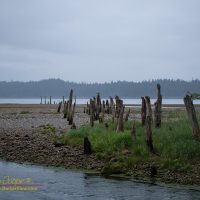
For one reason or another, fate seems to highlight this odd cove every time are in the area. From the first time I noted the unusual name on a chart to the halibut we have routinely caught here. Once when we simply planned to cruise by some odd activity caught my eye, again leading me into this place. Changing course we discovered whales bubble net feeding along the southern cliffs, a sight I will not soon forget.
The odd name is from the Tlingit, Iyukin, and was first recorded in 1869 by G. Davidson, U.S. Coast and Geodetic Survey. This name was accepted and was published in the 1883 edition of the Coast Pilot, to be shown as Iyoukeen on nautical charts ever since.
A sand and gravel beach backs much of the cove, with steep hills behind. An odd, very narrow, rocky peninsula separates the cove from Freshwater Bay to the south. Cruise ships, ferries, and fishing boats pass by taking little heed of this seemingly unremarkable cove.

Mid-morning the awaited news found me… The Hawaii State Supreme Court has upheld the conservation district use permit for the Thirty Meter Telescope on Mauna Kea.

To no one’s surprise, the court took a little longer with this particular case. A case fraught with many questions that are hotly debated in this state.
The news quickly fueled a firestorm of mainstream media articles across the country and social media postings. The pro-telescope communities I participate in were celebrating. Opponents were decrying the decision with responses that range from disbelief to inflammatory.
Mid-afternoon found me atop the Keck 2 dome to check on some instrumentation. From there I had a perfect vantage point to look down upon the TMT site on the north plateau. I stopped to consider what those few acres of rock below had cost so far in terms of time and passion.
When traveling in Alaska I regularly check the weather forecast. Not just the marine forecast, but the space weather forecast.
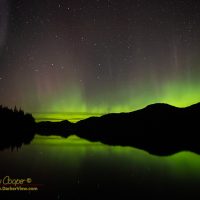
Space weather? Yes, our planet has weather out in space, weather created by streams of charged particles from our star. Sun spots, solar flares, and coronal holes can all cause these emissions to intensify. When these particles impact the magnetic field around the Earth it can create a geomagnetic storm.