Hawaiʻi Volcanoes National Park reopened to the public at the end of September. Reshaped by the eruptions the park has substantially changed since I was last there back in February. It was well past time I got myself out to the park to see the changes, it had been open almost two months!
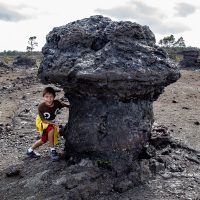
Julian examines a lava mushroom near the 1969 fissure on the Mauna Ulu trailI had resolved to go over the long holiday weekend. An additional idea occurred to me, if I was going, why not kidnap my young nephews along for the trip. We would leave the gals to whatever they will do, and go have an adventure.
This last week we said goodbye to a truly pioneering space telescope. The Kepler mission was designed to find exoplanets, planets that orbit around other stars. The mission succeeded beyond everyone’s expectations.
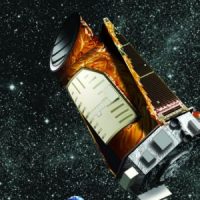
Artist’s rendition of the Kepler Spacecraft in orbit around the Sun peering at a distant solar system, press release image from the NASA Kepler websiteThis little space telescope monitored over 500,000 stars during it’s mission, watching for the minuscule dip in brightness as a panet passed in front of the star. For nine years Kepler stared at those thousands of stars, during that time it discovered over 2,600 exoplanets. Along with the planets came a long list of other discoveries such as binary stars, variable stars, and novae.
After nine productive years this engine of discovery has come to an end. With the spacecraft out of fuel NASA flight engineers sent the last commands, shutting the spacecraft down.
The Keck Observatory and the Kepler Spacecraft had a great partnership. It was not possible to confirm most Kepler’s possible exoplanets using only data from the spacecraft. A large telescope using a high resolution spectrograph, like HIRES on Keck 1, would allow astronomers to not only confirm Kepler’s discovery, but to learn more about each exoplanet.
In the wake of the supreme court decision on the TMT conservation district use permit last month, many like myself have been reading the opinions of the court. I was pleased to see that the justices were very clear in their views, there is very little room for any future legal steps in this case. This decision sets clear precedents for future land use cases that will certainly occur over the same issues.
Aliʻiōlani Hale housing the Hawaiʻi Supreme Court. CC Image by D. Logan/Wikimedia CommonsThe majority opinion is a systematic refutation of each argument made by telescope opponents. This is particularly true in the numerous trivial matters that opponents attempted to inflate into major issues. Issues like Judge Amanoʻs ʻImiloa membership, or the brevity of some responses to the absolute snowstorm of submissions in the contested case.
In addition to the majority opinion you may read the quite interesting concurring opinion by Justice Pollack. He agrees with the majority on the final result, but promotes using existing frameworks to judge land use cases such as this. It is also interesting the dissenting Justice Wilson joins in this concurring opinion, at least for the first three parts.
The dissent written by Associate Justice Michael Wilson was published almost two weeks later than the majority opinion. The reason for this delay is not given, it is possibly a result of Justice Wilson analyzing the majority opinion and responding to it in his dissent.
As is often the case with decisions like this, it is more interesting to read the dissent than the majority opinion. Any flaws or weaknesses in the case can be examined and can be more informative. This case is an exception to that, the dissent is interesting, if for somewhat different reasons.
An ancient megalith here on Hawaiʻi? That would be cool, check this out!
A YouTube video of a supposed ancient megalith in North KohalaThe video I find linked on a local Facebook group shows a rayed structure on the ground a few miles north of Kawaihae, with lines radiating from a central point for a mile or more, an enormous compass that points at destinations near and far from the islands.
It is a striking feature, but it is quite the jump to claim that this is a geoglyph created by an ancient civilization.
The video explains that the feature is 120,000 years old based on the geologic datings of the lava flows on the western slope of the Kohala. Part of this dating is based on a map of the island inscribed around the compass.
I know this area fairly well, even know some of the local ranchers, I find the evidence provided by the video a bit lacking. There are more than a few real archaeological remains in the area, remains of the rich Hawaiian culture that existed in the area before western contact.
As soon as I looked at the Google satellite imagery I had a pretty good idea of what I was looking at. A few moments of research confirmed my suspicions… The pattern on the ground is a paddock system used to control cattle movements in a section of range land. I am a bit disappointed, but not really surprised.
Seymour Narrows is a bit of water one approaches with caution. This narrow passage north of Campbell River provides the shortest route between Vancouver Island and the mainland for transiting vessels. This passage is also subject to dramatic tidal currents of up to fifteen knots.
The strong currents create large areas where the water seems to boil, dotted with whirlpools and debris swept along by the rushing water. The result is what explorer Captain George Vancouver described in his logs as “one of the vilest stretches of water in the world.”
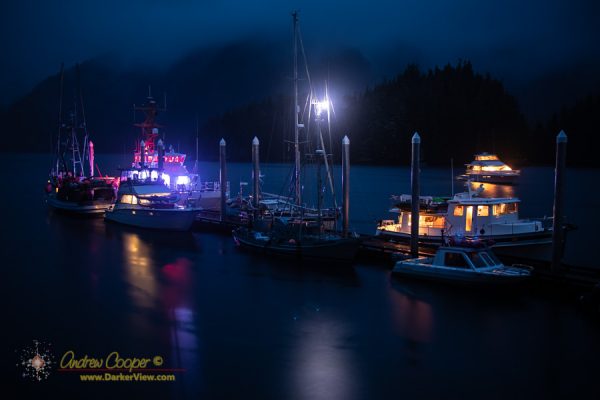
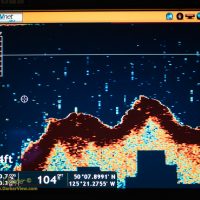
The remains of Ripple Rock well beneath the surface in Seymour NarrowsAs usual we had anchored and waited a couple hours for the tide to change, waiting for the worst of the currents to slack. While small, fast boats can pass by during high current, most vessels wait for the tide here. We were not alone, when we pulled anchor and nosed into the narrows we joined a parade of boats that had waited.
The passage was once much worse, a large rock named Ripple Rock lurked just under the surface at low tide. This mid channel rock created huge standing waves and vicious eddies as the current ran over it.