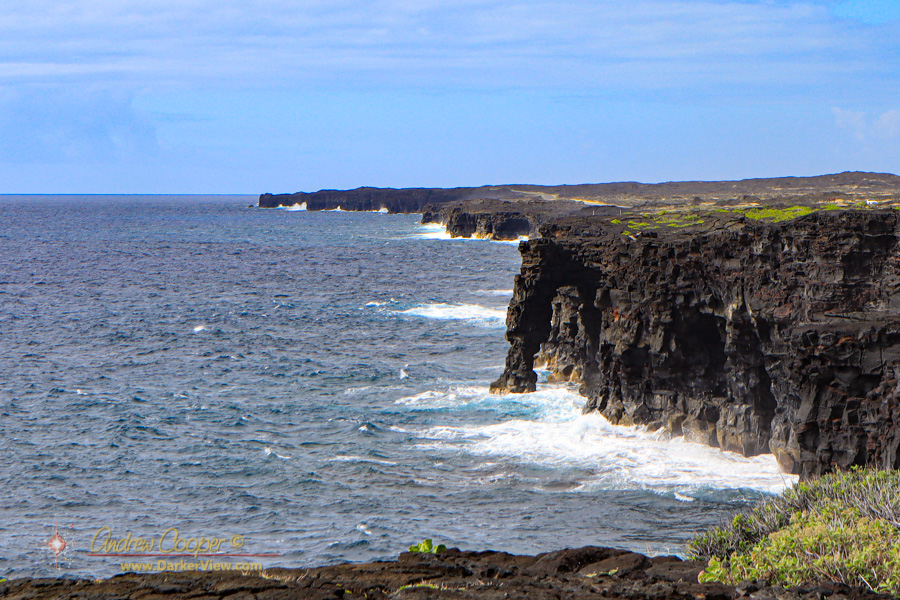
Living with active volcanoes, one gets to see new landforms appear regularly. The landscape can get rearranged with little notice, with places I once visited buried under new rock. In my time living on Hawai’i, I have seen roads, bays and tide pools, and entire neighborhoods disappear under new lava. Watching new land created by these flows of liquid rock is mesmerising.

The opposite is also true around here, sometimes prominent landforms are erased by the actions of flowing water, or the incredible power of wind and wave.
Thus we bid farewell to the Hōlei Sea Arch, cast into the sea by the heavy surf generated by Hurricane Nolo.
The arch was one of the features of Hawaiʻi Volcanoes National Park found along Chain of Craters Road. Featured on park maps and served by a viewpoint and interpretive signs, thousands of tourists have stood atop the cliff to admire what waves had sculpted from the jagged black sea cliffs.
Those same waves have erased what they carved. Sometime around September 27th, the arch fell into the sea. Apparently, no one witnessed its fall, there are no Facebook posts or YouTube videos of falling rock. All we have are before and after photographs. This is understandable as the park was closed during the hurricane.
I last visited the arch over a year ago, travelling the park with my parents. It had been noticeably eroded by the waves, appearing much thinner around the base than on previous visits. It was only a matter of time.