A Darker View

Archive
Astrophotography

Beaches? Tropical gardens? The volcano? Yeah, BTDT, not what I came to Hawaiʻi for. Visiting Mauna Kea is at the top of the list for some folks who visit our island, a priority I can fully understand. Even better? Bring a camera to this spectacular mountain. After six years of working on Mauna Kea I still carry a camera and find new shots. Some of the most fascinating photographic opportunities occur after the Sun has set. For those who pursue shots in the dark, long exposure photography, the summit provides a setting that is worth the effort to shoot.

Keck 1 Laser

The Keck 1 Laser undergoing engineering tests, Subaru telescope in background

The summit is open after dark, but not unconditionally, I need to stress some explanations concerning that. Officially the Mauna Kea Comprehensive Management Plan limits public recreational use to ½hour before dawn and ½hour after dark. This has not been strictly enforced any time in my experience on the mountain. There is no gate in use, you will see people drive up the summit road in the middle of the night.

So what are the real rules for summit access after dark?

Continue reading Staying on the Summit After Dark…

The weather finally broke, leaving a clear western sky and a chance to photograph the comet. I set up and managed just a few shots before the comet set into the top of a tree across the street.

At least I was able to get on-sky. Much more than can be said about our ‘scopes on the mountain. Observing was cancelled earlier this afternoon, there is too much ice on the domes to operate safely. At least the ice was pretty, and photogenic.

Comet C/2011 L4 Pan-STARRS

Comet C/2011 L4 Pan-STARRS over the Hawai’i, AT6RC and Canon 60D

The trade-winds have returned for the evening. And while they are welcome for the comfortable temperatures they bring, the winds are unwelcome for the problems they create at the telescope. I am trying to get in one last exposure sequence for the evening, but the guider graph shows trouble. There are constant errors, not small errors either. The Right Ascension axis seems to be the issue, with errors of +/-3 pixels on the guider. This is just not going to work.

I watch the graph for a while, trying to figure out what I can do. I have had an issue where the guide star was the source of the problem, two stars to close together, a double star I did not notice when selecting my guide star. I stop the guider and select another star… The problem continues.

As I feared, my problem is most likely the wind this evening, a continual issue on this rock I live on. A speck in the middle of a very large ocean, the winds are a fact of life here. I only shoot with small telescopes, less sail area to catch the wind with a short tube. A TeleVue 76mm, an AT6RC, or simply a wide angle camera lens. The smaller scopes provide less loading for the old Losmandy G11 I mount them on.

I decide to try something else, shifting the balance to load the RA gear down. I gently slide the counterweight down the shaft about an inch. There is barely a blip on the guider as I make the adjustment. Better yet the guide error graph settles down! Looks like I will be able to get in a few more exposures before putting the ‘scope away.

Guider Error Graph

The guide error graph showing the effect of shifting a counterweight.

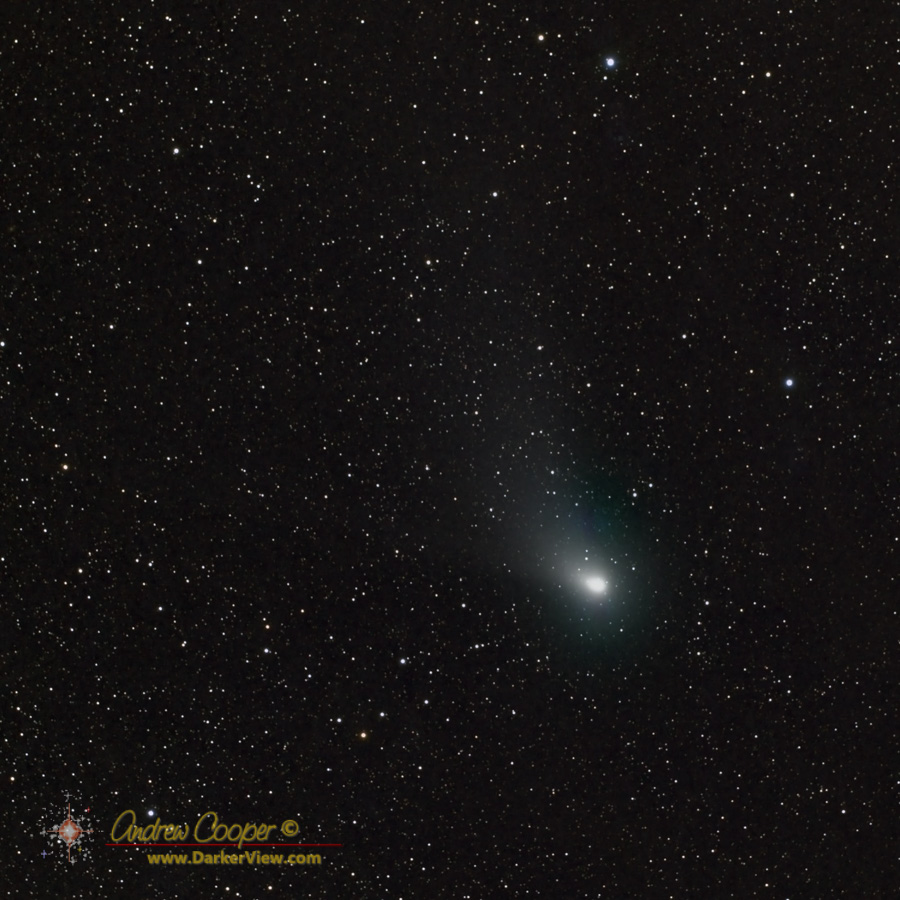
Another product of imaging earlier this week. Comet C/2012 K5 (LINEAR) is fading, but still bright enough to image. Right beside Orion it was well placed to target from my driveway. Just refreshing my comet hunting skills, getting ready for the show over the next few months as C/2011 L4 (PanSTARRS) comes into view.

C/2012 K5 LINEAR

C/2012 K5 LINEAR with AT6RC and Canon 20Da, stack of 18x6min

A photo taken from my driveway of NGC1365 and supernova 2012fr. It is a bright supernova in a classic barred spiral galaxy. I had observed NGC1365 in mid-October with the 18″, noting the beautiful spiral structure. The supernova appeared about two weeks later. I have since observed it in a couple telescopes, including Cliff’s 24″.

The nova seems to be fading now, it peaked around 12th magnitude in November. Currently about 14.5 magnitude, but still easy with the AT6RC and Canon 20Da camera.

NGC1365 and SN2012fr

The barred spiral galaxy NGC1365 and SN2012fr

Quarter Moon

A 53% illuminated waxing Moon, afocal w/Canon G11, TV-102 & 32mm Plössl

G-11 Control Panel

The control panel for a Losmandy G-11 telescope mount

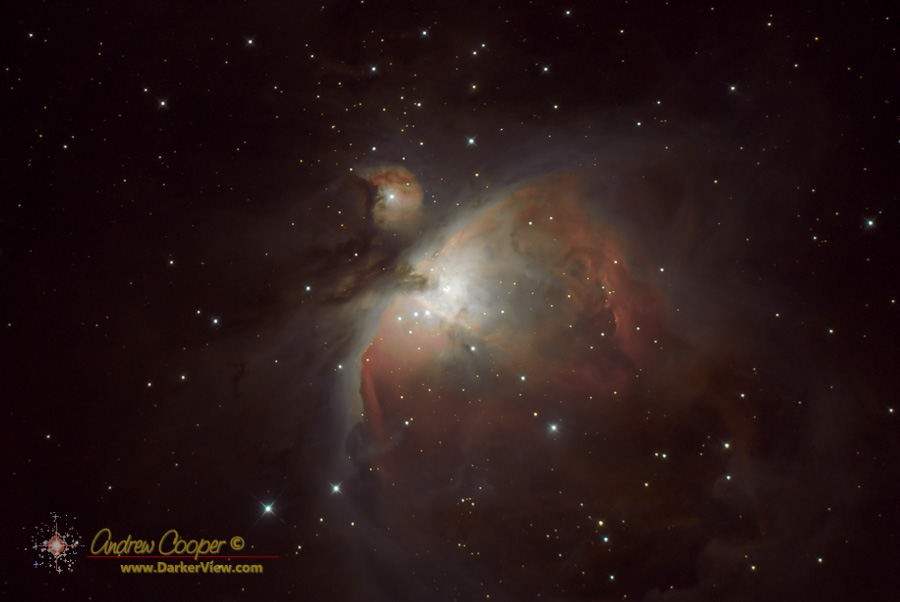
The first astrophoto taken with the EOS-M. Considering the trouble it is to manually trigger the exposures without proper camera control, I am surprised I stuck it out to take 40+ subs. Since 30 seconds was the longest I could program the camera for I simply maxed out the ISO and took a lot of subs plus a dozen darks. There is still way too much noise in the resulting frame. Still, the ISO 12,800 frames are not all that bad, better than I expected. If this camera had remote control it would be a decent little astro camera. Longer subs and a lower ISO would deliver decent results.

NGC1976 The Orion Nebula

The Orion Nebula with and EOS-M, 40x30s exposures @ ISO12,800, AT6RC and 0.8x focal reducer, a set of 12x4s exposures used to reveal detail in the core.

In the few days I had the camera I was determined to acquire some astrophotography test shots with the EOS-M camera. Even if it meant getting up at 3am to have some dark sky after moonset. It would have been easier a few days before, but a Pacific storm system had provided several days of overcast with occasional rain. This particular morning was just about perfect, clear skies, decent seeing and no wind to bounce the telescope around.

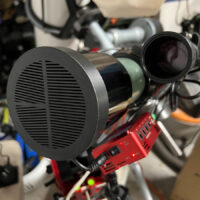
Astrophoto Setup with the EOS-M

Astrophoto setup with AT6RC, SBIG STi autoguider and the EOS-M camera

For testing I used the same setup I often use with my Canon 20Da or 60D. An Astro-Tech 6″ (150mm) Ritchey–Chrétien telescope riding atop a Losmandy G11 mount. A 0.8x focal reducer has T-thread at the rear allowing a Canon EOS lens adapter. To attach the EOS-M I used the Canon M Mount to EOS Mount adapter. An SBIG STi autoguider completes the setup.

The result is an f/7 optical system with 1080mm focal length. This gives a field of view of about 72×48 arc-minutes (1.2 x 0.8 degrees) on the sky when using a camera with an APS-C sensor.

Continue reading Astrophotography with the EOS-M…

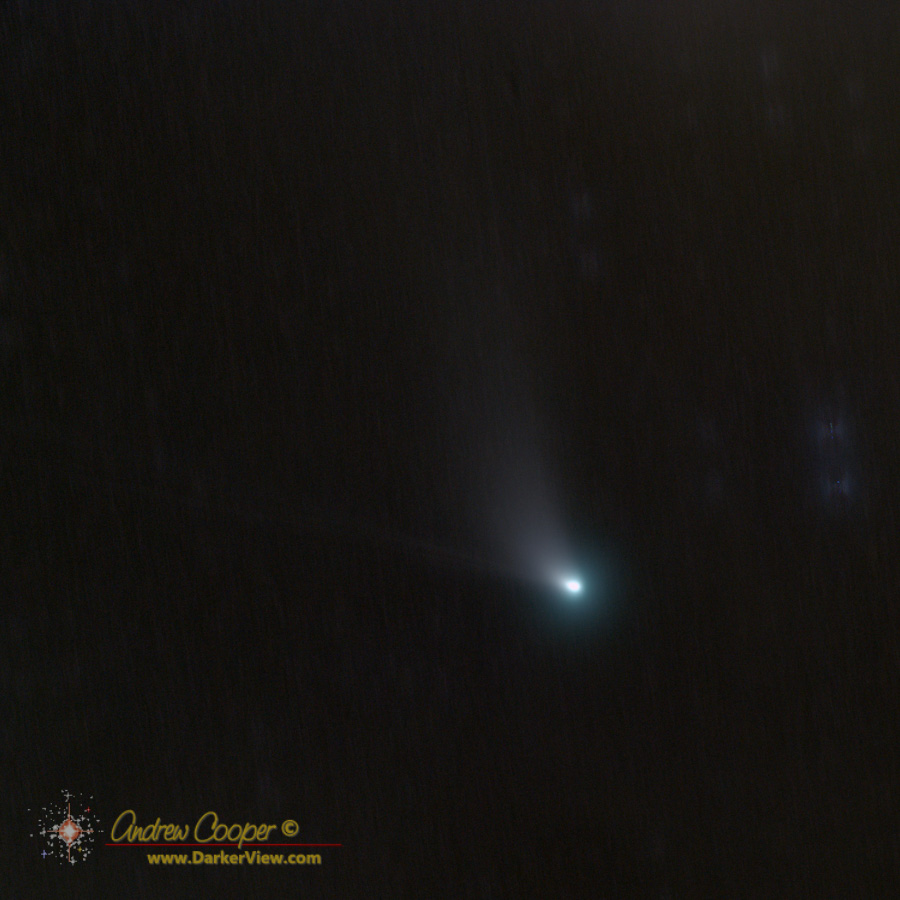
While Comet 168P Hergenrother may be a bit of a mouthful, it is the proper designation for an interesting comet. Discovered in 1998, the comet is one of dozens that orbit in the inner solar system. Normally inconspicuous objects, these comets orbit quietly, objects that only astronomers love, or even know about. You would normally have needed a substantial telescope to see 168P, shining very dimly at magnitude 15.5 at it’s brightest. A community of amateur astronomers keeps tabs on these comets, occasionally photographing them, updating the orbits.

As the comet approached perihelion during the beginning of October, it became apparent that something had happened. Several observers were reporting that the comet had brightened. Suddenly the comet was far brighter, eventually reaching near 8th magnitude, over 500 times brighter than expected. We have seen this sort of thing before, a cometary breakup. Observations from several large telescopes, including Gemini North here on Mauna Kea, showed that the comet has split into at least four pieces.

When a breakup occurs it exposes a great deal of fresh material and debris, dramatically adding to the supply of dust and gas in the coma and creating a far brighter object. It is not the comet itself we see, that is fairly small. It is the coma and tail, the cloud of dust and gas that reflects the sunlight and gives a comet the synonymous appearance.

Comet 168P Hergenrother currently sports a small fan shaped tail, easily visible in the telescope. We enjoyed this classic comet shape in the telescopes last new moon at the Mauna Kea VIS. Setting up a telescope and CCD camera last night allowed me to photograph the comet, appearing much the same as it did a few weeks ago.

Comet 168P Hergenrother

Comet 168P Hergenrother taken with a 28cm SCT and a CoolSNAP ES2 CCD camera at f/10, sum of 12x30s exposures binned 4×4