A dark moon weekend? I had not been out in a while, time for some dark skies with a telescope. This night had been scheduled for a while, the folks I work with keep asking me about getting a look through one of my big ‘scopes. Thus this night had been set aside on a calendar normally used for staff meetings and investor conference calls.
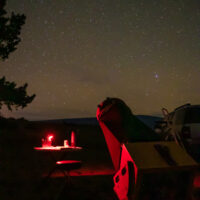
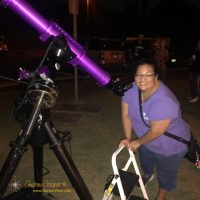
Deep Violet setup under the not so dark Mauna Kea skies of Kaʻohe
Where? Kaʻohe of course, the best place for this on the west side, easy range for my friends coming up from Kona.
Everone arrived on schedule at sunset, car pooling up from Kona. Greeted by a spectacular sky, a slim crescent Moon seeting into the golden glow of Hualalai, the bright planets Venus and Jupiter appearing in the gloaming.
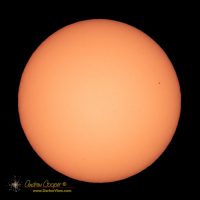
It was a clear predawn sky that greeted Waimea this morning, perfect to watch the transit of Mercury across the Sun.
The transit of Mercury on the morning of Nov 11, 2019
An alarm set for o-dark-thirty and a drive to Waimea with the first glow of dawn behind the mauna. I did not have to pack a ‘scope as I would be using an observatory outreach telescope, just make sure I have camera gear ready.
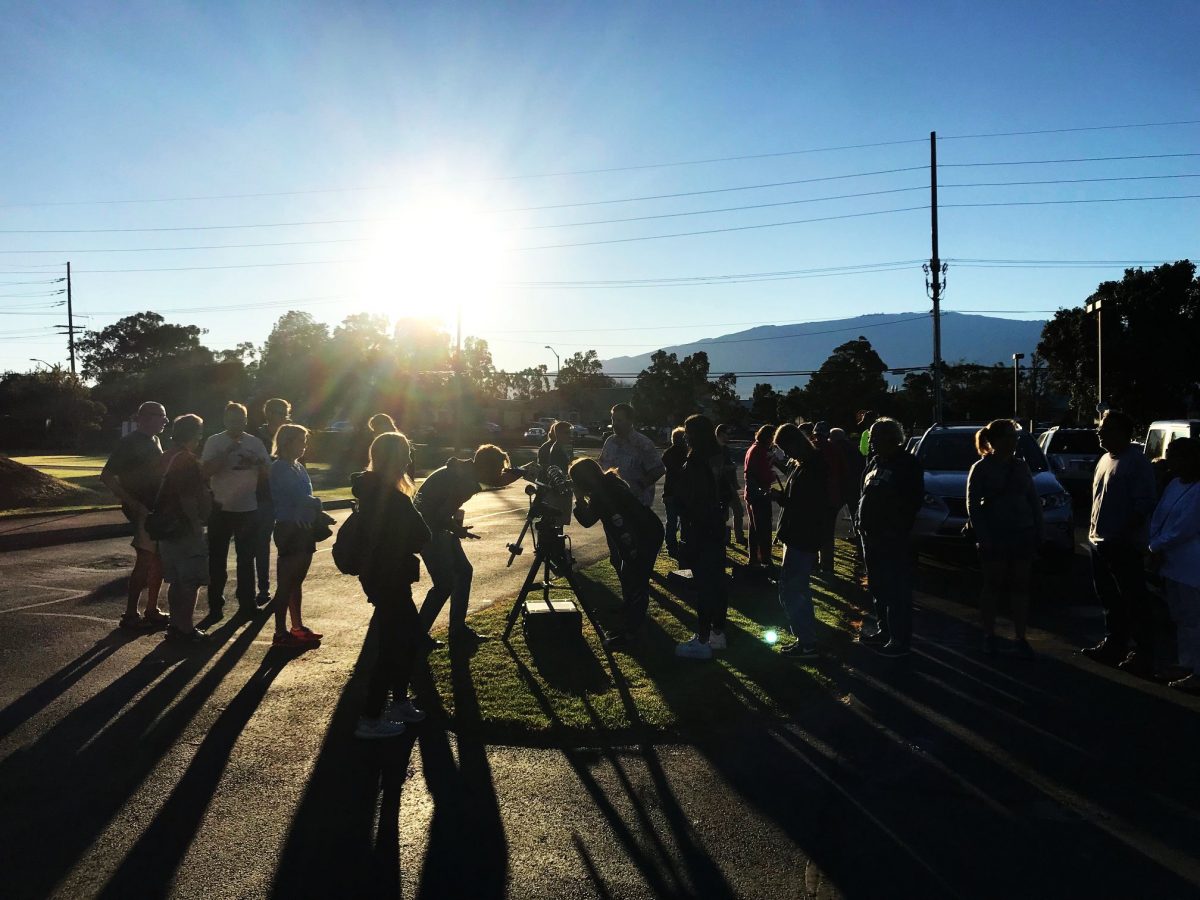
Realistically I was expecting only a few folks in addition to the club members I knew were coming. A light crowd maybe? Thus I was rather surprised to find the parking lot filling quickly and our big conference room buzzing at 6am.
It was quite the crowd considering the Sun had not yet appeared over the shoulder of the mauna!
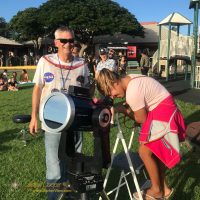
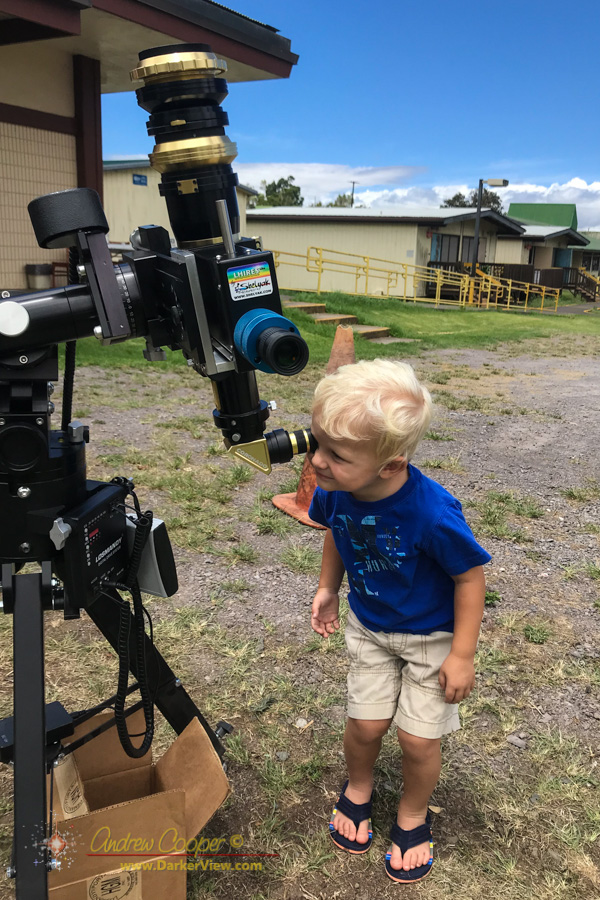
Scott showing folks the Sun with a white light solar filter
Since Mercury is quite small you will want a bit of magnification to view the event properly. If you do not have a good solar filter for your telescope come to a local event where telescopes are available.
On Hawaiʻi island you can either go to the W. M. Keck Observatory HQ in Waimea or Subaru Observatory HQ in Hilo. Both observatories are hosting transit events at dawn Monday morning 11 Nov, 2019.
These events start at 6am with webcasts of the transit from other observatories further east, with the Sun rising far enough to see the transit from 7-8am.
It was more of an event than I expected, and a much larger crowd. There were two bands, multiple food trucks and stands, performances by a dojo and a hālau, and of course a bunch of telescopes provided by Keck and the West Hawaii Astronomy Club.
Scott showing folks the Sun with a white light solar filter
Maggie , the school librarian had contacted Keck to see if we could provide a speaker and a few telescopes for viewing. Given the telescopes part the request got passed along to me to get the club’s assistance with the telescopes side.
As usual the club members volunteered quickly, no problem getting enough people and telescopes into place to do the event. As long as the weather held over Waikoloa this would be a good event.
I do enjoy doing school star parties, one of the best parts about running our little astronomy club is arranging these events.
Students of Mauna Loa School enjoy views of the Moon during a camp-out at Spencer Beach Park.
The school in this case is Mauna Loa School, a Hilo charter school. This did not entail a two hour drive to Hilo as they came to our side of the island. Much of the student body was camping out at Spencer Beach Park after a day spent visiting nearby sites including Anna’s Ranch.
The school had reserved the entire camping area of the park, along with the large pavilion. About 40 students, staff, and parents. We arrived to a small tent city and the smells of Mexican beans being prepared for dinner.
Invited for dinner we had burritos with the students while the sun set over the ocean. A classic Hawaiian evening with the beach and palm trees, a gentle sea breeze and a glowing sunset.
Early in the evening we were troubled by clouds, with nice views of the Moon through the gaps every few minutes. As usual for this coast the clouds slowly dissipated as daytime heat faded leaving a mostly clear sky towards the end.
The timing was perfect, with a crescent Moon, Jupiter, and Saturn all high and available for viewing. Four telescopes were available for viewing keeping lines a bit shorter at the ‘scopes, with many eager eyes.
As usual when viewing Saturn somebody jokingly accuses me of faking the image… A slide, a sticker, that has has to be fake. Yet there is was, encircled with those beautiful rings, the large moon Titan just above the planet.
Our deadline was 9pm, when the gate above the park would be locked. I gave everyone a 20 minute warning to break down and head out. After a few last looks at Saturn and profuse thanks from the students and staff we just made it, park security locking the gate behind us.
While much of the island focused on events taking place on the slopes of Mauna Kea, we had a better plan for Monday evening… Take some activities, and a couple telescopes out to a local library and share the sky with anyone who came.
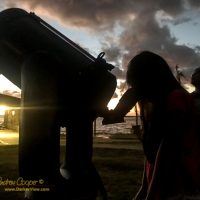
Shelly enjoying a view of Jupiter through the PPT
We planned to bring a presentation and activities to the Kohala library. While the gals presented inside we had a couple telescopes setup outside the front door for anyone to enjoy. Thus is was a team of four… Shelly, Kelleen, Scott, and myself that arrived at the library about 5pm.
The drive over the Kohala on the mountain road is often pretty in the late afternoon. This day was no exception, the afternoon lighting the rolling green hills, Haleakala on Maui looming directly ahead of me as I drove.
I do worry about setting up a star party in Kohala as the weather is notoriously fickle and heavy rain squalls can sweep off the ocean very quickly. I was greeted by nearly clear skies, a pleasant surprise that bode well for the evening.
It is odd working at a place that everyone wants to visit. To be expected working at the world’s best observatory, after a dozen years the novelty of the situation has never grown old.
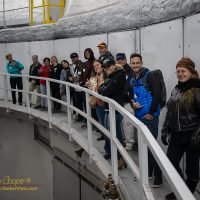
A Kama‘āina Observatory Experience Tour group visiting Keck 2I enjoy leading a tour through the building. Doing a tour gives me a chance to vicariously see the facility through my audience’s eyes, seeing this special place afresh, to renew the fascination and wonder.
I think I am a fairly good tour guide, everyone says so, they might be right. Certainly after a decade of tours I have heard most of the questions and have ready and well rehearsed answers.
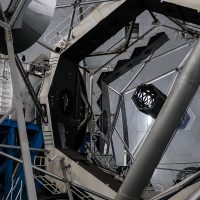
Looking at the primary mirror of the Keck 1 telescopeInside tours of Keck Observatory are currently only available two ways… Know someone who works at the observatory, or take one of the monthly Kama‘āina Observatory Experience tours offered through ‘Imiloa and supported by all of the Mauna Kea observatories.
The KOE tour is free, but open to Hawaii residents only, you have to have a Hawaii ID to go. Each month the tours visit two observatories, rotating through the various observatories on the summit. The tours are also immensely popular, filling up very quickly.
This coming Saturday the KOE tours will visit the James Clerk Maxwell Telescope and the W. M. Keck Observatory. If you are on one of the morning tours, yes, I will be there, leading a tour through our facility.
Light pollution, a subject near and dear to any sky-gazers heart. It seems we are always struggling to educate our fellow citizens that more is not better, it can be far worse, particularly when it comes to the subject of artificial light. We are at odds with the child inside all of us that delights in the creation of light, a magic that never seems to lose its charm.
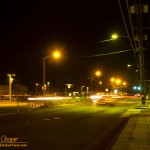
Downtown Waimea with new LED streetlights and old LPSUnfortunately artificial light has a price, and it can be steep, a hidden cost that many do not see. Light at night consumes a lot of energy, megawatts that are simply wasted illuminating places where no one sees it. Or worse, mega watts that are shone into the sky where it has no benefit at all.
Artificial light harms many species that live near our cities and towns, birds, sea-turtles, and more lured to their doom by the lights. The light also harm us, disturbing circadian rhythms and other natural cycles necessary for good health.
Light pollution also obscures the stars, drowning out the universe that would otherwise shine brightly overhead. Besides being a subject we should all care about, the night skies have a real economic impact here in Hawaii, a state largely dependent on a healthy environment and the tourists that come to enjoy that environment.