A Star Party for WHEA

They got lucky.

Cliff Livermore
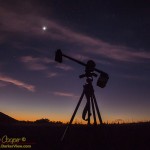
Cliff setup and ready for viewers at WHEA.
I often caution folks scheduling star parties in Kona that the afternoon and evening clouds will often spoil the attempt. The large Hualalai volcano is the culprit here. In the afternoon the clouds form in the lee of the mountain and give Kona the afternoon showers that nourish the rich rainforest found on the upper slopes.

We try anyway.

WHEA, or West Hawaii Explorations Academy is a charter school located in the NELHA complex just north of Kona and just south of the airport. They concentrate on science, mostly marine science, with an outdoor hands-on curricula. Large pavilions serve as additional classrooms. The campus is littered with evidence of various projects, from large pools, various gardens, and a phalanx of handmade cargo pallet catapults in the back.

Maureen Salmi
Maureen using her big dob at WHEA.
The school was having an overnight camp-out on campus, providing a large crowd of students wanting a look through a telescope.

There were some clouds to hamper us, but nothing that would obscure the view for more than a minute or two. A nearly full moon, just a few days shy of this week’s eclipse, was beautiful in the telescope. We also had Saturn, still available in the evening sky at the head of Scorpio. As the evening passed so did the clouds, thinning to a few wisps across the sky.

Maureen was there with her big dob. Chris and Doris with the C-14, Brad with his twin refractor that shows the Moon beautifully. Cliff set up the C-11 giving us five telescopes in all, plenty of eyepieces to supply visions to waiting eyes. I need to spend a little time working on our NextStar GPS 11″, the motor control issue is back, I was running in manual mode much of the evening.

We gazed at the terrain of the Moon and I showed kids, and a few teachers, how to take photos with a cell phone through the eyepiece. A good school star party and a well spent Friday evening. Even if it did take half an hour for the security guard to arrive to open the gate and let us leave. There were also too many chocolate chip cookies available.
Full Moon

Full Moon
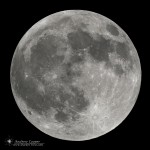
Full Moon taken 27Aug2007, 90mm f/12 APO and Canon 20Da
Full Moon will occur today at 16:50HST.

This full moon is a perigee full Moon, with the moment of lunar perigee occurring at 15:46, about an hour away from full moon. This full Moon will be a bit larger and a bit brighter than an average full moon.

Along with perigee, a total lunar eclipse will occur with this full Moon. Observers on either side of the Atlantic, including western Europe and the eastern seaboard of North America will be able to see the entire eclipse. Observers in Hawaii will only be able to see the last moments of the penumbral eclipse, not significant and not visually observable.

Continue reading “Full Moon”

The Definitive Pluto Image

The NASA New Horizons team has released a gorgeous full disk image of Pluto. I would predict that this high resolution image will be the definitive image of Pluto for at least a century. Expect to see this image any time you run across Pluto in any media, from Wikipedia to school textbooks.

Panning across the image one can see that Pluto does feature a fair number of impact craters, more than I noted on the earlier images that often concentrated on the ice fields of the Sputnik Planum. This ice cap is startlingly smooth, with flow features visible, primarily at the margins. The ice is probably nitrogen ice as water is essentially a rock at these temperatures. Indeed much of the bedrock visible across the image is probably water ice.

The ice sheet is made up of polygons, a feature sometimes seen in ice here on Earth. For some reason the boundaries of the polygons are marked with long linear double depressions. These depressions look like 4WD roads across a desert of sand, if the vehicles had tires a mile across.

On the right side of the ice fields of Sputnik Planum there are a a large number of aeolian features, huge ridges one would suppose are aligned with the prevailing winds. Given that the image resolution is 0.8 miles per pixel these features must be miles high. These have recently been dubbed snakeskin terrain. I expect the planetary scientists will have a bit of fun trying to figure these out.

It is a beautiful image, conveying a great sense of what this dwarf planet is really like. Download the high resolution image and just wander. The larger image is bigger than WordPress will allow, use the link above to get the full size image.

NASA’s New Horizons spacecraft captured this high-resolution enhanced color view of Pluto on July 14, 2015.
NASA’s New Horizons spacecraft captured this high-resolution enhanced color view of Pluto on July 14, 2015. Credit: NASA/JHUAPL/SwRI

Autumnal Equinox

Fall equinox occurs today at 22:20HST. Today there will be little difference between the length of the night compared to number of daylight hours. This is the first day of fall as marked by many cultures in the northern hemisphere.

This year many calendars will mark September 23rd as the beginning of fall, and so it is for much of the world. Here in Hawaiʻi the equinox actually occurs on the 22nd when considering the time zone differences.

2015 Solstices and Equinoxes
  UT HST
Perihelion Jan 4 08:59UT Jan 3 22:59HST
Vernal Equinox Mar 20 22:45UT Mar 20 12:45HST
Summer Solstice Jun 21 16:38UT Jun 21 06:38HST
Apehelion Jul 6 12:59UT Jul 6 02:59HST
Autumnal Equinox Sep 23 08:20UT Sep 22 22:20HST
Winter Solstice Dec 22 04:48UT Dec 21 18:48HST
 
Source: NASA Sky Calendar


The Icy Plains of Pluto

As the New Horizons data trickles back to Earth we are being treated to ever better images of this distant dwarf planet. Soaring mountains, glaciers of nitrogen ice flowing into ice caps that cover huge areas, a hazy and layered atmosphere, Pluto has turned out to be a surprise to just about every one. Those who expected an ancient cratered terrain have been presented with a surprisingly dynamic world.

Click on the image for more information, click again for the big version to really appreciate…

New Horizons Pluto
Pluto’s Majestic Mountains, Frozen Plains and Foggy Hazes: Just 15 minutes after its closest approach to Pluto on July 14, 2015. Credits: NASA/JHUAPL/SwRI

Makaʻiki – A 6-inch Travel Telescope

A six-inch f/5 telescope designed to allow maximum portability. A simple travel telescope that can go anywhere, small enough to fit in an airline carry-on bag while leaving room for clothing. Large enough to provide good views of celestial targets.

First Light for Makaʻiki
Makaʻiki under the stars for the first time at Hale Pōhaku on the side of Mauna Kea

I call the design Travel6, for obvious reasons. The actual telescope I have dubbed Makaʻiki, or simply “little eye” in Hawaiian. While 6″ may seem big to some, by the standards of amateur telescopes it is quite small. By the standards of the telescopes I work on it is downright miniscule.

Still, a 6″ telescope is quite capable in the right hands, able to give pleasing views of many celestial objects. The design is an RFT, or rich field telescope. A low power, wide angle eyepiece will result in a field rich in stars.

Like all good telescopes the design is based on ideas borrowed from other telescopes I have seen. In this case the basic design is from a very similar telescope by Brett Schaerer he named WikiKea, a telescope I had a chance to examine at Oregon Star Party a couple years ago. He incorporated a clever focus mechanism into that ‘scope that got my attention. This is a design I liked, I would have to build one for myself sometime.

Travel6 Telescope Plans

Of course I had no plans for the ‘scope, just a couple photos. The first task was to draw up a complete set of plans, only then would I be able to understand all of the design issues. I have posted the full mechanical plans for the telescope at the link above. These plans should be enough for anyone with a little workshop savvy to duplicate the telescope.

The design shown could be notably simplified if one chose to do so. I have enough parts left over to build a second scope, and may consider a refined design the second time through based on the lessons of the first pass.

Continue reading “Makaʻiki – A 6-inch Travel Telescope”

Life on the Island is Interesting

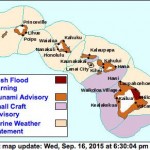
Hawaiian advisories for 16Sep2015
Active advisories for Sep 16, 2015. Tsunami, flash flooding or stormy seas, take your pick.
This is getting downright ridiculous. Over the last few weeks we have had multiple flash floods, a few hurricanes wander by, and a tsunami come ashore. Admittedly none of the hurricanes have come directly in, missing the island. The tsunami was only about a meter and no damage has been reported. The flooding has caused some property damage and a lot of cleanup has been required. Aliʻi drive is a mess again as are several other roadways. An interesting summer.

As if hurricanes, earthquakes, flash floods and tsunami are not enough, the USGS just raised the alert level for Mauna Loa to advisory/yellow.

Here we go… Yet Again

It is not a hurricane watch, but rather a tsunami watch that is currently in effect for the island. This afternoon’s 8.3 magnitude earthquake in Chile may have generated a tsunami that may arrive around 3am tomorrow morning. The early data from stations along the Chilean coast report a tsunami has indeed occurred of between ½m and 3m in height. Oh the fun of living in paradise…

Update: Tsunami watch downgraded to an advisory, minor effects expected.

Continue reading “Here we go… Yet Again”