
No Wind
When you want to see the stars, find someplace dark



Another Sunday hike. This one requires no drive to reach the trailhead, I put on my boots and swung the pack over my shoulder at the front door. This time I would head north out of the village to the Lalamilo Wind Farm.

I have hiked out this way before, but have not gone nearly as far out from the village. The hike is along old ranch roads through the pasture land that surrounds Waikoloa Village.
The grassy hills that surround Waikoloa may look inviting from a distance. It is when you actually attempt to hike here that the true nature of the area becomes apparent. These are old aʻa lava flows, studded with loose rock and clinker, difficult to see in the thick grass threatening to trip you, roll an ankle, or scrape your chins. You quickly learn to stay on the old ranch roads and jeep trails, which form a web across the landscape.
The cool morning air makes for a pleasant walk through the low hills. Goats are everywhere, bleating kids echo across the landscape, billy’s keep watch on you from boulders perched above the trail.
The facilities and detritus of cattle ranching are scattered across the area. Here an abandoned watering trough, another filled with water and operational. A wrecked and abandoned IH semi tractor sits in a corral rusting back into the earth.

It is not until you get close that you realize just how big the windmills are, they loom over than landscape. The five Vestas V47/660 turbines stand 55m (180ft) high and have blades 47m (over 150ft) long.
With no wind the blades are still and feathered. I take advantage of this to fly the drone around and get some nice photos before finding a bit of shade. I take a break to eat and drink before starting the walk back to the house. I figure the walk put 7.4 miles behind me, just a nice morning stroll.
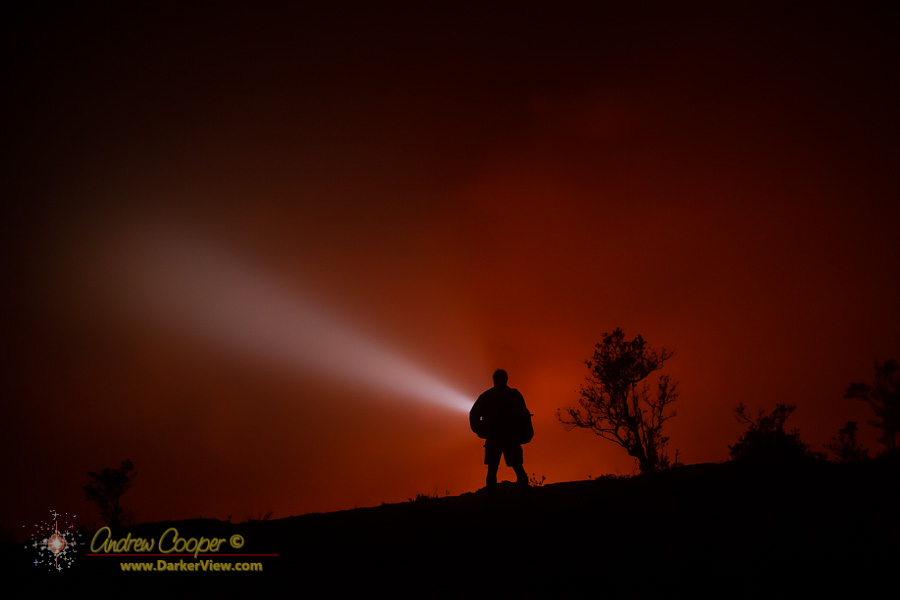

A tale of two lava lakes, of a landscape altered in way so dramatic it is hard to comprehend.
We think of solid rock being the ultimate in permanency, something about the world that should never change, at least in the span of a few months. Geologic change takes thousands of years, not less than one, it just seems wrong when this rule is violated.
Places we once stood, or parked a car, a hiking trail across a plain of solid rock… All gone in a dramatic upheaval. A parking lot the lies upon a block of rock the size of a supertanker, sitting hundreds of feet below where I once parked the car. Change is the reality of an active volcano.

I have seen change on this scale once before when Mt. St. Helens removed a mountain top that stood upon the horizon of childhood memory. Here at Kilauea the change was a bit slower, but no less dramatic.
I look across that caldera and note the places that are the same, the places that are gone. I may understand what has happened and how, but still some parts of my mind insist that this just cannot be true… Solid rock should not disappear or crumble like a cookie.
The return of lava to the crater seems like a return of normalcy. There was lava here for years, there should be lava here. Perhaps the lava will cover over that yawning pit that should not be. Fill the yawning chasm that affronts my senses so.
Perhaps, if the crater continues to fill, flooded to the rim with new lava, a new caldera floor will form, the cycle complete. Perhaps it may be possible to once again walk across the floor of Kilauea Caldera.
