Another weekend, another puʻu… So last week I climbed the wrong puʻu. This weekend I climbed the right puʻu.
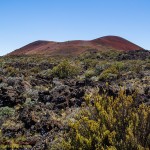
Puʻu Kole as seen from upslope across the aʻa lava fieldThe goal was to explore a pretty landmark I had looked at from the summit road so many times, Puʻu Kole. In the late afternoon light this cinder cone becomes a brilliant shade of red, a striking feature in an already impressive view.
Reaching this hill one travels a couple miles down the R-1 road, the Ka Aliali Trail. A couple of miles of 4WD road to bounce over. The road is not that bad, but I would recommend a true 4WD vehicle. DLNR requires a 4WD vehicle based on the signs, not that everyone reads the signage at the start of the road.
Unlike last weekend there was no heavy fog to obscure the landscape as I reached the area. My goal was obvious… the big red puʻu just downslope from the road. There is a short secondary road, signed R-2 that leads into the area between the two hills. After about a quarter mile this road fades at the edge of an aʻa flow. After parking I got out and sat on a rock outcropping for a while with a snack. The area is just pretty, the jagged black lava and native plants. I finished a bag of chips, downed a water bottle and simply enjoyed the view.
Puʻu Kole is notably harder to ascend than Puʻu Palaolelo. I suspected I was on the wrong puʻu last weekend when it was too easy, reaching the top after a quick stroll in the fog. Puʻu Kole is nearly twice as high, as least when approaching from the upslope side.
The original plan had been to hike Puʻu Kole, a dramatically red cinder cone visible from the summit access road. The red coloration leads to the name, Kole, which translates as red.
What actually happened is that I climbed the wrong puʻu.
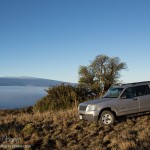
The vehicle parked on the side of Mauna Kea with a snow covered Mauna Loa in the backgroundPuʻu is Hawaiian for hill and is generally used to refer to the many cinder cones that dot the landscape of this volcanic island. As prominent landmarks these hills are used to describe the land, and can be found as references in the old land surveys. Every prominent puʻu has a name. The summit of Puʻu Kole is used to define the modern Hamakua and Hilo district boundaries.
As I traversed the R1 4WD road the side of Mauna Kea was enveloped in heavy fog, thick enough that you could not see a hundred yards, sometimes less. I was pretty sure I was in the vicinity of the target, and sure enough the shadow of a large puʻu was visible in the mist. So I parked the vehicle and climbed it.
It was when I reached the top and looked downhill that I noted there was another puʻu hiding in the fog. It was then I realized that I might just be on the wrong hill. Checking the maps I realized that I had climbed Puʻu Palaolelo.
Wrong? Perhaps this is the wrong word, there was no particular reason I needed to be on the right puʻu other than my desire to explore a place I had seen so often while ascending or descending the summit road. The error was fortuitous in that my original target hill was enveloped in thick fog all morning, while Puʻu Palaolelo, a little higher on the mountain, was alternately in the fog and in the sunlight.
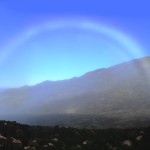
A beautiful fogbow, a glory and the spectre of the brocken on Puʻu PalaoleloIt was this play of fog and sunlight that led to the most dramatic experience of the day. When I neared the summit a beautiful fogbow appeared. Even better, when the angle of the sunlight and the steep slope of the puʻu allowed a glory and even a spectre of the broken appeared in the fog.
Standing atop the puʻu I could not miss the beauty of the morning. Still early the low sunlight was rich in color. Across the saddle you could see Mauna Loa, capped in vivid white, quite a contrast to her black lava flows. A chill wind swept fog over the summit, at times I was spattered with droplets. As the fog and light played across the landscape my camera memory card quickly filled. It was a satisfying hike, resulting in some pretty photos. My original goal of climbing Puʻu Kole lies unfulfilled, an excuse for another walk on the mountain.
Another experiment in growing tropical fruit… Deb had sprouted a pineapple using the top to one she had bought at the farmers market. With roots showing she asked me to set up a more appropriate home for the plant. That came in the form of a large pot on our front lanai. I was surprised when the pineapple not only survived but thrived. the plant is an attractive pot plant just outside our front door. I have shared some photos of the geckos and anoles that call the plant home.
Then the first signs of blooming appeared… In place of a new leaf a little spiky ball appeared at the center of the plant. This has developed into a very nice looking fruit, a recognizable pineapple covered with little purple blossoms. It is another tropical fruit I never imagined myself growing, one of the interesting things about living in Hawaii.
It has been raining all day in Waikoloa, a few tenths in the rain gauge as I left the house for work. In Waimea it is even worse, cool and damp, enough so that everyone is complaining about the cold. But then, island folks complain about anything under 80°.
Raindrops cover the leaves of the money treeThe weather was great for my mother’s visit two weeks ago. She was able to get some sun and beach before returning to the Northwest. Good thing she did not come this last week, nothing but grey skies and rain for the island. The storm is expected to last a few more days.
No progress on the lanai project this weekend, far too wet to paint. The trees in our landscape will like this rain, a steady soaking rain. Likewise the weeds will probably be doing all too well. I can turn off the watering system for a while. This morning’s shower was a tad cooler than I like, need to remember to turn on the electric backup in the solar hot water heater this evening.
My mother is on island, escaping the cold and grey of Portland for a week. An excuse to visit the Hawaii Tropical Botanical Garden… Again.
A white ginger (Alpinia purpurata) at Hawaii Tropical Botanical GardenI have visited the gardens several times across our years on the island. The garden is a beautifully maintained array of tropical plants collected from across the globe. Set in the lush jungle of the Hamakua coast above the pretty Onomea Bay the gardens are always a treat to visit.
Onomea Falls at the Hawaii Tropical Botanical GardenI admit plants are pretty, but the dizzying array of botanical specimens leaves me just a bit overwhelmed. Yes, it is yet another pretty orchid. I love to study the local plants and animals, but this collection from all over the world lacks much organization, having little focus. No matter, my main interest in visiting is to have fun with a camera and take advantage of the many photographic opportunities of these beautiful gardens.
Of course, being a tropical rain-forest it rained for our visit. I have never actually managed to visit the gardens when it was not raining. Still, the soft light of heavy overcast and the drops of water on leaves and flowers are just another photographic opportunity.
As my mother and Deb wandered around talking plants, I wandered nearby with a tripod and an umbrella borrowed from the entry station. I did come up with a few pretty photos. Not a bad day for a stroll on the garden.
It was not until much later that I realized what we had stumbled upon. One of those interesting places that makes Hawaiʻi special. One of those places that is now gone forever. It was a few years ago now, just travelling around the island with my sister-in-law, on island to visit for a week…
Nene’s aloha shirts on display in the shopWandering up the street ahead of the gals I saw it. A shop full of fabric is a problem, the bright colors would attract my wife like a bee to flowers. The little shops along main street of Honokaʻa all had colorful window displays designed to attract tourists. I expected there would be delays as the gals wandered in and out of the shops, just to be expected. Among these Nene’s Sewing Corner was definitely a problem. I casually blocked the door as my wife strolled up.
She, of course, realized what I was doing. Despite her attraction to the bolts of cloth, we were hungry and it took little to convince her to move on in the direction of food. Our stop in Honokaʻa was for lunch, not fabric shopping.
On the way back to the car we again wandered past the little shops, this time there was nothing to do but give in to the inevitable and go in.
You do not need to visit some remote Serengeti plain to see wildlife being wild. Our front lanai can be quite wild on occasion. In this case a pair of male carolina anoles having a territorial tiff. It was quite fun to watch, in the presence of another male they can puff themselves up to twice the size and deploy a bright red dewlap.
Carolina anoles (Anolis carolinensis) in the midst of a territorial threat display.
I have a growing collection of wreck photographs, to which I added another this week. What is it about the local roads that causes this?
A overturned car resulting from a single vehicle accident on Waikoloa Road 12Feb2015Many of the wreck photos in my collection came from the old saddle road. That road was truly dangerous, I did not even photograph every wreck I encountered. Not so much anymore, the rebuilt road is much safer. there are still wrecks, just not nearly as often. It is usually tired or drunk drivers running through the guardrail at the end of the road. That has happened four times now.
The latest wreck on Waikoloa Road seems to have been a single vehicle affair, encountered while returning from work. Best guess is that the driver put a couple wheels on the gravel shoulder for some reason, from there they lost control and flipped the vehicle. There was gravel all over the road just above the accident site.
Aside from the old Saddle Road, island roads are just not that bad. In comparison to the winding country roads I grew up on these should be much safer. Yet the accident count seems much higher in proportion to the cars on the road. It is also not that unusual to witness some really bad driving.
Checking the data shows Hawaiʻi is not the worst state. The traffic fatality rate is right in the middle for the states, about 1.01 deaths per 100 million miles driven for 2013. Data for Hawaiʻi County would be interesting to compare, a different situation than the other islands with our more rural nature. Hawaii is noted to have the largest proportion of single vehicle wrecks in the same set of data.
This morning there is news of three more fatalities, a fiery crash down in Kona that closed the Queen Kaʻahumanu Highway all morning. A reminder to be careful on the local roads.