
[dmalbum path=”/wp-content/uploads/dm-albums/Kohala Diving/”/]
Category: Hawai’i
Exploring the islands
End-of-Road Puakō
Possibly one of the best dive sites in the islands and certainly a favorite with local divers. The reputation stems from two factors, great diving in interesting terrain and easy shore access. The diving here can range from acceptable to spectacular with stunning water clarity and spectacular views of the coral.
View Larger Map
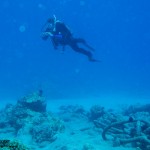
Just north of the cove where you will enter, there is a series of deep canyons into the coral. These start near the surface in 6-10ft of water and descend to 25-30 ft. The result of the canyons are a range of vertical coral walls that reach from near the surface to depths of 20-40ft. At the head of several of the canyons are a series of arch caves and skylights to explore. You can just make out this cave on the Google map at right, just into the reef from the marker.
 A canyon wall at Puakō End-of-Road dive site with Yellow Tangs (Zebrasoma flavescens) and Raccoon Butterfly Fish (Chaetodon lunula)
In our favorite cave a large arch leads into a wide cavern with a skylight. A second arch leads to a smaller cavern, and so forth until they are too small to enter. Look into the side ledges and caves for squirrelfish and sleeping turtles. Much of the interesting diving is shallow allowing for long dives. If you want to go deeper just swim out further from shore as the reef continues to descend.
Reach this site by driving north from Kona on the Queen Ka’ahumanu Hwy to the Puakō turn off. Drive down the main road through town, mostly just homes along the beach, for about three miles to reach the end of the road. The beach access is on the right about 100yds before the road ends in a locked gate to a private estate. The parking area is easy to spot as it will be busy with other divers and locals enjoying the beach. There is a fair amount of space but this place can get busy later in the day, particularly on a weekend. Park under the trees just a few feet from the water, you should not have to carry your gear very far. The map at the right should give you the right idea.

The entry at End-of-Road, Puakō
Most divers enter from the rocks or use the slot into the rock at the north end of the cove. From here you need to swim to the center of the cove over shallow rock and coral (4-8ft) to go around a shallow bar that juts out from the north shore. Once over the bar bear to the north to find the canyons across coral at 10-15ft. A little swim, but very scenic snorkeling along the way.
Avoid use of the site if there is substantial surf across the bars at the north and south side of the cove. These create a stiff outwards current at the center of the cove that can be difficult to negotiate getting back to shore. Just look for the surfers! If they are happy and surfing nice waves, a diver will not be happy.
End-of-Road is a good dive site to consider if the more exposed sites further north or south are problematic with a large swell. The region from Waikoloa to Kawaihae is some of the most sheltered coastline on the island. We often head here during the winter for shore diving, leaving sites like O’oma or Mahukona for the calmer days.
Mahukona Harbor
Heading north from Kawaihae there is some of the best diving in the islands. Most of the sites along this rugged coast northern are best dived from a boat. You can reach many from shore, but access can be tricky and a matter of knowing which 4WD road will get you to a usable put in point. There are a couple exceptions where access is easy, the best is Mahukona.
What you find here is a small port from the days when sugarcane and cattle were transported on small steamships that plied the waters up and down the Hawaiian Islands. A substantial pier and other facilities were built in a small cove to serve the north end of the island. A railway terminated here, allowing products to be brought in from much of North Kohala. Most of that is gone now, replaced by good roads, semi trucks and the large port at Kawaihae. What is left is a sleepy little cove with perfect water and great diving.
A steel ladder at the top of the wharf provides access right into the water. The access is simply the easiest I have ever used on a shore dive. No sand, no slippery rock, simply a parking lot at the waters edge!
View Larger Map
Once you leave the pier head for the center of the harbor. You will quickly find several heavy mooring chains. Large and obvious these chains are heavily encrusted with coral, simply follow them out to the wreck of the Steamship Kauai. The wreck lies in 12-24 feet of water at the center of the harbor.
The engine and propeller are the largest parts to be found and are a little to the north of the large sandy area at the center of the cove. The propeller is in only about 12-15ft of water, accessible to snorkelers as well as divers. Connected to the propeller by the shaft is the large steam engine. This is less obvious when you first see it, but hard to miss once you know what it is. Closer inspection will show numerous pipes, control linkages and the large flywheel at the rear of the engine. Looking into the engine you can see the crankshaft and the numerous fish that find the engine a perfect hangout. Spend some time here, we have found a dwarf moray, blue dragon nudibranch and great fish at the engine.
Scattered out from the engine is a great deal of other evidence of the wreck. The steamship had a cargo of agricultural products and railroad parts when it sank. You will find quite a few wheel sets for narrow gauge rail car use, one is under the engine, others in the middle of the sandy area just seawards of the engine. Cables, piping and ballast bricks are everywhere. A boiler can be found on the north edge of the sandy area, about 4ft in diameter and 12ft long. Check inside to see who is home.
We found three different species of moray eels here, good fish and healthy coral. Not many large fish, fishing and spear hunting is allowed in the area. The small fish area very numerous with large numbers of fry int the shallows and around the wharf.
Mahukona is just about the perfect shore dive site. Park on the pier, and just drop your gear in the water. Shallow diving unless you head out of the cove, but a lot to see in the harbor, you may never make it any further. This site makes for a long shallow dive exploring a little local history.
Heron

End of an Island Legend
Jack Thompson’s house has become something of an island legend. When the rest of the development burned beneath the lava his house was spared. For three decades the lava has repeatedly run past the house. East and west there was nothing but lava fields, around the house lush Puna jungle created an island amongst the devastation.
Jack’s luck has finally run out, madame Pele claiming the last house in the Royal Gardens subdivision.
You can get the whole story, along with a set of photos at Leigh’s Hawai’i Lava Daily blog. Leigh was there for the last hours, photographing the lava, and helping Jack remove a few last belongings when the time came to take the last helicopter out.

Kohala Dive Operations
Most of the Kona side dive operations operate out of Honokohau Harbor, giving access to dive sites from Kailua Bay to well north of the airport. These are the operations most divers visiting the Big Island are familiar with. The diving is good around Honokohau, but can be limited, island divers know that the character of the reef is different as you move north or south.
Experienced divers will often recommend diving the Puako and North Kohala reefs. Here the shoreline is notably older, where the volcanoes have not sent lava flows into the sea for many thousands of years. The reefs have had much longer to establish themselves, resulting in heavier coral growth and rich sea life.
If you want to try the sites further north, along the Kohala Coast, you need to choose another outfit to dive with. Two local dive ops operate along the Kohala coast, Blue Wilderness and Kohala Divers. Both outfits are small businesses, locally owned and operated, the owners often on the boat with you.
Kohala Diving Guide
My March project is to move all of the dive guide articles over from the old blog. Most of them are already moved over, scheduled to post through this month. Copied and pasted over from the old blog, I have gone through them and updated the posts with current information. The series of blog articles provides a nice guide to anyone exploring the Kohala coast with the plan of getting in the water to snorkel and dive.
Postcard from Hawai’i – Beach Day
It was a beach day today…

1940 Mauna Loa Eruption Film
Vintage film of Mauna Loa eruption during 1940 by Harold T. Stearns, a USGS Hydrologist-Volcanologist.
An eruption of Mauna Loa is something everyone fears and hopes for. This enormous volcano will erupt again, almost certainly within our lifetimes, possibly even the next decade. The last eruption was in 1984, the mountain has been quiet for well over two decades now, an uncharacteristically long period of quiescence. When it does erupt this volcano is capable of emitting huge volumes of lava, that reach the sea quite quickly down the steep slopes A dangerous mountain to be wary of.
Damon posted this some time ago, definitely worth re-posting here.
Keck in Motion Scene Guide
I have been getting a few questions about the video. To answer a few of them I have compiled a guide to the scenes. Some quick explanations to what you are seeing, information on the camera used as well as the exposure information.
The video is a combination of two techniques. Many scenes were filmed as standard video then accelerated during editing to allow the motion to become clear. Examples of this are scenes of telescopes slewing and the interferometer delay lines moving.
Slower subjects, such as clouds or the stars moving across the sky, were photographed as time lapse. Here a large number of still images were taken. These are then processed and converted to video using Photoshop CS5 before loading into the video editing software, Adobe Premiere Elements. To construct the time lapse sequences sometimes required thousands of separate images, quickly filling memory cards and exhausting batteries. After dark it is long exposure time lapse that is used, with individual exposures often 15 seconds to one minute long.