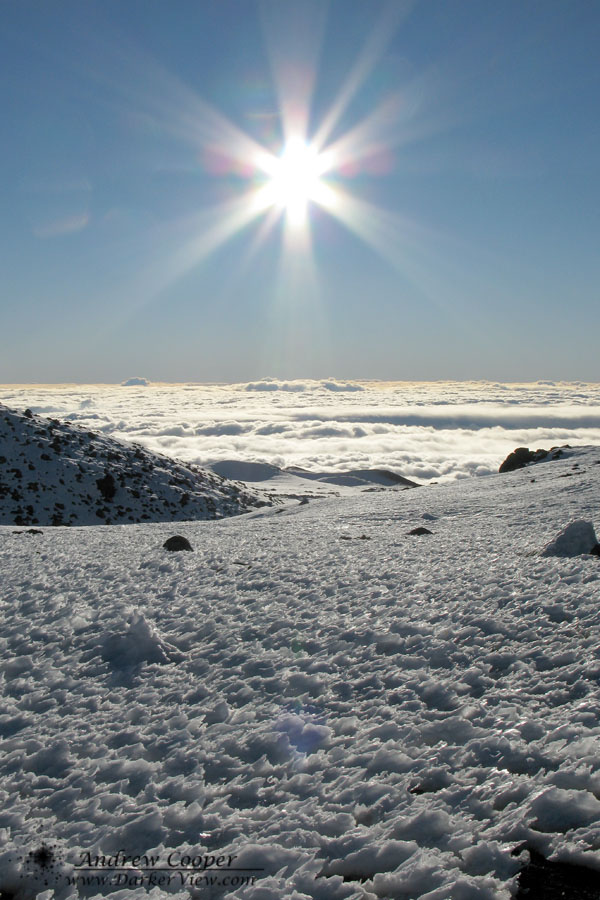
Watching sunrise from the summit of Mauna Kea is often the highlight of many visitor’s trip to the island. Any given morning will see a handful of tour vans and rental Jeeps atop the summit ridge awaiting the first glint of sunlight. A small crowd of camera wielding tourists mill about, gazing at the spectacle or huddle in vehicles to avoid the bitter wind.
I do occasionally stop to watch myself. While the telescope operators head for breakfast down below. I stop and join the crowd for a few minutes. Sometimes you just have to take a moment and enjoy the privilege of working in a place like Mauna Kea.
Click on the image for a better appreciation of what it is like to be there… Without the wind.
Sunrise seen from the summit of Mauna Kea, panorama assembled from ten separate frames.
Despite millions of dollars spent repaving, or outright rebuilding this road, some of the old Saddle still exists. While the road is vastly better than is has ever been, no amount of rebuilding can completely eliminate the hazards of dense fog, wild animals, and the other conditions that make this road unique.
This particular curve seems to claim at least one car each year. I have seen three other wrecks here, including at least two other vehicles upside down within feet of where this Toyota rests. And those are only the ones I have seen, not counting the number of times the fence has been crushed amongst a litter of vehicle parts. At least this time the injuries were mostly inflicted on the vehicle, the police officer I spoke with indicated that the passengers were quite lucky.
I have a fair collection of wreck photos taken along the commute up and down the mountain. A reminder to take the roads of Mauna Kea seriously.
A vehicle rolled into a pasture along Saddle Road near Kilohana
The ancient lava flows of South Kohala hold messages from the past. The old Hawaiians often carved petroglyphs into the smooth pāhoehoe along the shoreline. Laboriously pecked into the dark rock are images of men, turtles, canoes and more. Memories from a lost time, messages left by those who lived here so long ago.
Many of the images seem to be similar to modern grafitti, an attempt to make a mark that will be seen by others, maybe to record some memorable deed. Or perhaps simply to leave a mark that will outlive the artist, the hope of immortality carved in stone.
Petroglyphs along the beach at ‘Anaeho’omalu BayIf that was the goal, it worked.
Today, a century or two later, modern visitors can look down and wonder about those who carved the pictures. Did the man with an oar overhead complete some particular feat? Did he win the race against a rival? Complete a first voyage to an island over the horizon and return to boast of the journey?
I am actually rather surprised it had not happened to me before. Given the number of times I have dodged animals along Saddle Road. Pigs, sheep, mongoose, feral cats, francolins, quail… I had hit a turkey a few years back, but this was my first encounter with a larger animal.
I really prefer to avoid killing, but luck was not with me or the poor mouflon sheep this time.
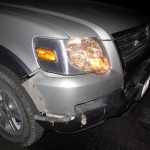
It came into the headlights from the side at a full run, I had no real chance of avoiding the collision. Fortunately it did not hit square on, as it was a fairly big ram. It struck a glancing blow under the passenger side headlight, with a dull thud I can still remember vividly.
Damage on the front quarter of a Ford Explorer due to a Mouflon SheepThe results were pretty ugly, bits of sheep across the road, blood and guts sprayed down the side of the vehicle. What was left of the unfortunate ram was left wrapped around a fencepost, thrown well clear of the collision. Yes, I have a photo. No, I am not posting it here. It is rather gory.
I did have one bit of luck, there was no critical damage, allowing me to continue on to headquarters in the middle of the night. I was a bit concerned when I found fluid leaking from under the vehicle, but it didn’t look yellow enough to be antifreeze. Further inspection showed it to be wiper fluid, the reservoir is just above the wheel and had taken a hit. In my flashlight beam it was slowly draining onto the road.
I inspected the tire, the brake line and everything else in the impact zone before continuing my journey. As I pulled out there was a chime and a message in the dash… “Wiper Fluid Low”… as if I was worried about wiper fluid!
Mike, our company mechanic, places the damage at about $4k in a quick guess. I suspect he is about right. Given the size of the ram and the speed I am really surprised it was not worse. I did do Mike a favor, I hosed the vehicle down before leaving it parked it in front of our little shop. With the contents of the sheep all down the side, it was pretty rank!
I always feel bad about killing a wild animal like this. My only solace is that feral mouflon are a species that represent a problem, with a population that is growing to the point it is damaging the mountain. I recall a few years ago when sighting sheep was a rare occurrence along Saddle Road, for the last year it has been difficult not to see them, with large herds a common sight.
I am not the first to hit a sheep in an observatory vehicle lately. This will not save me from the inevitable ribbing I will receive. There will be jokes, and I will just have to laugh along.
It has been a week since the paving machine began it’s slow work. Gone is the patchwork of pavement, a road seemingly built by many years of repair crews, so many patches that little remained of whatever pavement originally existed. Bit by bit the ragged road we have bounced over for many years is being covered by a smooth surface.
Crews laying asphalt on Saddle Road near MP40 in 2009The machine has reached milepost 48, a half mile more than that in the Kona bound lane. The first layer mostly completed by the county crews. From there to the district line the lanes are pleasant and smooth drive, such a contrast from the old pavement. This latest segment leads to the section that was paved last year, from MP48 to the rebuilt sections across PTA, the road is nothing like the rough experience of Saddle Road past. The only rough section remaining is the few miles from MP48 to the western terminus at Mamalahoa highway.
While making a pass in each lane, the crews left about a foot in the middle unpaved for now, keeping the center line exposed, and creating a road a few inches wider. Breaking with tradition, no one drives the center of the road in the repaved section, avoiding the small trough created between the lanes.
The infamous Saddle Road of fable and legend is vanishing, repaved or completely rebuilt. Those of us who drive it regularly enjoy the new smooth ride, but in some ways we also mourn the disappearance of the real Saddle Road.
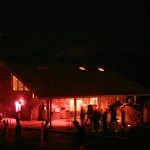
Last night was the sort of evening we love, and the reason we volunteer at the Mauna Kea Visitor Information Station. One of those nights where the stars seem close enough to touch, we bring them within reach of those who came to the mountain to learn about the universe.
The Mauna Kea VIS at night with a crowd at the telescopesConditions were near perfect, a dark, clear sky with no Moon, it would rise later. Not only was it dark, but the air was steady, allowing nice high magnification views of Jupiter and other objects. The air was still, it was cold, but without the wind that can make conditions miserable at 9,200ft. The result was a beautiful night that everyone cold enjoy to the fullest.
Joining us were visitors from around the world, I met people speaking German, Spanish and Czech, a British family living in Japan, and more. About fifty people were to be found on the patio when I did the evening star talk. Not only did they come, but they came with curious minds and a will to learn. The questions came from all sides, fast and furious, a constant stream of information.
With such beautiful sights in the telescope to see, the questions just come naturally. I used a C-14 on the Astro-Physics mount to jump from object to object, the Swan Nebula, the globular cluster of M22, the Andromeda Galaxy, the Wild Duck Cluster, the Ring Nebula, the Dumbell Nebula, Alberio. Everything looked so nice that even as jaded observer, I found myself lingering at the eyepiece to enjoy the view.
The evening was a series of personal conversations with one group or family. I would try to use little vignettes to put the knowledge in context, the shape and size of our galaxy, or the story of star birth and death. Trying to convey, in a few minutes, a little glimpse of a bigger picture and not just a mess of gee-whiz information. Sometimes this works, and you are rewarded with a moment of connection, where your audience suddenly understands.
Phase 5 in the rebuilding of Saddle Road is progressing rapidly, this is the totally new section from Mauna Kea State Park to MP42. As we came through the area Thursday morning a constant chain of trucks hauling asphalt was crossing the road. There was a great deal of other activity in evidence but we could not see the paving operation itself, it was somewhere out of sight behind the military barracks.
It appears that the entire segment now has at least some asphalt on it. This was most apparent at the east end. Monday afternoon this was still bare gravel, as of Wednesday the new roadbed was covered with a base layer of asphalt. The wide expanse of smooth pavement quite a contrast to what we had to turn down to continue our journey home.
As we come through the guys all take a moment to see where progress has been made. We all look forward to another seven miles of smooth and safe road.
The east end of Phase 5, rebuilding Saddle Road at Mauna Kea State Park on 20 April 2009The east end of Phase 5, rebuilding Saddle Road at Mauna Kea State Park on 23 April 2009