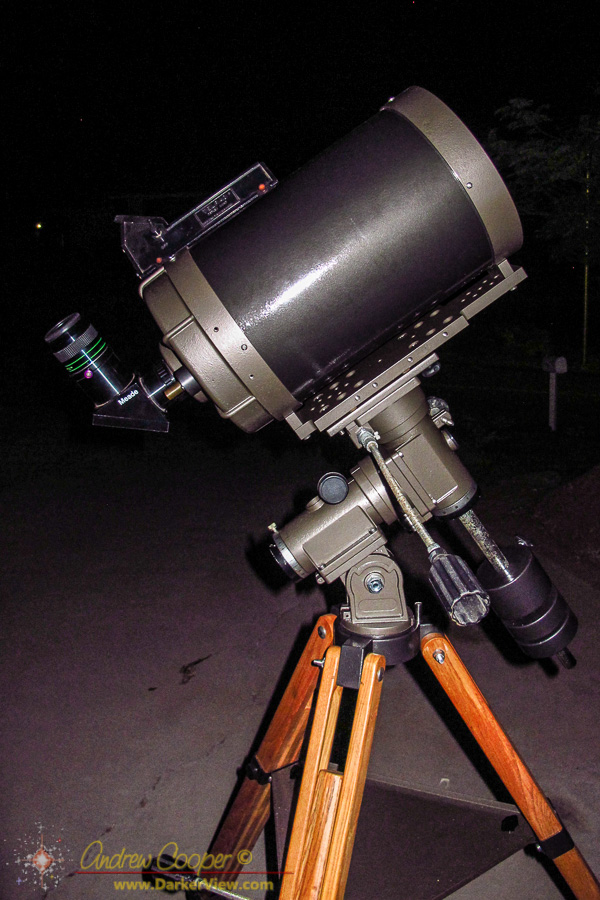
The tropical environment of Hawaiʻi is not kind to optical instruments. Tropical humidity can cause a host of issues ranging from corrosion of metal parts to decay of wooden and cardboard telescope structures. For those of us who build and use small telescopes the issues of tropical heat and humidity are rather concerning.
I have seen camera lenses lost to the white fungus. A friend once showed me a Canon 70-200 f/2.8 L, a $2000 lens, with fungus covering internal elements. Even on the “dry side” of Waimea the humidity was high enough to allow fungus to destroy this lens.
The problem is not an issue on the summit of Mauna Kea. The high altitude air typically exhibits a relative humidity of less than 10%. Several references note that a humidity of above 70% is needed to promote fungal growth on optics. We see no issues with fungal damage to the mirrors or instruments on the big ‘scopes.
Below the tropical inversion layer (about 6-7k feet) it is another issue entirely. Near sea level, where most of us live, humidity can remain above 80% much of the year. The warm and humid conditions of these islands are idea for growing anything, including the omnipresent fungal gardens that create the smells of a tropical landscape. Fungus is inescapable in this world, the spores drift on the wind and an stay dormant for decades, anywhere conditions are suitable fungus will grow.
The possibility of equipment damage was a major element in our buying a house. Waikoloa is located within one of the driest areas of the island. The humidity typically hovers in the 50’s, dry enough that I have had no issues with the multiple telescopes stored in the garage. Still, I do inspect stored equipment periodically, looking for the dreaded white fungus or other damage wrought by this tropical climate.
It is not a single species of fungus responsible for the problem. Apparently quite a few species are able to colonize an optical surface. Looking through the literature I find referenced to multiple species that can grow on optical glass…
The fungi which grow in optical instruments belong to the groups Phycomycetes, Ascomycetes and Fungi Imperfecti. The following species were frequently isolated from instruments which had been in New Guinea: Penicillium spinulosum, Thom.; P. commune, Thom.; P. citrinum, Thom.; Aspergillus niger, Van Tiegh.; Trichoderma viride, Pers. ex-Fr.; Mucor racemosus, Fres.; and M. ramannianus, A. Moeller. So far, Monilia crassa has not been isolated from Australian instruments, although Dr. W. G. Hutchinson (5) of the United States, found this to be a common species in the Panama zone, and it has also been recorded as frequent in West Africa by Major I. G. Campbell. – J.S. Turner, et al.1
I admit that the fungus can be pretty, in an odd sort of way considering the damage. Under a microscope it appears lacy, the mycelium fibrils growing across the glass in search of more nutrients to support the colony. In the center small round fruiting bodies are the launching point for new fungal spores.
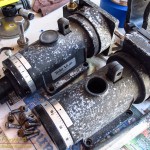
I recently had another round of battle with fungus while restoring a collection of instruments that had been stored in a garage on the side of Hualalai. The high humidity had wrought impressive damage on both the optics and metal components of the telescopes. And there is fungus! Found in the eyepieces and on the telescope mirrors. During the cleaning and restoration of the instruments I found it necessary to completely dismantle many optical assemblies just to remove and kill the fungus. I some cases I was in time, but not completely, it is not without regret that I throw a $400 eyepiece into the trash.
Dealing with the fungus is imperative, cleaning and killing the growth before severe damage can be done may save the equipment. If the growth is severe enough the glass surface and the coatings can be damaged. Apparently the fungi can excrete hydrochloric acid, etching the surface and creating permanent damage.
Killing the fungi requires a solvent that will both kill the fungus while not damaging the optical surface. I find references to both alcohol as well as other solvents. A mix of 50/50 hydrogen peroxide and ammonia is recommended by some references. Along with cleaning the glass I am careful to soak all of the structural elements as well. The tube, the spacers and lock-rings can all harbor minuscule colonies or spores awaiting suitable conditions to grow again.
Optical fungicide solutions tend to be expensive and hard to obtain, but they are available from some optical equipment manufacturers. Alternatively, you can use a 50/50 mix of hydrogen peroxide (H2O2) and ammonia (NH3). Usually, 5 ml of each is adequate (10 cc in total). Mix just prior to use and do not store the mixed product. – Ismael Cordero, Community Eye Health Journal2
Living in a warm humid environment one must be vigilant and ready to deal with issues when found. Examine optics regularly, keep a can of WD-40 next to the tool box (and use it), store optics and electronics with plenty of ventilation and reduce the humidity to well below 70% if needed. Extra vigilance to preserve valuable equipment is the price of living in paradise.