Among the tribes of the coastal northwest there is a ceremony that surrounds the first fish of the season. These ceremonies might vary from tribe to tribe, from family to family, but every tribe had such a ceremony.
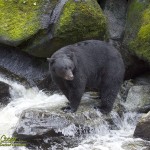
A black bear (Ursus americanus) fishing at the Anan Wildlife Observatory
Life once depended on the yearly return of salmon to the rivers and streams each summer. For bears, eagles, and humans the annual bounty of salmon provided the nourishment that would see them through the long winter. The forest itself benefits from the nutrients carried from distant seas into the trees where the salmon would spawn and die.
Upon catching the first salmon of the season the tribe will stop and celebrate. They celebrate the life of the fish, they celebrate the cycles of the natural world, they celebrate their connection with nature. Some protocols insist that the first fish be released, to continue upriver to spawn, to ensure the salmon continue to return each summer.
That one idea is the critical bit, our connection with nature. Any fisherman understands that he takes from the natural world. A good fisherman stops and considers what he takes. He takes only what he needs to feed his family. This is the entire point of the first fish ceremony, it serves to educate the community in the act of taking, to limit what you take to what the environment can provide.
I grew up in a hunting and fishing family, where a considerable portion of our food came from what my father caught or shot. Be it elk, deer, ducks, razor clams, or smelt, so many of my childhood memories center around the capture, preparation and storage of food… Chopping, packaging and freezing an elk was a serious amount of labor for the entire family.
It takes a while to make these little videos, a lot of tweaking to get it just right. Still, there are so many images, so many memories. Just watching allows me to relive so much of a great voyage!
As is my habit, I have produced a video summary of this summer’s voyage in the Nordic Quest. Take a few of the best photos, a little video, a snippet of timelapse, a decent tune, and mix well…
Having done this more than a few times now it is getting harder to be creative. Still there are always unique shots that come back from any voyage, such as the mother grizzly and cubs. There is also a sequence I had always wanted to try, a timelapse of the huge Alaskan tide change. This time I had a chance to shoot it, and had some success.
Ten days on the boat out of Juneau, our annual family trip fishing in Alaska is complete. This summer it was an all family affair… My mother and father, my brother and his wife, and their grandson Andre. Add Deb and myself for a total of seven aboard the Nordic Quest for ten days of fishing and exploring. The plan was to head south of Juneau, down Stephen’s Passage for the Frederick Sound area.
First stop was Taku Harbor for the night with the following day spent attempting to fish salmon in Stephen’s Passage. A pretty day, but no fish. The only luck we had was a single crab in one of the pots left overnight in Taku.
The towering wall of ice that is Dawes Glacier in Endicott ArmOn to Endicott Arm and Dawes Glacier. The weather was not great for visiting the ice, but we did arrive at low tide, the best time to see calving. We were rewarded by the sight of several ice-falls as the water level fell and the face of the glacier crumbled.
An afternoon spend fishing Halibut was rewarding as well, plenty of fish landed along with one hundred pound specimen caught by Andre. A halibut that big can not be gaffed and simply lifted into the cooler. Instead I harpooned the fish off the swim deck. My first harpoon shot was a bit off, hitting low, a second was much better, right through the spine behind the gills. Good this too, the fish promptly broke the steel leader. Two harpoon lines attached insured this fish was headed for the freezer.
My goal was not to visit the sanctuary itself, I have been here several times. Instead, my plan was to walk the 1871 trail south along the shore, something I had never had a chance to do. I did start at the sanctuary, passing through and shooting a few photos of Kiʻ i before heading south.
The 1871 Trail proceeds south from Puʻuhonua O HōnaunauThis historic trail proceeds south from the visitor center, cutting across the point and then along the shoreline. The trail connected villages and religious centers along the coast. North of the park the trail has become the modern route 160, crossing over the coastal plain to Kealakekua Bay. In satellite shots you can follow the trail along long sections of the Kona Coast. Along the Kohala Coast the King’s Trail was built in a similar fashion and serves the same purpose.
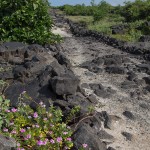
The trail is what was called a two-horse trail, wide enough for two horses to pass with room to spare, about eight feet wide. A curb of stone runs along both sides, while the roadbed between is cleared of rock and sometimes filled with sand or gravel to level the worst pits. In places the trial is built up to cross low areas with substantial stonework. The result reminded me in many ways of Roman roads in Europe, built to a similar pattern and cutting straight across the landscape.
On both side of the trail there are numerous remains of the ancient settlements. Stone walls and raised platforms reveal what was once a thriving settlement along the shoreline. There is the foundation of John Ahu’s house, complete with a cistern and an old grave. The remains of the ʻŌmaʻo Heiau, a hōlua slide and more are alongside the trail as you proceed. Ask at the visitor center desk for a guide to the various points of interest along the trail.
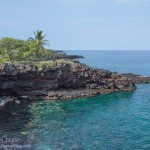
A cove of blue water beneath the sea cliffs of Kiʻilae BayAbout a quarter mile south of the visitor center the trail reaches the shoreline and runs along the top of the sea cliffs. The view is stunningly beautiful… small coves of crystal blue water lie at the bottom of the rugged cliffs. The coral reef is clearly visible, even from fifty feet above you can make out fish feeding amongst the coral heads. Here and there the bright yellow of small schools of tangs add color to the blues and greens. Next time here I need to remember to bring some snorkeling gear.
About halfway the trail is built against a small sea cliff. A large stone ramp was constructed to allow travelers to ascend the cliff. The amount of stonework serves to highlight how much work went into building this coastal access trail.
The south boundary of the park is a mere 0.8 mile along the trail, an easy stroll. Perhaps add a couple points of difficulty for the rough, rocky nature of the trail. It takes about half an hour to reach the abandoned fishing village. From there the trail continues south, out of the park. It becomes substantially overgrown, the path reduced to a cut through the brush with the occasional branch to push aside. I proceeded a bit further, but became rather annoyed with the amount of spider web I was accumulating.
As I sit amongst the abandoned stone walls of Kiʻilae Village it is interesting to imagine what the scene would have looked like a well over century ago in the 1870’s. A thriving settlement with travelers coming and going along the trail. Fishermen carrying their catch home, village women doing the chores and shopping, the tasks of life that never really change. Perhaps a royal procession going north to the temples at Puʻuhonua O Hōnaunau. The period was an interesting one, when western ways were mixing with the ancient patterns of life in the islands.
If you have some time while visiting Puʻuhonua O Hōnaunau, take an hour and walk the old trail. The scenery alone makes it worthwhile, with a bit of history thrown in.
The ship's electronic chart after trolling the Shark Hole in Salisbury Sound for salmon all morningI like fishing… In moderation.
Sometimes the order of the day is fishing, fishing and more fishing. No problem, Deb loves fishing! Go have fun dear, enjoy some more fishing. I’ll just sit up here and drive.
Drive back and forth across the same spot over and over again, as slow as the boat will go. So slow the vessel barely answers the helm, taking her own sweet time to turn. It is a peaceful job of driving, as long as the little charter boats stay out of my way. I am driving a boat five times their size that just keeps moving with minimal regard to whatever I do to the wheel.
I just sit back watch the bald eagles, a humpback whale threading through the swarm of charter boats, and watch the log on the GPS display slowly fill in with the record of repeated passes…
About the time you read this we should have cast off lines and left the Juneau area. The plan is to spend some time exploring the Glass Peninsula and Seymour Canal, an area we have often skipped past on our way south from Juneau. We have reservations for access to the bear viewing area at Pack Creek. Stay tuned for plenty of photos of grizzly bears fishing.
With any luck we will be back in a week. Hopefully the cats are OK with the house sitters. Hopefully the fish makes it back still frozen. And maybe I will not get eaten by a bear.
A catch of halibut at Knudsen Cove Marina, Ketchikan, July 1999There are fish, there are other fish… then there are halibut. Tales are told about halibut, tales of injured fishermen… tales of sunken boats… tales that could be true. These are big fish, powerful fish, and like any other respectable sea monster they come from the deep.
Just getting the line down to them in their dark depths is a chore. Hauling them up from three hundred feet down is a bigger chore. But this is the challenge of the fisherman.
These are fish you don’t bring on deck until they are well and truly dead. Some will shoot them, but we just use a harpoon. Even then the fight is not over, but for some strange reason of halibut neurology a solid whack at the base of the tail will end it.
Salmon fishing is real work, baiting the lines, setting up and dropping the downriggers, constant vigilance as you troll up and down the shore. Kelp and other flotsam gets fouled in the lines, the hooks need re-baiting often, up and down again with the downriggers with their heavy lead balls.
Halibut fishing is more my style, find a likely place, drop the anchor, drop in the pole, sit back and crack a drink and enjoy the scenery while you wait for the fish to bite. Given the choice of eating halibut or salmon I will take the halibut! Nothing against salmon, it is pretty good, just that halibut is better.
Poles in the water while fishing for halibut in Holkham Bay beneath Sumdum Glacier, Alaska