Hinahina (Geranium cuneatum ssp hololeucum) at 9,000ft on the slopes of Mauna KeaA striking silver shrub common on the cinder slopes and recent lava flows around Mauna Kea and the saddle region. The leaves are covered with small, silvery hairs giving the plant a silvery hue that is quite a contrast to the dark volcanic rock on which it is commonly found. The ground around the plant is often littered with these silvery leaves adding to the effect.
Hinahina (Geranium cuneatum ssp hololeucum) at 9,000ft on the slopes of Mauna KeaNative to the Hawaiian islands, Geranium cuneatum ssp. hololeucum is a member of the geranium family and is the only geranium to feature a woody structure. The plant is common on recent lava flows and cinder found at the upper margin of vegetation on the mountain.
A small shrub, most of the specimens I have seen are one to two feet high and a few feet in diameter. The leaves are ovate with linear veins and a forked tip.
The name is partially shared with the silversword found higher on the mountain, as hinahina means silver in Hawaiian. Several silvery plants share the common name hinahina across the islands. I prefer the name ʻāhinahina for the silversword and reserve hinahina for this pretty little geranium.
With all of the emotion being expressed over telescopes on the mountain this week, just a reminder of why Mauna Kea is the perfect place from which to look to the heavens…
Looking over a snow covered Puʻu Hau Kea to Mauna Loa, a bright meteor is visible, as is the GMD laser, Canon 6D and Samyang 14mm f/2.8 lens, 30s at ISO6400
Far from the palm tree lined beaches and the coral reefs that the islands are famous for. Maybe not what most folks think of when they envision Hawaii, but no less beautiful…
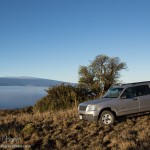
Parked at the end of the R-2 road, high on the side of Mauna Kea
Another weekend, another puʻu… So last week I climbed the wrong puʻu. This weekend I climbed the right puʻu.
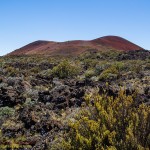
Puʻu Kole as seen from upslope across the aʻa lava fieldThe goal was to explore a pretty landmark I had looked at from the summit road so many times, Puʻu Kole. In the late afternoon light this cinder cone becomes a brilliant shade of red, a striking feature in an already impressive view.
Reaching this hill one travels a couple miles down the R-1 road, the Ka Aliali Trail. A couple of miles of 4WD road to bounce over. The road is not that bad, but I would recommend a true 4WD vehicle. DLNR requires a 4WD vehicle based on the signs, not that everyone reads the signage at the start of the road.
Unlike last weekend there was no heavy fog to obscure the landscape as I reached the area. My goal was obvious… the big red puʻu just downslope from the road. There is a short secondary road, signed R-2 that leads into the area between the two hills. After about a quarter mile this road fades at the edge of an aʻa flow. After parking I got out and sat on a rock outcropping for a while with a snack. The area is just pretty, the jagged black lava and native plants. I finished a bag of chips, downed a water bottle and simply enjoyed the view.
Puʻu Kole is notably harder to ascend than Puʻu Palaolelo. I suspected I was on the wrong puʻu last weekend when it was too easy, reaching the top after a quick stroll in the fog. Puʻu Kole is nearly twice as high, as least when approaching from the upslope side.
The original plan had been to hike Puʻu Kole, a dramatically red cinder cone visible from the summit access road. The red coloration leads to the name, Kole, which translates as red.
What actually happened is that I climbed the wrong puʻu.
The vehicle parked on the side of Mauna Kea with a snow covered Mauna Loa in the backgroundPuʻu is Hawaiian for hill and is generally used to refer to the many cinder cones that dot the landscape of this volcanic island. As prominent landmarks these hills are used to describe the land, and can be found as references in the old land surveys. Every prominent puʻu has a name. The summit of Puʻu Kole is used to define the modern Hamakua and Hilo district boundaries.
As I traversed the R1 4WD road the side of Mauna Kea was enveloped in heavy fog, thick enough that you could not see a hundred yards, sometimes less. I was pretty sure I was in the vicinity of the target, and sure enough the shadow of a large puʻu was visible in the mist. So I parked the vehicle and climbed it.
It was when I reached the top and looked downhill that I noted there was another puʻu hiding in the fog. It was then I realized that I might just be on the wrong hill. Checking the maps I realized that I had climbed Puʻu Palaolelo.
Wrong? Perhaps this is the wrong word, there was no particular reason I needed to be on the right puʻu other than my desire to explore a place I had seen so often while ascending or descending the summit road. The error was fortuitous in that my original target hill was enveloped in thick fog all morning, while Puʻu Palaolelo, a little higher on the mountain, was alternately in the fog and in the sunlight.
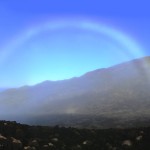
A beautiful fogbow, a glory and the spectre of the brocken on Puʻu PalaoleloIt was this play of fog and sunlight that led to the most dramatic experience of the day. When I neared the summit a beautiful fogbow appeared. Even better, when the angle of the sunlight and the steep slope of the puʻu allowed a glory and even a spectre of the broken appeared in the fog.
Standing atop the puʻu I could not miss the beauty of the morning. Still early the low sunlight was rich in color. Across the saddle you could see Mauna Loa, capped in vivid white, quite a contrast to her black lava flows. A chill wind swept fog over the summit, at times I was spattered with droplets. As the fog and light played across the landscape my camera memory card quickly filled. It was a satisfying hike, resulting in some pretty photos. My original goal of climbing Puʻu Kole lies unfulfilled, an excuse for another walk on the mountain.