Postcard from the Universe – Omega Centauri

I love it when everything actually works. As I have often stated… Astrophotography is an art of details. After dealing with each detail, one by one, sometimes it works…

Omega Centauri
Omega Centauri, NGC5139, sum of 31 x 1min exposures, AT6RC and Canon 60D

New Moon

Young Moon
A very young moon over Waikoloa, this is only 26 hours after new, visible to the unaided eye as a sliver in the fading glow of sunset
New Moon will occur today at 13:47HST.

With this new Moon, an annular solar eclipse will sweep across the North Pacific from China and Japan to the west coast of the United States. In Hawai’i this will be seen as a minor partial eclipse with only a few percent of the Sun obscured by the Moon.

Continue reading “New Moon”

Photographing the Transit of Venus

With the Transit of Venus looming on the calendar, a discussion of solar photography is in order. Taking good photos of the Sun is not that difficult, but can be aided with a little information. There are some unique challenges in solar photography.

Solar Filter
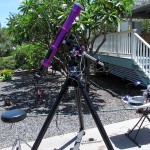
A solar filter mounted on a refracting telescope
The one obvious problem is dealing with the sheer intensity of the Sun. An intensity that can easily damage a camera if placed behind unfiltered optics. A proper solar filter is the easiest way to reduce the light to a safe level.

A solar filter will also produce the most pleasing images of the Sun. Indirect techniques like projection can be used. But for good solar photos, a proper filter in front of your optics is the single best method.

Solar filters for optics are constructed with a thin film of metal such as aluminum or stainless steel vacuum deposited on a substrate. This substrate is usually glass or a thin mylar film. The resulting filter allows only a small fraction of the light through, about 0.01% or 1/10,000 of the unfiltered value. Importantly, the filter blocks the ultraviolet and near infrared part of the spectrum as well. The result is a safe filter than can be used on a telescope or telephoto camera lens.

Sufficient magnification is needed if details of the Sun’s surface are to be well recorded. A few hundred millimeters focal length, found in common telephoto lenses will produce a reasonable solar image. The image will still be fairly small. To fill the sensor requires more. For an APS-C sized sensor (Canon T2i, 60D, 7D, Nikon D5000, D3200 or similar) a telescope with 1,000mm focal length will create an image filling a good portion of the image.

Image sizes for APC-C Sensors


Focal Length     Image Size (arcmin)
100mm   760×510
400mm   190×128
800mm   95×64
1000mm   76×51
1500mm   51×34
2000mm   38×25

The table to the left shows the resulting images sizes, in arc-minutes, given various focal length lenses, on an APC-C sized sensor. Recall that the Sun is about 30 arcminutes across as seen in our sky. With 100mm the resulting image is 510 arcminutes from top to bottom in the frame. This is 17 times the width of the solar image, a pretty small image indeed. With 400mm this improves to about 4, thus the Sun will reach about 1/4 the height of the image. At 1000mm this is about ideal, the Sun will reach more than halfway across the frame.

1500mm will just fit the solar image. While this may seem ideal, there is an issue. A small amount of drift will put part of the Sun out of the image, cutting off part of the disk. Sizing the image to fit in the frame with a good margin will allow some drift, while still giving a good image scale.

If you have a full frame camera (Canon 5DMkII, Nikon D800, etc.) a larger image can be used to fill the larger sensor, thus a longer focal length can be used. A telescope with 2000mm focal length will produce an image 17mm across, neatly fitting in the area of a full frame sensor.

Few compact cameras can boast a lens that will zoom far enough to produce an image of the Sun filling the frame. For these cameras another technique can be used, afocal photography. This can also produce good images, but will require experimentation to find the right combination of telescope, eyepiece and camera to produce a correctly sized image.

Solar Framing
The full frame solar image with about 1000mm of focal length and a Canon 60D
If you want to calculate the image scale for your optical combination, lens and camera, I suggest downloading the CCD Calculator from New Astronomy Press. You can enter the optical parameters and see exactly what the resulting image will look like with a sample image of the Sun, Moon or other selected objects.

Another issue is resolution. Our atmosphere usually limits the practical resolution to about one or two arcseconds, blurring any finer detail through atmospheric distortion. This can be much worse in the daytime with solar heating of the ground and air around the telescope. Thus the limit for resolution will be reached with about 1000mm focal length and a modern 10-15 megapixel camera. Any further magnification beyond about 1000mm will simply result in magnifying the blur. There are techniques for overcoming this (image selection and stacking), but if you know how to do that, you already know what you are doing.

Just a bit of summing up… You need a proper solar filter or other method of safely reducing the solar intensity. A long telephoto (400mm or more) will produce a reasonable solar image. A small telescope with about 1000mm of focal length is ideal for photographing the entire disk of the Sun with a DSLR camera.

Postcard from the Universe – Sol

Set up the gear again to get ready for Venus Transit. Attempting to autoguide on the Sun. No luck with the guiding, the software just does not like a non-pinpoint target. I did take a few photos in the process of messing about…

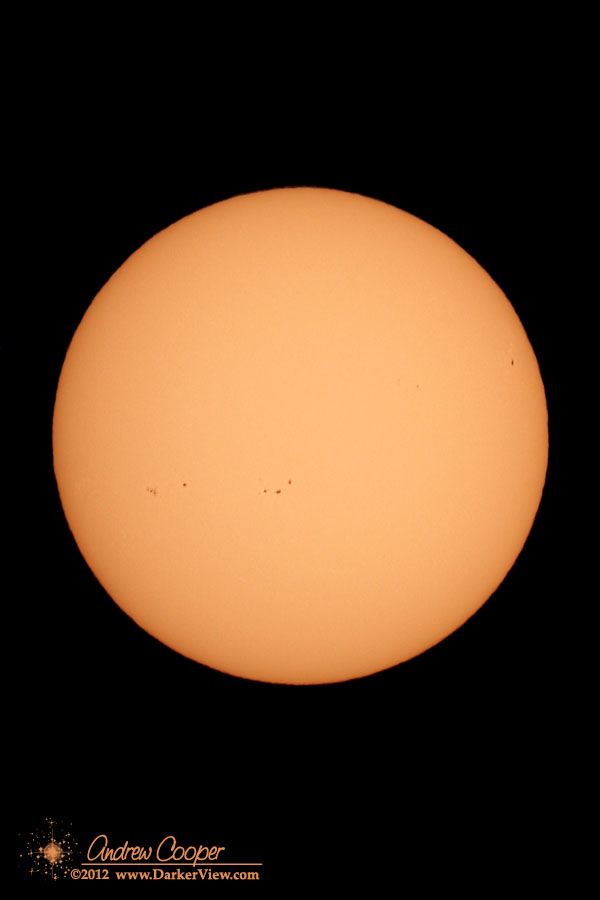
The Sun 19May2012
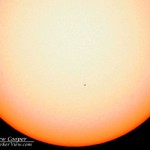
The Sun on 19 May 2012, 90mm APO and Canon 60Da

Safe Transit Viewing

You have heard it before, but it really is true! Looking at the Sun for longer than a few brief moments with an unprotected eye can lead to permanent damage. Looking at the Sun with any sort of optical deceive that has not been properly filtered can lead to instantaneous eye damage.

Discussed below are the only safe methods I am aware of to view the Sun. There are some dodgy methods out there. Take chance with your irreplaceable eyesight? I think not. Be careful and do it right if you want a look.

For the unaided eye there are a couple options to view the Sun safely…

  • Solar Viewing Glasses Proper solar viewing filters are made from a thin plastic film, usually mylar, coated with metal to properly filter the Sun’s light for viewing with the unaided eye. These are widely available and quite cheap. Local astronomy organizations have been giving them away in preparation for the transit. Do not attempt to use these viewers in conjunction with binoculars or small telescopes, they do not provide sufficient filtering for optics!

  • Welding Glass Filters used for viewing welding offer much the same protection as solar filters. A shade 13 or darker welding filter can provide good protection for the unaided eye. Again, do not use a welding filter with any sort of optical device such as binoculars, they are not designed for such use and may not block enough light.

A much better view of the event can be seen if modest magnification is used. Do keep in mind that any soft of binoculars or telescope also concentrates much more light that the eye alone. Remember those childhood “experiments” involving a magnifying glass and ants? The best options here are the use of solar filters designed to be used on a telescope, or indirect means such as image projection.

Solar Filter
A solar filter mounted on a refracting telescope
  • Solar Filters for Telescopes Filters specifically designed for telescopes consist of either a plastic film, or a sheet of glass, coated with a thin layer of metal to block the Sun’s light. These filters pass about 1/1000 of one percent of the light. More importantly, they block the harmful infrared and ultraviolet light that could so easily cause damage. The filters can be purchased in many sizes as appropriate for various models of telescopes, costing between one hundred and several hundred dollars.

  • Image Projection One of the simplest methods of displaying a solar image is projection. A white screen placed a foot or two behind a telescope will produce a very nice image of the Sun that can be safely viewed by a number of people simultaneously.

    Keep in mind that the beam of light out of the eyepiece is quite intense, potentially hot enough to burn a careless finger placed near the exit from the telescope.

    The method works best with small optical systems, binoculars or the smallest of telescopes. You do not need big optics to project a very nice solar image.

    You do not have any optics? Use the simplest optical arrangement of all, the pinhole camera!

If you do not have a safe means of viewing the transit and do want a look, you can go to one of the many public events being organized. Here on the Big Island there are quite a few options, one should be close to you.

Viewing the Transit of Venus on Mauna Kea

Everyone is gearing up for the Transit of Venus. Starting at just after noon on June 5th, Venus will cross the face of the Sun. This will be our last chance to see such an event in our lifetimes, as a result, many skywatchers are making an extra effort to see this transit. This includes a number of folks who are traveling to Hawai’i this June, just to be here for the transit.

Transit of Venus
The June 2004 Transit of Venus, image credit Jan Herold
The Office of Mauna Kea Management and and Mauna Kea Support Services are making an extraordinary effort for the transit. An interesting exercise, protecting the mountain, ensuring everyone is safe, and allowing reasonable access to the summit. This is a challenge under normal circumstances. Throw in the possibility of a much larger crowd and it could be a real problem. Thus, the following extra measures will be in place…

  • The summit access road will be closed to public vehicular traffic at the Visitor Information Station.
  • Access to the summit will be provided via free shuttle service between the Visitor Information Station (VIS) and Mauna Kea summit.
  • Parking at the Visitor Information Station (VIS) is limited. Additional parking will be provided, however If parking spaces fill up, vehicles will be held below the VIS until parking becomes available.
  • Mauna Kea Rangers and Hawaii County Police Officers will be present to assist with parking and public safety.

There will be solar telescopes stationed at the MKVIS, at the summit, and at a number of other locations around the island. With many options to choose from, you do not need to go to the summit to get at least some view of this event.

The diehards, those wanting to see the entire transit, will probably go to Mauna Kea. I really do not know what sort of crowd to expect on the mountain. While it could be substantial, I really expect a more modest showing than some folks are predicting. In any case it will be a fun event.

Myself? I will be on the summit. I will be running the Keck live webcast of the event using one of my telescopes. From a vantage point behind the Keck 1 telescope we should be in position to witness the entire event from start to finish.

More Astronomy Haiku

Rosette Nebula
The Rosette Nebula and cluster

Dark sky filled with stars
Telescopes help us see them
Takes your breath away
    – Jennifer Sanchez

Space explorers
In the night implore
Please let it not rain!
    – Mz’ili McKezfue (age 7)

Falling from the skies
In our scary, lonely nights
Brightening the sky
    – Angelita Camacho

It is amazing how much can be encompassed in so few words.

Poems used with permission.

Transit of Venus Timing

Transit of Venus
The June 2004 Transit of Venus, image credit Jan Herold
For reference I am posting precise transit timing for the June 5th Transit of Venus. The data is taken from Fred Espenak’s wonderful NASA Eclipse Website. I just extracted the cities that are of most interest to my Hawaiian readers. For the full list of US cities you can go here.

As you might notice, the times change by a mere two seconds between Kona and Honolulu. These times will be pretty close for the entire island chain. That last number is the Sun’s altitude, the angle above the horizon. Note that this is near 90° for Hawai’i, nearly straight up for the start of the event. Final contact will occur with an altitude of about 5°, just above the horizon near sunset.

Location Name External Sun
Ingress Alt

h m s °
Internal Sun
Ingress Alt

h m s °
Greatest Sun
Transit Alt

h m s °
Internal Sun
Egress Alt

h m s °
External Sun
Egress Alt

h m s °
Anchorage, AK 14:06:30 51 14:24:04 51 17:26:53 38 20:30:46 16 20:48:32 14
Honolulu, HI 12:10:07 85 12:27:46 89 15:26:20 49 18:26:38 9 18:44:38 5
Kona, HI 12:10:09 86 12:27:48 87 15:26:16 47 18:26:33 7 18:44:33 3
Los Angeles, CA 15:06:26 58 15:24:02 55 18:25:33 18 — – — –
Phoenix, AZ 15:06:03 54 15:23:40 50 18:25:32 13 — – — –
Portland, OR 15:06:05 57 15:23:40 54 18:25:53 23 — – — –
San Francisco, CA 15:06:29 61 15:24:04 57 18:25:39 22 — – — –
Seattle, WA 15:05:58 56 15:23:32 53 18:25:57 23 — – — –

All times are local time. Keep in mind that this event occurs on June 5th for viewers in the US and Hawai’i. Some sources show June 6th for a date, and so it will be for viewers on the other side of the date line in Australia, Japan and China.

Viewing the Transit of Venus on Hawaii

There is only one more chance in our lifetimes to see a Transit of Venus. If you are curious about this event, where do you go to see it?

Transit of Venus
The June 2004 Transit of Venus, image credit Jan Herold
Hawai’i is well placed to see the entire event. The transit starts just after noon, with the sun high in the sky. As the transit ends just before sunset, a clear western horizon will be required to witness final contact. For the true astronomical diehards, the summit of Mauna Kea will be the destination. With a clear view, above the clouds, the entire event will be visible.

For those folks who just want a nice view of the event, and do not necessarily need to watch for the entire seven hours, there are a number of easier options. To accommodate the public, there will be solar telescopes setup and manned by volunteers at a number of locations around the island…

  • Mauna Kea Visitor Information Station (MKVIS) A portion of the VIS parking lot will be converted into a viewing station. Telescopes with solar filters will be available. A NASA-sponsored live web cast of the Transit will be displayed inside the VIS and in the presentation room. Parking space at the VIS is limited. If parking fills, vehicles will be held below the VIS until parking becomes available. You may want to consider some of the other sites listed below.
  • ʻImiloa Astronomy Center of Hawaii, Hilo ʻImiloa will display the NASA webcast of the Transit. Leading up to the day of Transit, ʻImiloa will also be running a special planetarium show titled “When Venus Transits the Sun.”
  • W. M. Keck Headquarters, Waimea Livestream from the summit at headquarters in Waimea. Headquarters will be open until 6 p.m. Solar telescopes will be available. Free solar cards for viewing the Transit directly will be provided, while supplies last.
  • Canada France Hawaii Telescope (CFHT), Waimea Solar telescopes and a sunspotter will be available for the public. A raffle for a copy of “Hokuloa: The 1874 Transit of Venus Expedition to Hawaii” by Michael Chauvin will also be held.
  • Puʻu Koholā Heiau National Historic Site, Kawaihae From Noon till 4:30pm. Special glasses will be available, and a live webcast from the summit of Mauna Kea in the Visitor Center theater. As well, park rangers will give special presentations about the historical significance of this event throughout the day.
  • Natural Energy Lab in Kailua-Kona Mahalo to the Natural Energy Lab for sponsoring this event!
  • Keaʻau In the lot across from the Fire Station, Mahalo to W. H. Shipman Ltd for sponsoring this event!