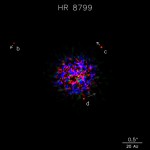
Three exoplanets orbiting a young star 140 light years away are captured using Keck Observatory’s near-infrared adaptive optics. Image credit Christian Marois, NRC and Bruce Macintosh, LLNL
Gone are the days of being able to count the number of known planets on your fingers. Today, there are more than 800 confirmed exoplanets — planets that orbit stars beyond our sun — and more than 2,700 other candidates. What are these exotic planets made of? Unfortunately, you cannot stack them in a jar like marbles and take a closer look. Instead, researchers are coming up with advanced techniques for probing the planets’ makeup.
One breakthrough to come in recent years is direct imaging of exoplanets. Ground-based telescopes have begun taking infrared pictures of the planets posing near their stars in family portraits. But to astronomers, a picture is worth even more than a thousand words if its light can be broken apart into a rainbow of different wavelengths.
Those wishes are coming true as researchers are beginning to install infrared cameras on ground-based telescopes equipped with spectrographs. Spectrographs are instruments that spread an object’s light apart, revealing signatures of molecules. Project 1640, partly funded by NASA’s Jet Propulsion Laboratory, Pasadena, Calif., recently accomplished this goal using the Palomar Observatory near San Diego.
AstroDay 2013!It is AstroDay, a chance for all of the observatories to do a little community outreach.
Prince Kuhio Plaza is the largest mall on the island. Perhaps small by large city standards it is still the focal point of shopping in Hilo. The observatories and a few other organizations use tables all through the branches of the mall. In the center of it all is a stage with live music, giveaways and other activities for the crowd. The whole thing is a great family day and a great outreach opportunity.
A nice short video on Keck and the hunt to find and confirm extrasolar planets. It features regular Keck observer Nader Haghighipour from the Institute for Astronomy, University of Hawaii talking about his research into exoplanets.
I had a chance to help out with some of the interior shots. We had to hurry as the film crew was running late and they were up against the schedule, it was time to release the telescopes to the astronomers for the night. It is nice to see the crew got the needed shots and to see the final result a few months later.
Join us this Sunday for a live broadcast from Keck 2 remote observing! Here at Keck we will be participating in a campaign to observe Saturn’s auroras. Join JPL scientist Dr. Kevin Baines and Dr. Tom Stallard of the University of Leicester while they are engaged in using the telescope.
This false-color composite image, constructed from data obtained by NASA’s Cassini spacecraft. Image credit NASA/JPL/University of Arizona/University of LeicesterSunday April 21st
3am-5am Hawai’i Standard Time
6am-8am Pacific Daylight Time
9am-11am Eastern Daylight Time
1pm-3pm UT
At Keck the team of astronomers have five half night’s of observing on Keck 2 using the NIRSPEC spectrograph. They will be making infrared observations to understand more about the auroral features and the interaction of Saturn’s atmosphere with the planet’s magnetic fields.
NASA funded observations on the W. M. Keck Observatory with analysis led by the University of Leicester, England tracked the “rain” of charged water particles into the atmosphere of Saturn and found the extent of the ring-rain is far greater, and falls across larger areas of the planet, than previously thought. The work reveals the rain influences the composition and temperature structure of parts of Saturn’s upper atmosphere. The paper appears in this week’s issue of the journal Nature.
“Saturn is the first planet to show significant interaction between its atmosphere and ring system,” said James O’Donoghue, the paper’s lead author and a postgraduate researcher at Leicester. “The main effect of ring rain is that it acts to ‘quench’ the ionosphere of Saturn, severely reducing the electron densities in regions in which it falls.”
Observations of Europa from the W. M. Keck Observatory help NASA and California Institute of Technology (Caltech) astronomers go one step further in demonstrating life may be possible in the ocean of one of Jupiter’s moons. In addition to the known existence of water, a paper published today shows hydrogen peroxide is abundant across much of the surface of the smallest of the Galilean Moons. The paper argues that if the peroxide on the surface of Europa mixes into the ocean below, it could be an important energy supply for simple forms of life. The paper was published online in the Astrophysical Journal Letters.
(On March 14, a separate paper was published by the same team in Astronomical Journal, demonstrating the salty ocean of Europa makes its way through the frozen surface, introducing the possibility the ocean is habitable. Click here for that news release.)
“Life as we know it needs liquid water, elements like carbon, nitrogen, phosphorus and sulfur, and it needs some form of chemical or light energy to get the business of life done,” said Kevin Hand, the paper’s lead author, based at NASA’s Jet Propulsion Laboratory, Pasadena, Calif. “Europa has the liquid water and elements, and we think that compounds like peroxide might be an important part of the energy requirement. The availability of oxidants like peroxide on Earth was a critical part of the rise of complex, multicellular life.”
This color composite view combines violet, green, and infrared images of Jupiter’s intriguing moon, Europa, image credit NASA/JPL/University of Arizona
The scientists think hydrogen peroxide is an important factor for the habitability of the global liquid water ocean under Europa’s icy crust because hydrogen peroxide decays to oxygen when mixed into liquid water. “At Europa, abundant compounds like peroxide could help to satisfy the chemical energy requirement needed for life within the ocean, if the peroxide is mixed into the ocean,” said Hand.
Co-author Mike Brown of Caltech in Pasadena, analyzed data collected from the Near-Infrared Echelle Spectrograph (NIRSPEC) and OH Suppressing Infra-Red Imaging Spectrograph (OSIRIS) instruments on the mighty Keck II telescope on Mauna Kea, Hawaii, over four nights in September 2011. The highest concentration of peroxide found was on the side of Europa that always leads in its orbit around Jupiter, with a peroxide abundance of 0.12 percent relative to water. (This is roughly 20 times more diluted than the hydrogen peroxide mixture available at drug stores.) The concentration of peroxide in Europa’s ice then drops off to nearly zero on the hemisphere of Europa that faces backward in its orbit.
Hydrogen peroxide was first detected on Europa by NASA’s Galileo mission, which explored the Jupiter system from 1995 to 2003, but Galileo observations were of a limited region. The data from Keck Observatory shows that peroxide is widespread across much of the surface of Europa, and the highest concentrations are reached in regions where Europa’s ice is nearly pure water with very little sulfur contamination. The peroxide is created by the intense radiation processing of Europa’s surface ice that comes from the moon’s location within Jupiter’s strong magnetic field.
“The Galileo measurements gave us tantalizing hints of what might be happening all over the surface of Europa, and we’ve now been able to quantify that with our Keck telescope observations,” Brown said. “What we still don’t know is how the surface and the ocean mix, which would provide a mechanism for any life to use the peroxide.”
I suppose I should do a write-up of Keck Week. It has been a week since the event wound down. But… That was a massive whirlwind of activity, way too much to do, I am just now exiting decompression mode.
I am not the only one attempting to recover. I stopped by Debbie Goodwin’s office Monday. Her desk is piled with follow-up work, her usually neat office a bit of a wreck. The same story everywhere around headquarters, the remains of open house litter the complex, slowly disappearing as folks clean up and put away. At least the conference room had tables and chairs for Tuesday’s AO Team meeting.
We are still awaiting the numbers, visitors to open house, donations, etc. But even without data I think we can call the event a total success. It was huge in any case, turnout for open house was somewhere in the 1,500 to 2,000 visitor range as expected. What I do know was the reaction I got as I walked about the events.. A lot of happy folks! Everyone was having a good time.
An array of backyard telescopes await the crowd in the Telescope Shop, photo by Maureen SalmiThe two West Hawaii Astronomy Club exhibits were a mixed success, not through any fault of the club. The solar viewing was completely wiped out by the Waimea weather, not just the usual misty clouds, but pouring rain. To the success side, the Telescope Shoppe worked well, as I hoped it gave our club members something to talk about, a hook to draw in the visitor. The display of small, amateur instruments looked pretty good, everything from some of my binoculars on a parallelogram mount to Tony’s 12.5″ Obsession dob. A pair of Orion 8″ dobs gave us a ‘scope to point to for budget minded folks, an iOptron cube and a Meade 8″ LX-90 represented some GoTo options. This is an activity I highly recommend to anyone hosting a similar event.
The fun of soldering a flasher circuit board, photo by Maureen SalmiThe rain did little to dampen the crowds every part of the complex was crowded. The other Operations Department exhibits were quite popular… David was playing with liquid nitrogen in the courtyard, exploding bottles, freezing bananas, making ice cream. In the electronics lab there were flashers to solder, small circuit boards with LED’s and a battery allowing folks to try their hand with a soldering iron. In the shop we had a hydraulic press stamping keychains. Kids pumping a lever to create the fifteen tons of pressure needed to emboss the Keck hexagons into brass.
It is a lot of fun, and a lot of work. It is a real treat for the community. With the enormous effort we will not be doing this every year. The last open house was three years ago, it will probably be that long before we do it again.
The usual engineering minutia takes up much of my week… Paperwork, documentation, purchase orders, meetings, etc. There are the occasional chances to just have a little electronic fun. Thus I greeted a request from a couple of our support astronomers with some enthusiasm. They needed a variable intensity light source for calibration of the OSIRIS spectrograph. This source sits inside an integrating sphere on the AO bench along with four spectral sources, small tubes of neon, argon, xenon and krypton.
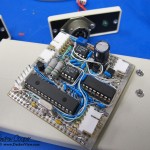
The remote current controller PCB and case prior to final assemblyThere was already a white light source in the calibration sphere, but control was limited to simply on or off. The spectrograph uses various filters that each let through differing amounts of light from the calibration source. This created problems during calibration, some sort of variable intensity source was needed. It also needed to be quite precise, with a well regulated output that would not vary during the hours a calibration script could run.
I set aside a bit of time each day to design and build the source. The last couple hours of the afternoon are best, at this point I have had quite enough paperwork. A chance to practice my trade sketching out the circuit, or simply sitting at the bench and soldering… Perfect.