
As I devour my third plate from the buffet, I realize I have all day, and no reason to leave the park just yet.
It had been a lovely morning… Arrival in the park at 2 am to a spectacular lava fountain. I had spent the previous five hours hiking to viewpoints with heavy camera gear and shooting the eruption from several angles.
Episode 57 lasted 5.8 hours, the second shortest episode of the current eruptive series, ending just before sunrise. As I ate breakfast, there was only fume and a misty rainbow to be seen in the big picture windows looking across the caldera.
I consider the now empty plate… The eruption may have ended, but I am refueled and ready to go. Time for a hike.
There are a few places remaining on my list of park features I hope to explore. I sweep around the map with a finger, where do I go today? I will neglect to mention the actual location I decided upon. It is an area well known to those who frequent the park, but it is not an established trail, and as a result, not ground into dust by the tourist hordes.
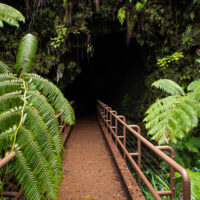
On the way, I did stop at Nāhuku, it was early enough that there was parking to be found, and the lava tube and surrounding rainforest are best visited in the steady rain. With few visitors about, I could take a few people-free photos in spots that would be crowded later in the day.
As I continued to my destination, I found I had left the rain behind on the caldera rim. Parking at an established viewpoint, I turned the other way and headed out across the lava.
This is a relatively recent flow, recent being sometime in the last century. An eruptive fissure sits at the top of the flow field while dense rainforest lies all around.
Walking is fairly easy across the pāhoehoe, with only a few places where the jumbled plates require careful steps. My path is more than a bit meandering as I thread my way across the flow, avoiding rough ground, stopping to look at this and that.
The fissure is my first destination, where large spatter ramparts surround deep crevices. The violence of the eruption is evident in the jumbled landscape… Tumbled blocks, collapsed sections of the spatter ramparts, all with smooth lava intermingled, frozen where small streams and sheets once flowed from the vents.
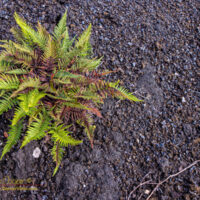
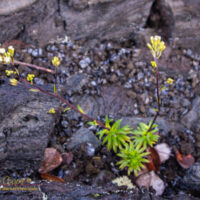
Over the intervening decades, the usual pioneer plants have colonized the flow. Ferns and small ʻōhiʻa lehua promise the return of the dense rainforest as long as time is permitted before the lava flows again. I find these small, tough plants create lovely still life scenes for the camera. I pause here and there to compose a photo or two of yet another fern.
The walk is decidedly crunchy, across the lava flow tephra from the current eruptions has been scattered by the winds. There is a surprising amount considering this place is not normally downwind of the caldera. Still, the ground is littered with a solid layer of small bits of reticulite. There is a good collection of footprints through the tephra showing that I am not the only one to come this way since the tephra fell.
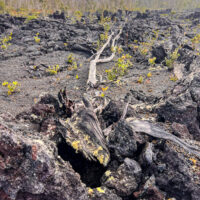
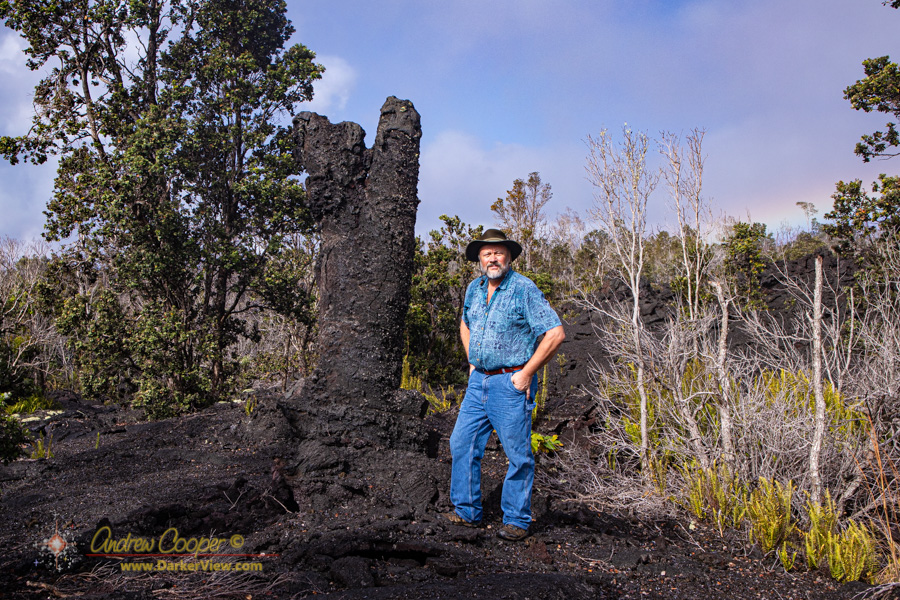
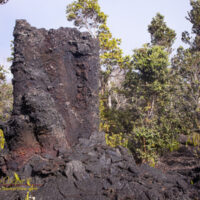
I knew there would be lava trees here, but I was still stunned by what I found… Not a few lava trees, but a forest of them, many taller than I am, some with the charred remains of the trees still within. A few actually looked like the trees they formed around, retaining the branched shape rather than the usual rough column of basalt standing above the flow.
The hot, fluid lava that surged from the vent created excellent conditions for lava trees to form. The lava cooled quickly against the living trees, forming a layer of rock that preserved the tree’s shape, even as the tree itself burned.
A number of the lava trees feature remains of the original tree, the charred trunks wrapped in a lava crust. In a few cases, the upper trunk and a few branches must have stood clear of the lava flow, escaping the fire, now fallen and scattered atop the cooled lava. I have no expertise in identifying weathered wood, but I suspect most would have been ʻōhiʻa lehua based on the makeup of the surrounding forest.
I am intrigued when I come across a cable, a heavy shielded cable that might have been used for some sort of instrument. The cable winds its way across the flow for hundreds of feet. I determinedly follow the cable to each end, through the crevices and under heavy brush. But alas, each end stops at a loose coil of cable and a ragged cut. Any instrumentation that was once deployed here is gone, but the cable was oddly left behind.
I wend my way back across the flow, taking a slightly different path than my outbound course. The flow is a thousand vignettes, each little glade, every jumbled plate of lava a small story to be told, visible to anyone who will pause and look for a moment with curious eyes.
With a long night of lava photography and a morning hike behind me, I find I am satisfied, my body complaining with gentle aches. Satisfied, I return to the vehicle for the long drive home.
Share this:

