Postcard from the Reef – Longnose
When you want to see the stars, find someplace dark

W. M. Keck Observatory position announcement…
Responsibilities
Qualifications
The W. M. Keck Observatory operates the largest, most scientifically productive telescopes on Earth. The two, 10-meter optical/infrared telescopes on the summit of Mauna Kea on the Island of Hawaii feature a suite of advanced instruments including imagers, multi-object spectrographs, high-resolution spectrographs, integral-field spectroscopy and a world-leading laser guide star adaptive optics system. The Observatory is a private 501(c) 3 non-profit organization and a scientific partnership of the California Institute of Technology, the University of California and NASA.
To learn more about this position and to apply, go to: www.keckobservatory.iapplicants.com
Equal Opportunity Employer


A line of big telescopes greeted the crowd. Mike had his 20″, Cliff his 24″, my 18″ Deep Violet, later in the evening Olivier set up his 18″ Priscilla. All of this large glass was open to the public, we each had long line of folks waiting a turn at the eyepiece. It was a huge Saturday night crowd, several hundred people awaited darkness. Yes, I had made the decision to observe from the VIS, knowing that there would be a crowd, but wow!
Showpiece objects, the Andromeda Galaxy, The Pleiades and Jupiter were available for viewing. I was stuck on the Orion Nebula all evening long. I changed targets once, to meet a chorus of request to move back to the nebula. I have to admit it was a pretty view, even to me, who has seen this sight more times than I remember. I put the 35mm eyepiece in place, creating a bright low power view that had visitors waiting through line a few times for second and third looks.
In addition to the big dobs there were quite a few smaller ‘scopes present. Maureen had her C-11 setup, Larry brought his nice Stellarvue 102mm refractor, Mike had an 8″ SCT beside his 20″ for use by a friend. Dan didn’t bring a ‘scope, but he did bring pizza! We met Woody, an Alaskan Airlines pilot flying the Anchorage to Kona run. Out of a couple carry-on sized bags he produced more telescope than we would have thought fit in airline luggage…. A neat collapsible pier arrangement with an alt-az mount and a very nice WO 110mm APO.
Two dives, almost two hours underwater, much of that time spent combing the reef face and cave walls for small invertebrates to photograph. I was well into my second dive of the day, a nice cave called Henry’s, where I had now spent over forty minutes carefully searching the interior and entrance areas of the lava tube. My real target is nudibranchs, but so far the day’s diving had revealed only two, both species I had found and photographed many times before.
A splash of color at the base of a large antler coral got my attention, it was shaped just right, but I was not in a position to see it clearly. Getting closer it looked better, about the right size with white raised features. It was only after circling to the other side of the coral and getting in close that I saw that this was probably not a nudi. It took a moment to realize that this was probably a dark purple sponge with bright white osculum. Even in the photo you have to look close to realize what it is.
Except in a few obvious cases, I make no real effort to properly identify sponges. This is a task that takes an expert, a collected specimen and a proper lab to do. I did check briefly through the book to see if there was a clear match, but as I expected, this sponge will remain identified simply as… a sponge.

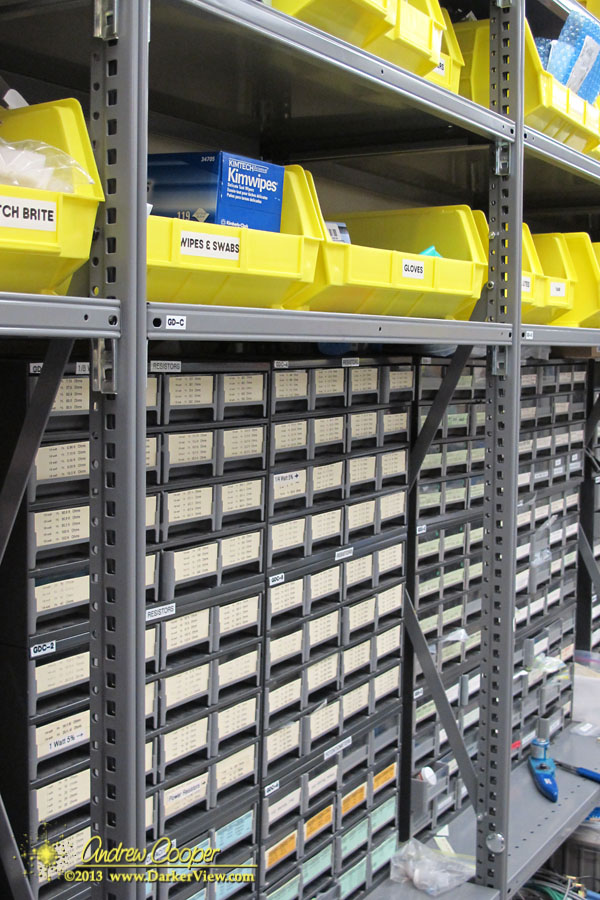
The summit of Mauna Kea is a long way from anywhere on this island. If something breaks we really need to have the parts on-hand to fix it. The result is that just about any unclaimed space in the building is used to store spare parts. We have stuff stashed everywhere!
This goes for the electronics lab too. A little bit of everything we might need is available. Now you just need to spend a few months learning where to find everything…
Tonight and tomorrow the pair of planets, Mercury and Mars will be about 30′ apart, close enough to easily fit in the low power view of most small telescopes. The pair will be 13° above the sunset, setting about an hour after the Sun slides below the horizon.
After the 8th the pair will separate, with Mercury heading for maximum elongation on February 16th.