Let me be quite clear… My idea of Super Sunday does not involve any sort of professional sporting event. This includes no television or funny commercials, no party, piles of chicken wings or large screen displays, and no halftime show.
Sky checking out the reef at RidgesI joined the guys for some diving instead. My idea of a Super Sunday!
It was a pretty good day to go diving. The surf was a bit high, no problem as we would be diving from the boat. It was Dennis, Sky, Pete and myself, the usual crew. Dennis chose to head south of Kona, a good choice as we found nice conditions… Good vis and little surge. Going south also allowed us to do a little whale watching along the way. We encountered spinner dolphins just outside the marina, and again in front of Kailua Bay on the way back. Two humpbacks caught Dennis by surprise, surfacing right in front of the boat as we cruised south, giving us a great view as we waited for them to move away.
For the next few evenings Mercury and Mars will pair in the sunset for a dance. Tonight the two are 3°13′ apart, with Mercury rising rapidly. Tomorrow the two will be only 2°17′ apart. On the 7th and 8th there will be about 30′ between the two. After the 8th the two will gradually draw apart. On the 10th the separation will be just over 2° with the addition of a 1.8% illuminated Moon just 7° lower and north of the pair.
The pair should be easy to spot. Mercury will be shining brightly at -1 magnitude with Mars at about 1.2 magnitude. A pair of binoculars might help spot the dimmer Mars.
Neptune is also in this dance, but at 8th magnitude it could be very difficult or impossible to spot, even with optical aid. On the 5th, with Mercury and Mars only 2° apart, Neptune will be right between the two.
Tonight and tomorrow night Mars and Neptune will be under a degree apart. But, as the pair is quite low in the sky, this may not be observable. The planets will be 40′ apart tonight, a little closer tomorrow at only 27′ separation. The pair will be 14° above the horizon at sunset. Mars, shining a 1.2 magnitude should be relatively easy to spot. The 8th magnitude Neptune may be too dim to see, even with a telescope, against the bright glow of sunset.
On the evening of February 5th, Mercury will join in to create a trio, just 2° below Mars with Neptune between the two.
The planet Mercury is starting an evening apparition. The planet should become visible this week just above the fading glow of the setting Sun as a magnitude -1 object. Currently about 10° from the Sun it will rise higher each evening, reaching a maximum elongation of 18° on February 16th.
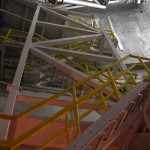
The five flights of stairs needed to climb the Keck 2 Nasmyth Deck
Wait! What is broken?!?
The elevator.
It has been broken for two days. The contractor is here to fix it, but this is the day Olivier and I need to get a job done in AO. It would have to be the Keck 2 elevator, not the Keck 1 elevator. Which telescope are we working in today? Keck 2 of course.
This will mean climbing the stairs to the Nasmyth deck, all five flights of stairs. Five flights does not sound too bad, until you remember that the bottom of these particular stairs start at 13,600ft above sea level. Climbing these stairs is guaranteed to get your heart pumping and remind you of the consequences of every one of those 13,600ft.
The job? Re-installing one of the mirrors in the rotator that was re-aluminized earlier in the week. A delicate, fiddly job that would take much of the day. There will, of course, be missing parts, needed tools, or other small things that we will have to get during the course of the job. Things that are at the bottom of those stairs.
Every trip up and down would be planned, this is not the time to remember that you also needed an #8-32 nut, after the climb. No forgotten items, everything thought through twice. We got the job done, a critical bit of optics safely secured back in the mount and correctly aligned.
In the end I only had to climb the stairs five times through the day.
It is always another little problem. But, on occasion, a problem is an excuse to have a little fun while getting the job done.
Enter an old WYKO interferometer with a composite video output. The gear is a critical piece of kit used to monitor the deformable mirror used in the adaptive optics system. The images from the interferometer are analyzed by a windows PC with special software. Windows, as in Windows 98!
Updating this computer has been on our to-do list for way too long. Time to get it done… When installing the new computer and video board to update this system I found that the video quality was quite bad. It would tear about halfway down the image, something wrong with the horizontal sync? Looking back it was not great on the old system, but usable. On the new system it was just not going to work.
It was another hike out to see the lava. Not that I really need an excuse to make this hike. This time it was to take a friend along. I have worked with Olivier for several years, between the two of us we do much of the physical maintenance on the Keck adaptive optics systems. Shortly he will be departing the island for another opportunity. Before he leaves he wanted to cross off one more item from his bucket list, seeing the lava close up.
The ocean entry at KupapaʻuUnlike last time we found the ocean entry was going strong, lava pouring into the sea very near where we saw nothing in December. There were multiple small entries spread along hundreds of yards of sea cliffs. On the west end of a shallow bay, we could get a decent look from promontories on the east end, upwind of the acrid plumes. Right below us was one particularly good font of lava, in reach of a modest telephoto lens.
It was still completely dark, the light of the full moon masked by the clouds. The waves were lit by the crimson glow, occasionally surging against the cliffs and hiding the lava from view. The glow also illuminated the billowing clouds of steam rising above each rivulet of lava. The scene is surreal, something that is both unexpected and somewhat difficult to believe. This is something that is outside our usual daily experience.
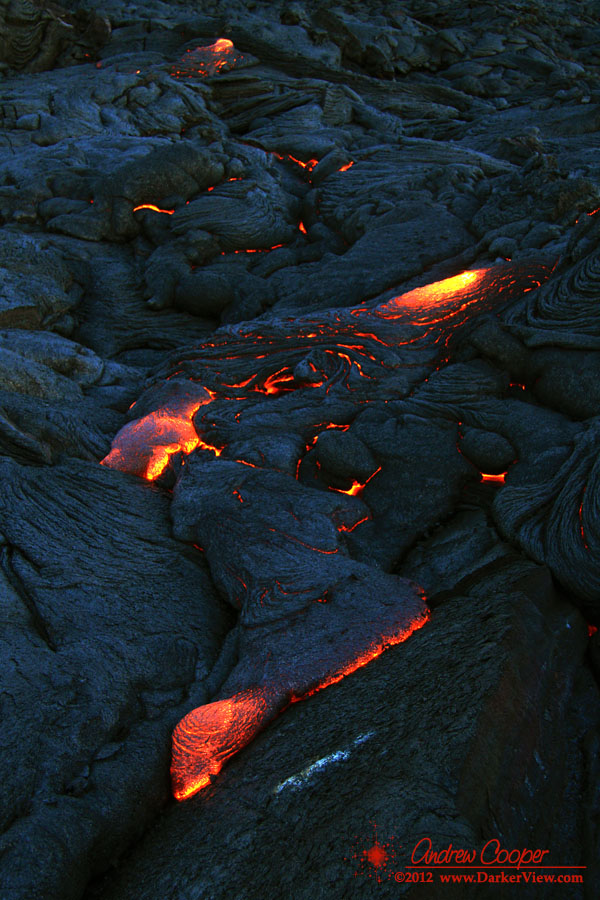
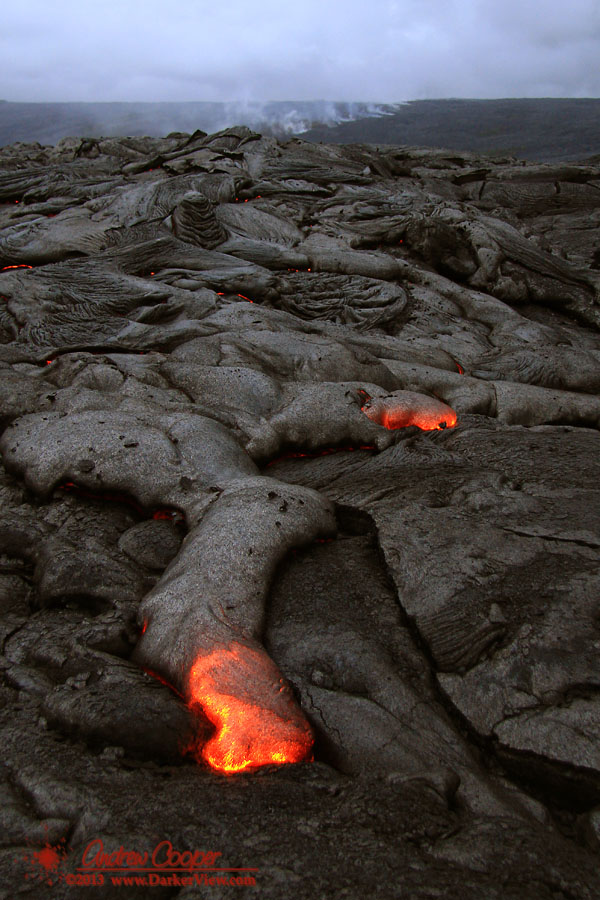
An active pāhoehoe breakout at KupapaʻuAfter spending some time at the ocean entry we searched inland for a breakout we could approach more closely. A slight glow to the north indicated a possible breakout, but I had no idea if it was close or miles away. With hope we headed for the glow and got lucky. It was only about a quarter mile to the breakouts. Several lobes of lava were advancing over the slightly older flows. Dropping our gear well back from the active lava cameras were deployed. This is what we came to see and photograph, lava as close as the heat would let us get.
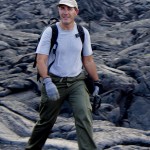
Olivier hiking over the lava at KupapaʻuFor two hours we shot the breakouts. As usual, the flow would crust over, just to break out and advance again. The changing flow would provide ever different photo opportunities as the light of dawn slowly waxed. It was a cloudy day, small showers moving through, softening the dawn light and making the hot glow stand out all the more. The photos and video capture the scene, but do poor justice to the sound. The crackle of the cooling crust, raindrops hissing on the hot surface, low resounding cracks from deep in the rock under our feet.
With the day well begun we headed back to the ocean entry to shoot a few more frames in the early light. We sat on rock that was fairly warm under us, shooting the lava pouring into the waves. Relaxing a bit, digging a few bites to eat from the pack, we talked of cameras and lenses, of life on the island, a last bit of camaraderie with someone I might never meet again. We sat and just enjoyed this spectacle of raw nature. This was why we came, there is some risk in just being here, but the experience is worth it.